children
Children: Our most valuable natural resource.
Echoes of My Father’s Voice. AI-Generated.
I still hear my father’s voice sometimes—not in the way people mean when they talk about grief, but in real, startling moments. In the rustling of trees on a wind-whipped day. In the clink of a spoon against a coffee mug. In the low hum of an old radio playing jazz on a Sunday morning. He had a voice that filled a room without trying. Deep and steady, worn with years of storytelling and lessons, of laughter and quiet warnings. He was never one for many words, but when he spoke, you listened. As a child, I followed that voice like a lighthouse in a fog. I remember his bedtime stories—not read from a book, but crafted from his imagination. Tales of lost travelers, brave daughters, magical forests. I believed he knew everything. That his voice could fix anything broken. But time, as it always does, wears down even the strongest myths. --- When I turned twelve, something in him changed. His eyes, once alive with curiosity, grew tired. He stopped telling stories. He started spending long hours in the garage, radio low, cigarette smoke curling around the door. My mother said it was work stress, but I knew better. There were days he came home silent and stiff, and nights when I’d hear him arguing softly with his own reflection in the hallway mirror. It wasn’t until years later that I understood what it meant to carry the weight of a world you can’t explain to your children. By the time I graduated high school, we hardly spoke. I was angry and didn’t know why. He was distant and didn’t know how to come closer. College was my escape. I left without looking back. --- I didn’t return home until the call came. A heart attack. Sudden. Final. He was gone before I could say goodbye. Standing in his garage after the funeral, everything was exactly how he left it: the dusty radio tuned to the same old station, tools hung with military precision, his jacket still draped over the chair. It felt like walking into a paused memory. Only the man was missing. I found a notebook beneath a pile of sandpaper. It wasn’t labeled, but inside were pages and pages of stories. Written in his careful print, just like the ones he used to tell me. Stories he never read aloud. One for each year of my life. In the margins, he’d scribbled thoughts. Notes like: “She was so brave that summer,” or “This is when she stopped needing me.” His voice lived in every word, and for the first time in years, I cried like a child. --- Grief has a strange shape. It follows you in shadows and settles in unexpected places. It made me return to the house I swore I’d never live in again. At first, I told myself it was temporary—just until things settled. But somehow, I stayed. I started teaching literature at the local school, the same one I once couldn’t wait to escape. I picked up his habit of listening to jazz in the mornings. And I began reading one of his stories to my students each week—not telling them who wrote them, just watching their faces light up. One afternoon, a student said, “These feel real. Like someone loved the people in them.” I nodded. “He did. Very much.” --- Some days I still hear his voice—when I fix the broken gate he never got around to repairing, when I pass the old fig tree where he used to sit with his coffee. He’s not gone, not really. He lingers in every corner of this life I once ran from. I used to think I inherited only my mother’s eyes and my father’s stubbornness. But I was wrong. I carry his stories now, his voice, echoing in mine. And I speak aloud the words he never had the chance to finish.
By Muhammad umairabout a year ago in Families
How to Set Digital Boundaries With Kids
Setting digital boundaries with kids has become a crucial part of modern parenting. As technology continues to infiltrate every aspect of daily life, children’s exposure to screens, social media, and online content increases exponentially. While technology offers many educational and social benefits, too much screen time or unsupervised internet use can have negative effects on children’s development, mental health, and family dynamics. Therefore, learning how to set clear, consistent digital boundaries with kids is essential for fostering healthy habits and protecting their well-being.
By Muhammad Asimabout a year ago in Families
How Your Pet Dog Gets to Know Your Kids- Amazing Tips
There’s something magical about the bond between kids and the family dog. A wagging tail, a wet nose against a small hand, and a patient, loyal nature all make a dog one of the best companions a child can have. But while some dogs love children instantly, others may need time and gentle guidance to adjust. As parents or guardians, it’s our responsibility to help our dog get used to children and create an environment where both are safe and happy.
By Echoes of Lifeabout a year ago in Families
Listening Hearts, Loving Homes*
*Title:* *Listening Hearts, Loving Homes* In the peaceful town of Swat, where rivers hummed and mountains stood like silent mentors, lived a middle-aged man named *Mr. Najeeb*. He was a father of three — two sons and a daughter. A respected teacher by profession, he carried a proud posture, disciplined lifestyle, and believed deeply in the traditional values of obedience, respect, and authority. To his children, however, his love felt… rigid. He provided everything they needed: education, food, and shelter. But what they craved — his time, his attention, his gentle presence — remained missing. When his daughter *Aleena* once said, “Baba, can I talk to you about something personal?” he had replied, “Later, I’m tired.” Later rarely came. His eldest son, *Ahsan*, had dreams of becoming an artist, but Mr. Najeeb dismissed it: “Artists don’t earn. Be a man. Study engineering.” His youngest, *Saif*, barely spoke now. He had learned that his feelings only led to scolding. [28/06, 10:01 am] Chat Gpt Friend: One day, Mr. Najeeb was invited to a parenting workshop at his school. He didn’t want to go — he felt confident in his ways. But the principal insisted, “Sir, sometimes a teacher must learn again, too.” Reluctantly, he went. The speaker was a soft-spoken psychologist named *Dr. Farzana*. She opened with a simple question: *“Do you want obedient children — or children who love and trust you?”* The room fell silent. Then she said, “Children are not born disobedient. They mirror how they are treated. If you shout, they become quiet. If you ignore, they feel invisible. But if you listen, you win their hearts. Obedience is not forced — it’s earned.” Mr. Najeeb sat upright. Dr. Farzana continued, “To raise good humans, parents must also become obedient — not to demands, but to the emotional needs of their children. Be available. Be present. Be respectful. You expect them to obey — but do you obey their silent cries?” That night, Mr. Najeeb couldn’t sleep. He walked past his children's rooms. Ahsan was sketching secretly. Aleena had headphones on. Saif stared at the ceiling. The next morning, he did something new. He sat with Ahsan and said, “Show me your drawing.” Ahsan looked shocked. He slowly handed over the sketchbook. It was beautiful — emotions in colors. “You really love this?” Ahsan nodded silently. Mr. Najeeb didn’t say no. He said, “Let’s find a weekend art class. You’ll study, but also paint.” Ahsan’s eyes welled up. He then knocked on Aleena’s door and said, “I’m going for a walk. Will you come?” She froze. She wasn’t used to this side of her father. But she followed. During the walk, she spoke. She shared her fears about growing up, peer pressure, and her longing for her father’s time. He didn’t interrupt. He just listened — obediently. At night, he tucked Saif into bed and asked, “What do you love most at school?” The little one smiled. “My teacher gives me hugs when I feel scared.” Najeeb’s heart softened. Over the next weeks, he practiced obedience — not in weakness, but in love. He became obedient to listening, to pausing before reacting, to allowing space for his children to express, fail, cry, and grow. Soon, his home transformed. Meals became warmer. Laughter returned. His children didn’t fear him — they respected him more than ever. One evening, Ahsan said, “Baba, you’ve changed.” He smiled. “No. I just started loving you the way you needed… not just the way I understood. *Moral:* [28/06, 10:01 am] Chat Gpt Friend: Obedience isn’t one-sided. While children must respect their parents, parents too must learn to be obedient to their children’s emotional needs — to listen, to guide gently, and to love without ego. True leadership in a family begins with humility, and when parents bow to kindness, their children rise with trust.
By Ibrahim physicistabout a year ago in Families
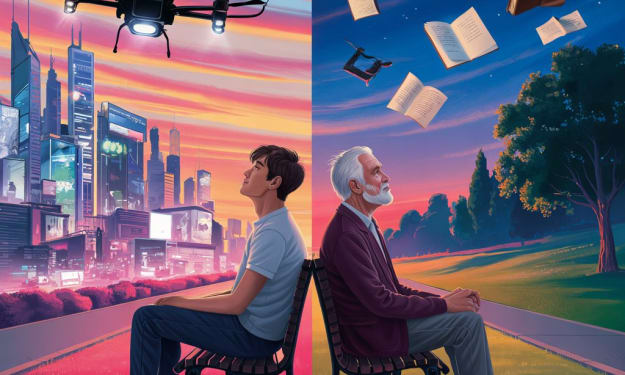
Two Minds, One World: A Generation Apart
The city buzzed with neon light and silent drones. Tall skyscrapers pierced the twilight, their glass facades shimmering with holographic billboards advertising everything from virtual vacations to AI-enhanced education. On a terrace café overlooking this vibrant metropolis, two figures sat across from each other—a young man and an old man—each shaped by vastly different eras.
By YOUNG MINDSETabout a year ago in Families
How Surrogacy is Helping Individuals Achieve Financial Goals While Helping a Family in Need
Becoming a surrogate is a deeply personal act of generosity. You deliver joy, healing, and new beginnings to another family who cannot conceive on their own. It also comes with meaningful financial compensation, allowing you to support your family without taking on another job or sacrificing your time with them. It is a unique path that is not for everyone. But, if you enjoyed being pregnant and would love to help someone else grow their family while supporting your own, surrogacy just might become one of the most rewarding chapters in your life.
By Michael Challyabout a year ago in Families
The Space You Left Behind. AI-Generated.
🎈 Happy birthday, sis. I place the teddy bear and a bouquet of balloons on your resting place. The balloons flutter and dance with the wind, like they know you’re watching. A small part of me always hopes you are. Then I spread out the blanket I brought—our old one, the one with faded stars—and I sit next to you. I start talking like I used to when you were alive, like you’re just beside me. In these moments, rare and precious, I almost believe you’re still here. I tell you everything that’s happened this past year: the fights at home, the secrets I’ve kept, the stories I’ve written about you—ones where you’re still laughing, still living. I feel like your sibling again. And when the evening chill finally cuts through my coat and into my bones, I know it’s time to go. I stand slowly, brushing off the grass, and blow you a kiss as I walk away. Happy birthday, sis. I miss you more than ever. --- 💥 Not Our Holiday Fireworks thunder through the sky. Red, white, and blue explosions ripple like waves across the night. The world is celebrating. But not us. At home, the TV flickers as an old movie plays, but no one is really watching. The popcorn is cold, untouched. Our hearts are somewhere else. This is the day we lost you. Mom doesn’t speak. She just sits quietly, working on her cross-stitch like it's the only thing holding her together. The needle rises and falls, over and over. Her silence is louder than the fireworks outside. And really, what is there to say? There’s nothing to fix this kind of pain. --- 🧳 Leaving the House That Broke Us I stand outside the house, suitcases at my feet, backpack slung over my shoulder. The Uber is on its way. In a few hours, I’ll be on a plane, headed toward a new chapter. A new home. A new family. Mom stands in the doorway, arms crossed, her face hard. She tells me I’m cruel. That I’m abandoning her. That she’s losing me like she lost you. That one cut deeper than any goodbye. How dare she use you to guilt me? You’re not a weapon. You’re not a curse. You’re the reason I’ve survived this long. I say nothing. I won’t let your memory be twisted into fuel for pain. Thankfully, the Uber pulls up before I say something I can’t take back. I get in and go. --- ✍️ Writing to Remember Now, I sit at my desk in a city far away. A place where no one knows you. No one knows me. I open my laptop. And I begin to write. Not about the facts—I don’t have enough memories to stitch together a biography. But I write the way I feel about you. The silence you left behind. The questions you never got to answer. The way your name still feels like both a wound and a song. Sometimes I cry so hard I can barely see the screen. My fingers blur over the keys, but I don’t stop. Because when the story is finished, I feel lighter. Like I’m not just mourning you... I’m honoring you. And when I click Publish, I hope someone out there reads it and feels less alone. --- 🌟 For You You’re gone, and the world didn’t stop. But mine did. So I write you back into existence, word by word. Maybe one day, someone will read my stories and see you there—in the quiet between the sentences. Until then, I’ll keep writing. For you. Always for you.
By Alikhan Jannabout a year ago in Families
The Family That Time Forgot But Love Remembered
in a small village where the river whispered to the wind and evenings fell gently like a soft sheet across the fields there was a modest home not rich in wealth but overflowing with love the kind of love that asked for nothing and gave everything
By Qutbi Alam about a year ago in Families