adoption
Adoption proves that sometimes, you can choose your family; all about the process before, during and after adoption.
The Clock That Stopped at Midnight
The clock on the living room wall stopped at exactly 12:00 a.m. the night Anna died. It was strange—eerie even. For twenty years, that clock had ticked steadily through laughter, arguments, celebrations, and sleepless nights. But the night the light left her eyes, time itself seemed to pause. James noticed it the next morning. He was walking past the living room when he glanced up and frowned. Midnight. Still. He tapped it, shook it, even changed the batteries. Nothing. It remained frozen—like the world around him. Anna had been his wife for thirty-four years. Their love wasn’t perfect, but it was real. They met in college when he spilled coffee on her books and she called him “an uncoordinated disaster.” He said her eyes were distracting. She rolled hers. A month later, they were inseparable. When she was diagnosed with ovarian cancer, it felt like the universe had punched him in the gut. But Anna, ever the fighter, smiled and said, “We’ve had more good years than most. Let’s not cry yet.” They didn’t. Not at first. They cooked together, went on slow walks, watched old black-and-white films, and pretended the hospital visits were just annoying interruptions. But deep inside, they both knew. The end came softly. No sirens, no panic—just a quiet exhale, and she was gone. Now, James wandered through a house that felt unfamiliar. Her scarf still hung on the hallway hook. Her perfume still lingered on the pillow. Her laughter echoed in the corners of his mind. And the clock—still unmoving—mocked the stillness in his chest. He couldn’t bring himself to move anything. The tea cup she last drank from remained on the kitchen counter. Her shoes sat by the door. Her knitting rested on the arm of her favorite chair, the yarn unfinished. Friends visited. They brought casseroles and flowers, offered comforting words like “She’s in a better place,” and “Time heals all wounds.” James nodded politely, but inside he wanted to scream. Time hadn’t healed anything. In fact, it had stopped. One day, he found himself staring at her old journal. He hadn’t touched it since she passed. Flipping through its pages, he saw pieces of her soul—poems, to-do lists, little notes about the garden, even sketches of random strangers from the park. Then he found a page titled, “If I Go Before You.” His hands trembled. > If I go before you, Don’t stop living. Make tea in my favorite mug. Play that silly song I hate but you love. Water my lilies. Sing off-key in the shower. And please, don’t let the clock on the wall stop. James burst into tears. That night, he went to the living room and took the clock off the wall. He replaced it with a painting Anna had once made of their first home—a crooked little cabin with red shutters. The clock, he packed gently into a box, wrapped in her favorite shawl. And the next morning, for the first time in months, he took a walk. The wind was crisp. The trees rustled like whispered blessings. A little girl rode her bike past him and waved. He smiled back. When he returned home, he made tea in Anna’s mug and played the song she hated—the one he danced to like an idiot. And at that moment, James realized something: time hadn’t stopped. It had paused—for grief, for love, for memory—but it was ready to move again. And so was he. Startriting
By Afzal khan dotani (story uplode time 10:00 PM)about a year ago in Families
Why Some Relationships Don’t Last Long
In the beginning, everything feels perfect. The texts, the calls, the laughs, the smiles — it all seems like a dream. But with time, something changes. Small fights turn into big arguments. Smiles turn into silent nights. You begin to ask yourself, “What happened to us?”
By Umar Khattakabout a year ago in Families
The Last Letter and a Tiny Promise
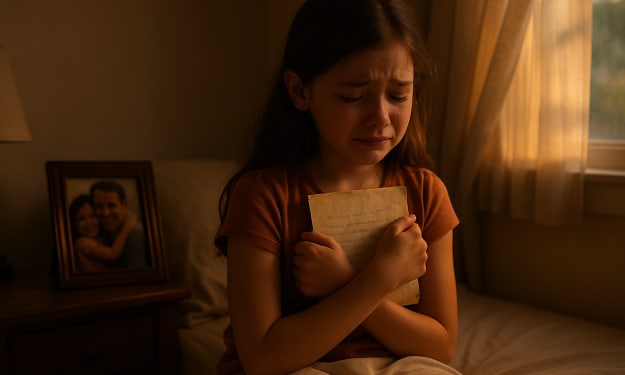
The Last Letter and a Tiny Promise In a modest home nestled amidst the bustling lanes of a small town, lived Ahmed—a man whose entire universe revolved around the sparkling eyes and infectious laughter of his little daughter, Aima. She was not just his child, but the very essence of his being, the reason behind every breath he took. Aima, with her boundless curiosity and uncontainable energy, was pure joy incarnate—a tiny burst of sunshine who saw her father as nothing short of a superhero. Their lives were painted with the hues of simple yet priceless routines. Every morning, Ahmed would gently wake her up, her sleepy smile enough to dissolve his exhaustion. He had mastered the art of braiding her hair with fatherly care, listening intently as she shared her dreams and school adventures. Come evening, the roles reversed as he became dragons, knights, and fairies in her imaginative bedtime stories. Ahmed worked tirelessly—double shifts, long journeys, calloused hands—yet his heart remained light, buoyed by Aima’s dreams. To him, she was his “princess,” a word he’d softly breathe into her hair during their quietest moments. And Aima adored him with the unfiltered love only a child can offer—clinging to him, trusting him, needing only his smile to feel safe. But life is often cruel in its silence. One day, a shadow began to creep into their bright world. Ahmed, once vibrant and strong, began feeling an unrelenting fatigue, an ache he brushed off as overwork. When he finally saw a doctor, the verdict was swift and merciless: advanced cancer. Aggressive. Irreversible. The news shattered him—not for himself, but for Aima. How could he tell her that her invincible hero was crumbling? He chose silence, determined to protect her innocence. Time slowed. Every shared moment became sacred. He watched her play, his heart aching with the knowledge that these seconds were numbered. His laughter became a mask, his strength a crumbling wall. Aima noticed. Papa didn’t play the same. His hugs weren’t as strong. Sometimes he just stared, lost in thought, smiling softly at nothing. She responded in the only way she knew—more drawings, more cookies, more kisses. Small hands trying to light a fading flame. The illness advanced with merciless pace. His body weakened, and smiles grew harder to fake. In those final, painful days, all he could think of was Aima. He wanted to leave behind something more than memories—something she could hold, read, and remember. With trembling hands and a breaking heart, he wrote her a letter. A birthday gift for her tenth year—a piece of his soul wrapped in paper and ink. He poured into it every dream, every ounce of love, and a simple, eternal promise: that he would always be watching. Then the day came. Quietly, in his sleep, Ahmed slipped away. A peaceful departure that left a storm behind. Aima, too young to fully grasp the permanence of death, watched silently as unfamiliar sorrow swept through her home. She saw people cry. She noticed the silence. And she asked, with a whisper that shattered hearts: “Papa will come back, won’t he?” The house that once echoed with laughter now stood heavy with stillness. Years passed. Aima grew. Her laughter returned—but so did a silent void that never truly left. Then came her tenth birthday. Among balloons and quiet celebration, her mother handed her an old, sealed envelope. “Your papa wanted you to have this today,” she whispered, her voice trembling. Aima opened it slowly, her fingers trembling. The familiar handwriting hit her like a warm breeze from the past. As she read, a flood of memories rushed over her—his voice, his warmth, his love. The letter spoke of his pride in her, his hopes for her, his unshakable belief in her dreams. He urged her to be brave, kind, and to never give up—just like he never gave up on her. He promised his love would always be with her, a guiding star from afar. Tears streamed down her cheeks. Every word felt like a hug, every line a whisper of comfort. In that moment, she truly understood the depth of his sacrifice and the eternal reach of his love. From that day on, Aima lived with new strength. She excelled in school, pursued her dreams, and faced life’s challenges with the quiet determination that mirrored her father’s spirit. The letter remained with her always—a sacred promise folded close to her heart. And with every step forward, she felt him—like a gentle wind, a quiet whisper in her soul—reminding her that love like his never fades. It becomes a promise. A legacy. A guiding light. Forever.
By Noman Afridiabout a year ago in Families
Letters Between the Lines. AI-Generated.
In a dusty corner of the Oakbridge University library, nestled between the aisles of forgotten literature and fading journals, Elara found her favorite escape. Table 12—close to the poetry section and far enough from the noisy study groups—was where she spent her afternoons buried in books and scribbling thoughts in her worn leather journal.
By The 9x Fawdiabout a year ago in Families
Stay Full and Energized All Day with These High-Fiber Snacks for Weight Loss
When it comes to managing your weight and maintaining steady energy levels throughout the day, snacking can either be your best friend or your worst enemy. Many of the convenient, processed snacks available on the market are packed with refined carbs and added sugars, offering a quick energy boost followed by a crash that leaves you hungrier than before. Instead of reaching for chips or candy bars, consider fiber-rich snacks that support weight loss, gut health, and long-lasting energy.
By Ahmad shahabout a year ago in Families
Why I Celebrate My Dog’s Gotcha Day More Than My Birthday
Most people circle their birthdays on the calendar, plan parties, or expect well-wishes and gifts. But to me, that date means less and less with each passing year. Instead, there’s another day I hold sacred—August 18—the day I brought home the dirty, wide-eyed mutt who changed my life.
By Echoes of Lifeabout a year ago in Families
The Last Cup of Tea
The house hadn’t changed. The cracked veranda tiles still sighed under his feet, just as they did when he used to chase after the neighborhood kids. The faded wind chime still hung by the front door, though it no longer sang. Dust lay gently on the windows, as if time itself had exhaled and settled in. Aariz turned the key in the rusted lock. The door opened slowly, creaking like an old memory resurfacing. It had been four months since his mother passed away. He hadn’t come back since the funeral. Couldn’t. Everything in this home reeked of her – her scent, her scolding, her soft humming in the kitchen when she made her famous cardamom chai. Coming back felt like walking into a memory he wasn’t ready to relive. But the lawyer had called. The property needed to be emptied. Sold. It was time. He stepped inside, half expecting to hear her call out his name the way she always did: “Aariz beta, chai thandi ho jayegi!” But the only voice that greeted him was silence — heavy, solemn, and absolute. The living room was untouched. Her shawl still hung on the back of the armchair. Her reading glasses were resting on the open pages of a half-finished Urdu novel. A pair of her slippers peeked out from under the coffee table. Aariz sat down on the couch, closed his eyes, and for a brief moment, pretended she was in the kitchen — that at any second, the whistle of the kettle would sound, and she’d come in carrying a tray of tea and biscuits, smiling through her tired eyes. But there was no kettle. No tea. Just silence. He wandered into the kitchen. The same rusted stove. The same spice rack she refused to replace. A little chalkboard still hung by the fridge, with her last written note: “Aariz will come next week. Must buy his favorite cake.” His chest tightened. He remembered the last phone call — two days before she passed. "Are you eating properly?" "Yes, Ammi." "When are you visiting again?" "Soon, just finishing up work." "Don’t wait too long, beta. Mothers don’t live forever." She had laughed when she said that. He didn’t. She died of a silent heart attack two mornings later. Alone. In this house. With no one to hold her hand. He had arrived too late. The tears came uninvited, hot and bitter, as Aariz stood by the stove and imagined her standing there in her worn-out apron, stirring tea, tasting it with her pinky, then insisting it needed "just one more elaichi." He wiped his face and opened the cabinet. There, neatly arranged, were the teacups they always used. One of them had a tiny chip on the rim — his favorite. He pulled it out, along with her special tea tin. He made the tea slowly, deliberately. He boiled the milk, added sugar the way she did — not too much, just enough. Crushed the cardamom pods the way she taught him. Let it steep just a little longer for the stronger flavor. He poured it into both cups — hers and his. Then he sat across from her empty chair. For a while, he didn’t speak. He just sat there, the cup warming his hands, the steam rising slowly between them like an unfinished goodbye. Then softly, almost brokenly, he whispered: "I’m sorry, Ammi." "I should have come back sooner." "I thought there would be more time." The chair didn’t respond. But the house listened. And somehow, he felt she heard him. When he left later that evening, he didn’t take much — just her shawl, the tea tin, and the chipped teacup. He locked the house gently, like tucking a child into bed. As he walked away, he looked back one last time. The wind chime moved — just slightly — and this time, it rang. Epilogue: Grief doesn’t ask for permission. It arrives when you’re unready, and stays longer than you want. It isn’t loud or dramatic. Sometimes, grief is just a cold cup of tea on the table — untouched, but filled with memories.
By Ikram Ullahabout a year ago in Families
Saudi Arabia Sees Surge in Early Divorces: Sociologists Reveal the Hidden Causes
Saudi Arabia, a country where traditional family values are held in high regard, is facing an unexpected and rising social challenge — the increasing rate of early divorces, often just weeks or months after lavish wedding celebrations. Despite promises of love and commitment, many couples in the Kingdom are separating before even completing their first year together. According to the 2025 report issued by the Saudi Ministry of Justice and the General Authority for Statistics, an average of 157 divorce cases are registered daily across the country. That’s roughly one divorce every 9 minutes. More alarmingly, divorces now account for 12.6% of all marriages in Saudi Arabia, a trend that experts say is both socially and psychologically concerning. Al-Baha Tops the Divorce Charts The report further reveals that the Al-Baha region, located in the southwestern part of Saudi Arabia, recorded the highest divorce rate in the country — with 36% of marriages ending in separation. Following closely are Riyadh with 21.7% and Hail with 19.2%. One particularly eye-opening statistic is that 65% of all divorces occurred within the first year of marriage. This finding strongly suggests that many couples lack compatibility from the start, or are unprepared for the realities of married life. Real-Life Cases: Love Turned Cold Take, for instance, the cases of Fahad Al-Otaibi and Reem Al-Qahtani, whose marriages lasted less than six weeks. Both unions ended over misunderstandings, lack of shared responsibilities, and poor communication. In another case, Ahmed Al-Raythi’s honeymoon became a turning point, not for joy, but for separation. His wife expected a luxurious and highly curated lifestyle, while Ahmed desired a simpler, more grounded life. Their differences, which seemed manageable during courtship, became insurmountable after marriage. These are not isolated stories — they reflect a growing number of couples who enter marriage with unrealistic expectations, often shaped by social media, peer pressure, and idealized romantic fantasies. Sociologist Insights: The Root Causes Prominent Saudi sociologist Dr. Ahmed Al-Najjar has weighed in on the alarming trend. He attributes the rise in divorces to a combination of social, economic, and psychological factors: 1. Excessive Wedding Expenses: Lavish weddings often leave couples (or their families) in significant debt. Once the celebrations are over, financial strain takes a toll on the relationship. 2. Immature Decision-Making: Many young couples rush into marriage without understanding the long-term responsibilities that come with it. Dr. Al-Najjar warns that emotional impulsivity is replacing thoughtful compatibility assessments. 3. Superficial Relationships: Pre-marital interactions, often limited or virtual, don’t provide a deep understanding of the partner’s personality, values, or expectations. 4. Over-involvement of Families: In many cases, extended family interference exacerbates even minor disagreements, especially in traditional households where parents may try to control the marriage. 5. Unrealistic Expectations: A marriage is more than just a celebration. It demands emotional intelligence, communication skills, and mutual respect — qualities that Dr. Al-Najjar says are often underdeveloped. > “Marriage is not just an event; it’s a lifetime partnership,” says Dr. Al-Najjar. “Without conscious effort, patience, and maturity, even the grandest wedding won’t survive the realities of everyday life.” Culture Shift: From Romance to Reality While arranged marriages still exist in Saudi Arabia, there has been a growing trend toward love marriages and self-selected partners, particularly in urban centers like Riyadh and Jeddah. However, this shift has not necessarily decreased divorce rates. In fact, romantic relationships formed without deep understanding may inflate emotional expectations, which later clash with the practical demands of cohabitation. Another emerging challenge is the influence of social media culture. Instagram-perfect weddings, filtered photos of couple goals, and viral videos promoting luxury lifestyles have created false ideals. When real life fails to live up to those illusions, disappointment sets in fast. Legal Developments and Women's Rights Interestingly, Saudi Arabia has also made strides in women’s legal empowerment in recent years, including reforms that now allow women to be notified via SMS when they are officially divorced. This transparency has encouraged many women to stand up for their rights, but it has also contributed to a spike in mutual or initiated divorces by women, particularly when the marriage lacks respect or compatibility. The Ministry of Justice reported over 350,000 divorce cases in one year alone, indicating that the issue is national in scale, not just regional. What Can Be Done? Experts suggest several long-term strategies to address this growing crisis: Pre-marital counseling programs to educate couples on marital roles and expectations. Promoting simpler wedding ceremonies to reduce financial pressure. Encouraging family boundaries, ensuring that newlyweds have space to build their own dynamic. Public awareness campaigns on mental and emotional maturity in marriage. Legal initiatives to streamline conflict resolution and post-divorce counseling for both men and women. Final Thoughts The rising divorce rate in Saudi Arabia, particularly among young couples and newlyweds, is a wake-up call for both individuals and society. It highlights the urgent need for a cultural shift in how marriage is viewed — not as a social milestone or display of wealth, but as a meaningful, lifelong commitment. As sociologists, religious leaders, and policymakers debate the root causes, one truth remains clear: a wedding can last one night, but a marriage demands a lifetime of patience, understanding, and effort.
By Ikram Ullahabout a year ago in Families
When We Met Again
The first time they met, it was raining. Ayaan was late for a lecture; Zoya was standing under a tree trying to protect her sketchbook from the downpour. He offered his umbrella, and she declined with a polite smile that stayed with him longer than it should have. The second time they met, it wasn't raining—at least not outside. It had been seven years. Seven years since Ayaan had watched Zoya walk out of his life without turning back. Seven years since pride and pain had drowned all words. They had promised forever but delivered silence. And now, here they were. Inside a quiet little bookstore tucked away in a corner of the city neither had claimed as home. Their eyes met across the fiction aisle. She held a copy of The Little Prince. He held a coffee that had suddenly gone cold. "Zoya," he said, like the name still belonged on his lips. She blinked, then smiled. "Hi, Ayaan." It wasn’t dramatic. No tears. No gasps. Just silence thick with memories. They decided to sit. A small café table, two cappuccinos, and a chasm of unspoken things between them. "You look the same," she said, not looking at him. "You don’t," he replied. "You look... stronger." She smiled, not flattered but seen. They talked. About books, about places they'd been, people they'd met. Not once did they mention what had broken them. But it was there. In the pauses. In the way she stirred her coffee too long. In the way he avoided eye contact when she spoke about Paris. Zoya was an artist now. She had held an exhibit in Prague. Ayaan had left academia and started writing children’s books. They had built lives that didn’t include each other. And yet, here they were, retracing steps. "Do you ever think about that night?" she asked finally. He didn’t need to ask which one. "The night it all fell apart?" he replied. "Every time I walk away from someone, I think about it." Zoya looked down. Her fingers traced invisible lines on the wooden table. "I always wondered if we were too young... or just too scared." Ayaan nodded. "Maybe both." Then came the silence again—so heavy it could crush bones. But also, in that silence, something shifted. A recognition. That maybe they weren’t the same people anymore. But the feeling? The feeling that never really left. "Would you walk with me?" she asked, almost shyly. He said yes before she finished. They walked down the narrow streets like strangers who once were lovers, like people trying to remember the steps of an old dance. The sky was overcast, teasing rain. Just like the day they met. At the park, they stopped. Zoya turned to him, eyes soft. "Ayaan, I don’t know if this is a beginning or just closure... but being here with you now—it feels like the first time." He reached for her hand, hesitant but hopeful. "Maybe it is the first time," he whispered. "The first time we’re old enough to know what it means to stay." She didn’t pull away. And as the rain began to fall again—soft, forgiving—they stood there, two hearts that had once broken now beating in quiet rhythm. Not trying to fix the past. Just gently holding the possibility of a new chapter. --- 🌟 "Some stories don’t end. They just take a long pause. And sometimes, that pause is exactly what you need to come back to the first page—with new eyes and the same old heart."
By Afzal khan dotani (story uplode time 10:00 PM)about a year ago in Families