
Macklemore's Anti-Israel Rant at MetLife
Macklemore's surprise set at MetLife turned into an anti-Israel rant. I watched it happen next to my daughter, and I couldn't stay.

Update (September 14, 2026): Since this was written, Ed Sheeran has dropped Macklemore from the remaining dates of the tour, reportedly over the same "Free Palestine" statements described below. Read more here.
Months ago my daughter called me because she wanted to see Lukas Graham open for Ed Sheeran at MetLife Stadium. She particularly wanted to hear “7 Years.” I bought the tickets and that was really all this was supposed to be. A father and daughter going to a concert.
The song has some obvious resonance for me now because it moves through a life from childhood toward sixty, an age that is rapidly closing in on me. I did not think much more about that when we arrived at MetLife. I would later.
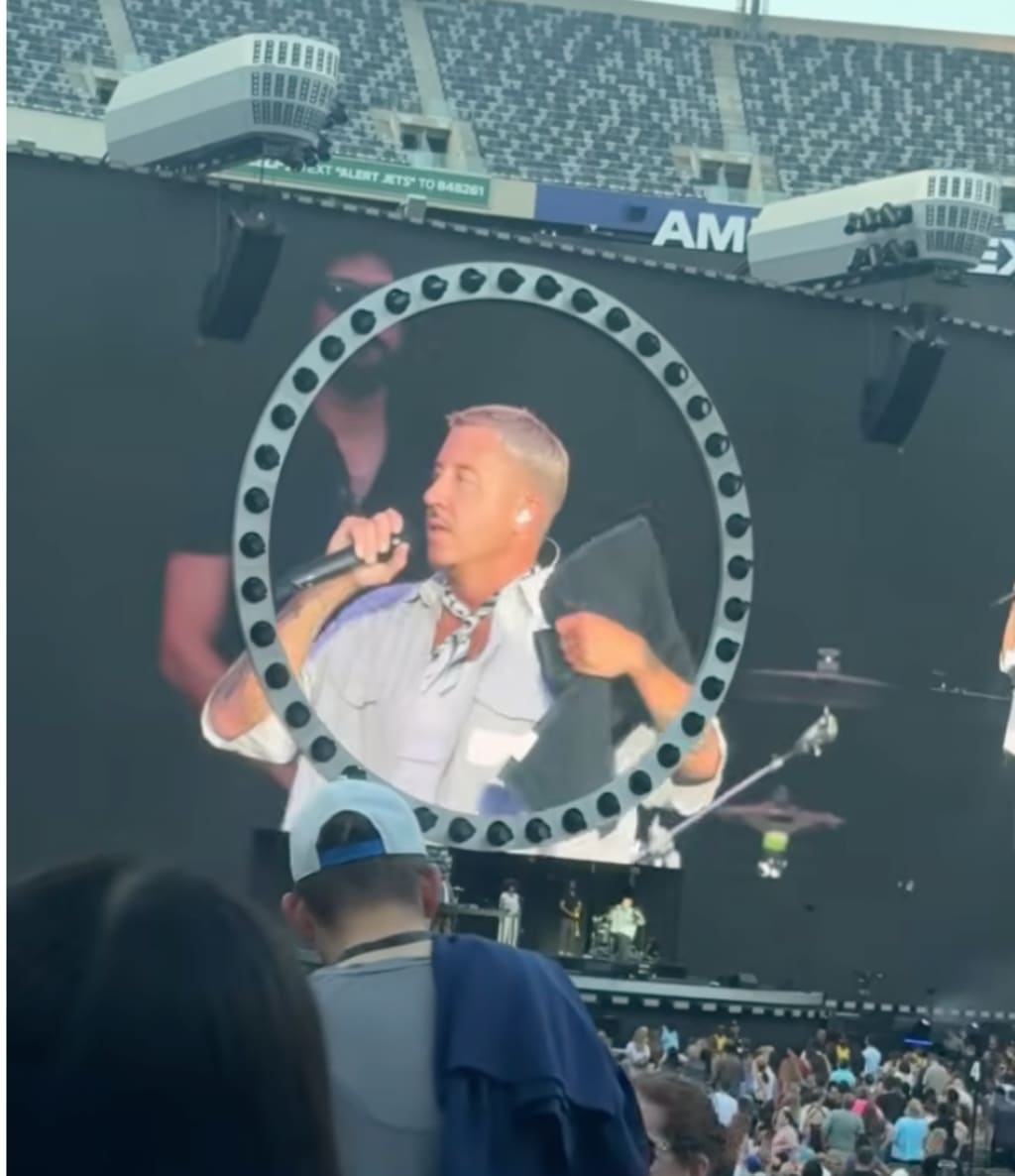
I had not bought tickets to see Macklemore. According to what he said from the stage, his appearance was a surprise addition to the show. It was certainly a surprise to me. My daughter knew more about his recent politics than I did. She had been telling me that he had become aggressively against the Jewish state of Israel. When he came out wearing a keffiyeh I recognized what he was signaling. I remember hoping that was going to be the extent of it.
I could live with that. People have political beliefs. Artists wear symbols. Palestinians deserve safety, freedom and dignity just as Israelis do. None of that was going to make me leave a concert with my daughter.
What happened after that was different. Macklemore did what a good performer knows how to do. He got a stadium excited. He played the songs people knew, got them singing with him and created that strange collective energy that happens when tens of thousands of people begin responding together.
Then he performed “Same Love.” That matters to me because “Same Love” is about gay marriage, tolerance and accepting people who have historically been marginalized. It asks people to reject prejudice and extend empathy beyond themselves. I agree with that. The crowd agreed with it.
Then almost immediately he used that same emotional energy to take the audience somewhere else.
Before he got there he gave what I thought was a rambling and strangely self-important preamble about two words that had inspired him to do these shows. He talked about his daughter and about what he wanted to teach her. That got my attention because I was sitting there with mine.
My daughter had just been warning me about him. I was watching him wearing the keffiyeh and, at least initially, I was willing to sympathize with what he seemed to be trying to say. Here was another father trying to teach his daughter right from wrong. He had apparently decided that this was an issue he was willing to attach his reputation to.
Then he finally arrived at his two words. “Free Palestine.”
That is when I began to understand that this was not simply an artist acknowledging Palestinian suffering. He had decided to use an enormous concert audience as his pulpit. And the strange thing is that it was not even necessarily the words of the song that bothered me most.
You could listen to parts of “Hind’s Hall” and hear the language of freedom, human rights and liberation. It can be packaged as another Macklemore song about standing beside the marginalized. But then you looked at the screens.
The screens told a much less ambiguous story. Israeli soldiers. Palestinian suffering. Destruction. A visual world with an aggressor and a victim.
What was missing was as important as what was there. October 7 was missing. The young people murdered at a music festival were missing. Families murdered in their homes were missing. The hostages were missing. Israeli children were missing. The fear and trauma of an entire population were missing. The history that explains why there is a Jewish state in the first place was missing.
That is not education. It is selection. And selection is one of the oldest tools of propaganda.
You do not have to fabricate an image to propagandize with it. You show one image and withhold another. You amplify one person’s suffering and erase somebody else’s. You build a story in which the audience knows who the victim is and knows who the villain is before anyone has been asked to think very hard about why. Then you put it to music.
That is what I found so disturbing about the progression from “Same Love” to “Hind’s Hall.” One minute Macklemore was asking a stadium to reject prejudice and understand the humanity of people who had historically been marginalized. Minutes later the screens were offering one of the most complicated conflicts in modern history as a remarkably uncomplicated moral story.
What happened to all that empathy? Why did empathy suddenly become selective? Why, when the Jewish state entered the story, did complexity disappear?
And this is where his discussion of his daughter stopped sounding touching to me. If you are going to tell tens of thousands of people that this is part of what you are teaching your daughter, then I think it is reasonable to ask exactly what you are teaching her.
If you teach her Palestinian suffering and omit Israeli suffering, you are not teaching history. If you teach her Gaza and omit October 7, you are not teaching context. If you teach her right from wrong then talk about those who hide behind human shields of the innocent. If you teach her about Israeli soldiers but not about hostages, Hamas or murdered Israeli civilians, you are not teaching complexity. You are passing down a conclusion.
One day his daughter will grow up. She will read things he did not show her. She will meet Israelis and Jews whose lives do not fit inside the story her father projected onto those screens. She may ask why nobody told her about the things that complicated what she had been taught. And maybe she will discover something all of our children eventually discover. Their parents were not always right.
That thought leads me to a much more uncomfortable question for Macklemore. Where did all of this begin for you? Who taught you to see Israel this way? Who gave you your first assumptions about Jews, Israel, money, media, power and America? Was it your family. Your friends. Your neighborhood. Your politics. Your father. Your grandfather. Your mother.
I do not know. I cannot state that somebody in Macklemore’s family taught him antisemitism because I have no evidence of that. But I would ask him.
Prejudice rarely introduces itself by saying hello, I am prejudice. It arrives as fragments. A joke. A stereotype. A story that always seems to have the same villain. An assumption that gets absorbed so early that eventually it feels like something you independently discovered.
So how deep does this go? Because Macklemore himself once gave us an extraordinary clue about the depth of his knowledge.
At a pro-Palestinian rally in Washington in November 2023 he told the crowd that he was teachable and that he did not know enough, but that he knew enough to call what was happening genocide. (Pitchfork)
That sentence tells me almost everything about what bothered me at MetLife. “I don’t know enough.” That should lead to curiosity. It should lead to reading. It should lead to caution before accusing a nation of one of the gravest crimes human beings have named. Instead it led immediately to certainty.
If Macklemore wants to use the word genocide in front of enormous audiences then he should read what the word actually means. Genocide is not simply another word for a terrible war or even enormous civilian suffering. Under the Genocide Convention it requires prohibited acts committed with the specific intent to destroy, in whole or in part, a national, ethnic, racial or religious group. That specific intent is central to the legal definition. (United Nations)
There are profound arguments taking place around the world about Gaza, Israeli military conduct, proportionality, civilian casualties, war crimes and genocide. Those questions deserve evidence and seriousness. “I don’t know enough but I know enough” is the opposite of seriousness.
And yet within months of saying it Macklemore had written “Hind’s Hall” and the uncertainty seemed to be gone. With it came a new hook for fans he could work into a frenzy.
By the time I saw him at MetLife there was no “I don’t know enough” left. There was certainty. There were images. There was a stadium. There was a microphone. There were tens of thousands of people he had already gotten excited through his music. And there was an answer he wanted all of them to arrive at together.
I also have to wonder why this issue became so central to Macklemore’s identity at this particular stage of his career. I don’t particularly love the word “woke.” It is overused and usually tells you more about the person saying it than the thing being described.
But perhaps Macklemore woke up to something else. Perhaps he woke up to the fact that the cultural dominance of his early career was behind him.
His 2017 album “Gemini” debuted at number two. Then there was a gap of more than five years before “Ben” arrived in 2023 and debuted at number eighteen. Number eighteen is not failure. Most musicians would be thrilled with it. It also is not Macklemore at the height of “Thrift Shop,” “Can’t Hold Us” and “Same Love.”
Then came October 7. Within weeks he had made Palestine a major part of his public identity.
I cannot prove that one caused the other and I will not pretend I can. Maybe his conviction is completely sincere. But I can ask whether a man whose cultural relevance had diminished discovered in Palestine a new constituency, a new identity, a new controversy and a new reason for people to talk about Macklemore.
This would not, however, explain everything. There is an earlier incident.
In 2014, when Macklemore was still enormously successful, he appeared onstage in Seattle wearing a dark wig, beard and a large prosthetic nose. Many people saw a grotesque Jewish stereotype. He denied that he intended to portray a Jew and apologized.
That incident does not prove he hates Jews. Saying “Free Palestine” does not prove he hates Jews. Criticizing Israel does not prove he hates Jews. I do not know what is inside his heart and neither does anyone else.
But I am allowed to look at the pattern and ask questions. A performer once accused of appearing in antisemitic imagery eventually becomes one of popular music’s loudest antagonists of the Jewish state. He acknowledges that he does not know enough about the conflict and nevertheless declares genocide. He produces music and imagery presenting one side of the conflict with enormous emotional force. Then he brings that presentation into mass entertainment and connects it to the moral education of his daughter.
At what point am I supposed to stop noticing?
This is also where my own politics have been affected. I have lost faith in a Democratic Party that I once expected to speak with far greater clarity when antisemitism appears disguised in the language of progressive morality.
I am not asking Democrats to support every Israeli government or every Israeli military action. I don’t. I am asking political leaders who speak constantly about hate, minorities, tolerance and protecting marginalized communities to recognize that those principles do not stop when Jews become uncomfortable.
I want fervor. I want information. I want a fucking stance.
If antisemitism is wrong when it comes from the political right then it is wrong when it arrives from the political left. If collective blame is wrong for one minority then it is wrong for Jews. If stereotypes about minorities are poison then old insinuations about Jewish money, Jewish power, Jewish control and the unique illegitimacy of the Jewish state do not become acceptable because somebody attaches the word justice to them.
I came to MetLife to see Lukas Graham and Ed Sheeran. I did not purchase my ticket to learn how Macklemore is passing down a tradition of misinformation that I believe has contributed throughout history to Jewish persecution.
And Ticketmaster cannot pretend it has nothing to do with the product it sells. Neither can Ed Sheeran.
If Macklemore was indeed the surprise addition he described himself as, then when I purchased those tickets I had no opportunity to know that this political performance would become part of the evening. It was way too choreographed not to have been known well in advance. If Ed Sheeran’s people did not take a look at the video then they specifically are to blame. If they did and they approved it, then they are to blame.
Ticketmaster facilitated the event. The promoter facilitated it. Ed Sheeran gave Macklemore his audience.
An opening performer is there to warm up the crowd for the headliner. Macklemore certainly warmed them up. That was exactly the problem. He got people excited through music and then redirected that excitement into politics. By the time he arrived at Israel, he had already done the difficult part. He had created the crowd.
I watched that happen in real time and I could not stay. Ed, I came to hear you. I never did.
There was no way for me to watch what had just happened, see that stadium respond the way it did and then mentally erase it when you walked onto the stage. So my daughter and I left.
I want my money back. But increasingly I realize that the money is the least important part of what I took away from that night.
Because there were two fathers in the story. Macklemore was talking about his daughter. I was sitting beside mine. He was talking about what he wanted to pass down to her. I was thinking about what I wanted my daughter to understand. Had I not left, I would have taught her the wrong thing.
I want my daughters to know enough to distrust certainty. I want them to question propaganda even when it supports something they already believe. I want them to understand that compassion which disappears when it reaches somebody you dislike is not compassion. I want them to know that history almost never arrives neatly divided into good people and bad people.
And I want them to understand something else. Jews have heard simple stories about themselves before. We know what happens when complicated human beings slowly become an idea. A group. A problem. A symbol of money or power or privilege. A people for whom the normal rules of empathy somehow no longer apply.
Which brings me back to why my daughter and I were at MetLife in the first place. Lukas Graham. “7 Years.” A song that moves almost impossibly quickly through a human life until the singer imagines being sixty.
I am nearing that moment now. And when I look backward from seven toward sixty I realize how much of my life I spent believing that the darkest lessons of Jewish history had been learned. Not forgotten in books. Learned.
That America was different. That the civilized world was different. That whatever disagreements we had, there were certain places we were not going back to.
I am not comparing Macklemore to Hitler. I am not comparing MetLife Stadium to a fascist rally. That would diminish history rather than illuminate it.
What frightens me is something smaller and therefore perhaps more important. I watched ignorance infect a stadium in 2026. I watched a performer admit that he once did not know enough and somehow arrive years later at absolute certainty. I watched selective images become a history lesson. I watched people who had come to hear music cheer a political conclusion because the music had already brought them together.
I watched one father say that this was part of what he was teaching his daughter while I sat next to mine wondering what she was learning from the exact same moment. Maybe Macklemore believes he is handing his daughter a tradition of justice. I worry he is handing her something much older.
And as Lukas Graham’s song carries a life from childhood toward sixty, I find myself almost there, looking backward over mine and frightened by a question I never expected to be asking at this age.
How can this happen here?
About the Creator
Jeremy Frommer
Chairman & Co-Founder of Creatd ($CRTD) and Vocal. We have much work to do together.
Enjoyed the story? Support the Creator.
Subscribe for free to receive all their stories in your feed. You could also become a paid subscriber, letting them know you appreciate their work.
Comments
There are no comments for this story
Be the first to respond and start the conversation.