Latest Stories
Most recently published stories in Families.
POWER Of Reach
The $10 Million Benchmark: Unpacking the High-Stakes Architecture of Modern Media Monetization The recent Department of Justice (DOJ) indictment involving Tenet Media and high-profile creators has sent shockwaves through the digital landscape. While much of the public discourse focuses on the geopolitical implications, a deeper analysis reveals a sophisticated—and cautionary—blueprint for high-level YouTube monetization. By stripping away the headlines, we find a masterclass in audience leverage, signal origination, and the critical necessity of brand sovereignty.
By Untitled Source3 months ago in Families
How to Spot an Ageing Hot Water System Before It Fails on a Monday Morning
Waking up to an unexpected cold shower on the busiest day of the week is a rude start for any Sydneysider. Yet many hot-water failures give off early warning signs months in advance. By recognising those cues, homeowners and tenants can schedule maintenance in their own time rather than scrambling for an emergency call-out. Below is a practical, Australian-English guide to identifying, interpreting and acting on the small clues that often predict big trouble.
By Trevour Miles3 months ago in Families
The Day I Realized What My Mother Had Given Up for Me. AI-Generated.
When I was a child, I thought my mother was simply doing what all mothers do. She woke up before everyone else, prepared meals, reminded me to complete my homework, and somehow managed to solve every problem that appeared in our lives. To me, it all seemed normal. At that age, I never stopped to wonder how difficult life might have been for her. Children rarely notice sacrifice. They notice the things they receive, not the things someone else gives up. Looking back now, I realize that many of the opportunities I enjoyed existed because my mother quietly placed my needs ahead of her own. She never announced her sacrifices or asked for recognition. She simply kept moving forward, one day at a time. Growing Up Without Understanding As a teenager, I often believed life revolved around my own problems. If I wanted something and couldn't have it immediately, I became frustrated. If my friends had something newer or better, I complained. My mother usually listened without arguing. What I didn't understand was that she carried worries I never saw. There were bills to pay, responsibilities to manage, and countless decisions to make. Yet she tried her best to protect me from those burdens. Whenever I asked how things were going, her answer was always the same. "Everything is fine." Years later, I learned that everything was not always fine. She simply didn't want me to carry worries that belonged to her. While I focused on school, friends, and my own goals, she was quietly making sacrifices to keep our lives stable. The Small Things That Meant Everything When people think about sacrifice, they often imagine dramatic moments. In reality, sacrifice usually appears in small, ordinary ways. It is the parent who works an extra shift. It is the meal skipped so someone else can eat. It is the dream postponed because a family needs support. My mother's sacrifices were hidden inside everyday life. She wore the same coat for years while making sure I had what I needed for school. She spent money on books and supplies instead of buying things for herself. She gave her time, energy, and attention without expecting anything in return. At the time, I thought these things were normal. Now I understand how extraordinary they were. The Moment Everything Changed As I grew older and became responsible for my own life, I started to see the world differently. For the first time, I experienced financial pressure, long workdays, and the challenge of balancing responsibilities. Suddenly, many memories from my childhood looked different. I remembered how tired my mother often seemed after work. I remembered the times she said she wasn't hungry and encouraged me to finish the last portion of food. I remembered how she always found a solution even when circumstances were difficult. The older I became, the more I understood. And with that understanding came gratitude. I realized that many of the things I had taken for granted were actually the result of her determination, patience, and love. A Different Kind of Strength The strongest people are not always the loudest. Sometimes strength looks like patience. Sometimes strength looks like showing up every day even when you're exhausted. Sometimes strength looks like carrying responsibilities without complaining. My mother taught me that strength is not measured by physical power or public recognition. It is measured by commitment, resilience, and love. She faced challenges that I didn't fully appreciate until adulthood. Yet she continued moving forward because she believed her family mattered more than her personal comfort. That kind of strength deserves recognition. Lessons That Stay Forever The greatest gift my mother gave me was not financial support or material possessions. It was her example. She taught me the value of hard work. She taught me the importance of kindness. She taught me that real love is often demonstrated through actions rather than words. Those lessons continue to influence my decisions today. Whenever I face a difficult situation, I think about her determination and persistence. Whenever I feel tempted to quit, I remember how many obstacles she overcame without giving up. Her example became part of who I am. A Mother's Silent Legacy My mother's sacrifices may never appear in history books. There will never be awards celebrating the countless small decisions she made for the benefit of her family. Yet her influence is visible in every success I achieve and every lesson I carry forward. Her legacy is not built from fame or recognition. It is built from love, consistency, and quiet determination. The older I get, the more I understand that some of the most important contributions in life happen behind the scenes. They are not announced to the world. They are simply given. And that is what makes them so powerful. A mother's silent sacrifice often goes unnoticed when it is happening. But years later, when we finally understand everything she gave up, we realize that her love shaped our lives in ways we may never fully measure. The greatest tribute we can offer is not just gratitude, but appreciation while we still have the chance to say it.
By Golden Smith 3 months ago in Families
The Plug Pulled? Inside the Shocking Lena The Plug Divorce from adam22 . AI-Generated.
Grab your tea, because the internet is buzzing today! In a plot twist nobody saw coming, the lena the plug divorce is officially making headlines. OnlyFans superstar Lena Paul (better known as Lena the Plug) has filed to end her marriage to podcast host and YouTuber adam22 (real name Adam Grandmaison).
By Kashif Hayat3 months ago in Families
The Importance of Visual Learning Tools in Early Childhood Education
Early childhood education focuses on helping children build foundational skills that support language, communication, memory, and creativity. During the preschool years, children learn most effectively through visual experiences, repetition, and interactive activities. Because of this, educational tools that combine images with simple vocabulary continue to play an important role in modern learning environments.
By Meshal Sprout3 months ago in Families
Ink on the Edge of Her Silence
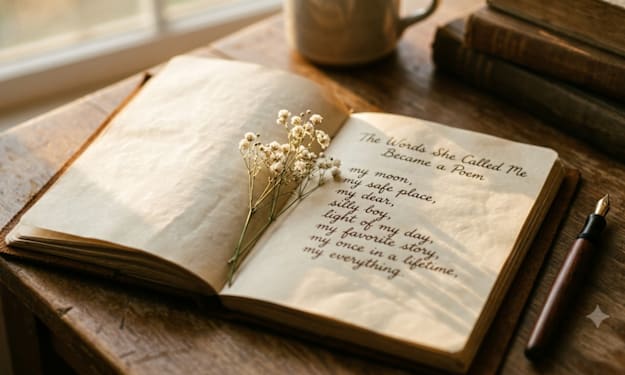
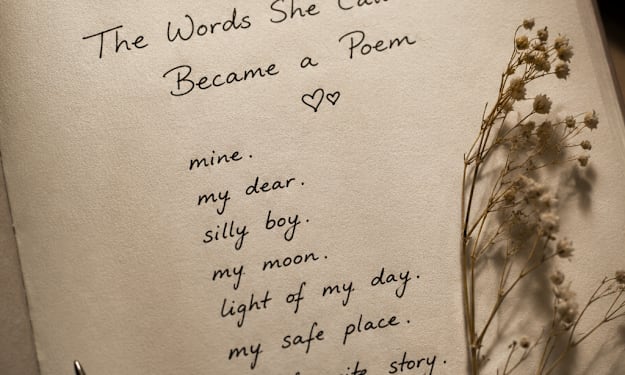
The first time she called me “mine,” it was accidental. We were 19, stuck in a campus library during a thunderstorm. The lights flickered, the windows shook, and she grabbed my sleeve without thinking. “Mine,” she whispered, like she was reminding the storm I belonged to someone. I laughed it off. But that night I wrote it in the margin of my physics notes. Just that one word. _Mine._ After that, the names started coming. Not all at once. They arrived the way seasons change — so slowly you only notice when everything looks different. “*My dear*,” she said when I brought her coffee the way she liked it, black with one sugar, even though I always got mine wrong. She said it soft, like she was tasting the words. I pretended not to care. I wrote it on a receipt and kept it in my wallet until the ink faded. “*Silly boy*,” she called me the day I tried to fix her wobbly desk chair with a library card and too much confidence. I fell backward, and she laughed until she cried. Then she knelt beside me, pushed hair out of my eyes, and said it again: “Silly boy.” Not mocking. Fond. The way you say it to something small and loved that keeps breaking. We never dated, not officially. We were two people orbiting each other in shared spaces: late-night study rooms, coffee shops that closed at 2am, bookstore aisles where we’d read aloud to each other just to hear the sound. Everyone else asked if we were together. We said no. But she kept naming me, and I kept becoming those names. When my mother got sick, I stopped sleeping. I’d sit by the hospital window and she’d sit beside me, not talking, just being there. One night I fell asleep and woke up to her voice, barely a breath: “*My moon*.” She was looking at me, not the sky. “You light up even when you’re dark.” I didn’t have words for that, so I carried it home instead. I wrote it on the back of a prescription slip. _My moon._ She had a way of seeing me that I didn’t have for myself. When I got rejected from the graduate program I wanted, I called myself a failure. She called me “*light of my day*” and dragged me to the bookstore. We spent hours there, not buying anything, just reading the first pages of random novels and inventing endings. “You’re not a rejection letter,” she said. “You’re the part people reread.” The names became a map of us. “*My safe place*” the night I told her about my father. “*My favorite story*” when I stayed up till dawn helping her finish her thesis, both of us delirious, quoting bad poetry. “*My once in a lifetime*” on her last day in the city, before she left for a job three countries away. She said it without looking at me, while she was packing books into boxes. I stood in the doorway and pretended my chest wasn’t caving in. I thought that would be the last one. People leave, names fade. But two years later, a letter came. No return address, just my name in her handwriting. Inside, a single sheet of notebook paper. At the top, in her cursive: _The Words She Called Me Became a Poem_. Under it, the list. _mine._ _my dear._ _silly boy._ _my moon._ _light of my day._ _my safe place._ _my favorite story._ _my once in a lifetime._ _my everything._ And at the bottom: “I kept calling you until you believed you were loved. Did it work?” I read it in a coffee shop, the same one where she first called me “my dear.” The barista asked if I was okay. I wasn’t crying. Not exactly. It felt more like a book finally closing on the right page. I never answered the letter. Not with words. I started writing. Stories, mostly. Small ones about people who learn each other through the names they give. I put them in journals, then online, then in a thin collection I self-published. I dedicated it to her, though I never used her real name. I just wrote: _For the girl who turned me into a poem._ People ask me what the book means. I tell them it’s about nicknames. That’s technically true. But really, it’s about being seen. She took all the sharp, uncertain parts of me and gave them soft edges with language. She didn’t change who I was. She just told me who I could be, one name at a time. Sometimes I still get messages from strangers: “You called me ‘my safe place’ in chapter 3 and I needed that today.” I always think of her when I read them. I hope she knows her names traveled farther than she did. I keep that letter in a book on my shelf. Not for nostalgia. For practice. On bad days, when I forget myself, I open it and read the list out loud. _Mine. My dear. Silly boy. My moon. Light of my day. My safe place. My favorite story. My once in a lifetime. My everything._ She was right. The words she called me did become a poem. And I became a man who knows how to live inside one.
By Khalil Ullah3 months ago in Families
The Words She Called Me Became a Poem
There are memories that do not arrive like events. They do not knock, do not announce themselves, do not ask permission to stay. They simply become language inside you—quiet, uninvited, permanent. I did not remember the day I met her the way people usually remember beginnings. There was no thunder in the sky, no dramatic silence in the room, no sign that something irreversible was happening. Only a table near a window, a half-empty cup of tea, and the way she said my name as if it had always belonged to her voice. Not my full name. Not the name the world used. But smaller names. Softer names. Names that did not feel like labels, but like meanings being discovered for the first time. “Mine,” she said once—not as possession, but as recognition. As if she had finally found something she had been missing in every sentence she ever wrote. And I remember thinking—strangely—that I had never truly existed until she renamed me in her tone. --- She spoke like poetry even when she was angry. When she was quiet, it felt like unfinished verses hanging in the air, waiting for the right breath to complete them. She did not write poems the way poets do. She wrote them the way people bleed without noticing. Slow. Honest. Uncontrolled. And I became one of her lines. Not the beginning. Not the ending. Somewhere in the middle where meaning is uncertain but necessary. She called me things I did not understand at first. “Dear.” Not as distance. But as closeness too heavy to explain. “Silly boy.” Not as insult. But as forgiveness already given in advance. “Moon.” Not as metaphor. But as something that stays even when it disappears. Each word she gave me was not just a sound—it was a version of me I had never met before. And slowly, I stopped recognizing myself without them. --- There was a notebook she kept with her everywhere. Old paper. Soft edges. Ink that sometimes bled like it was remembering more than it was writing. I saw my name appear there once. Not the official one. Not the one on documents or introductions. But the name she had invented for me in silence. It was surrounded by other words—careless, beautiful, unedited: light of my day safe place my favorite story my once in a lifetime I did not know I was allowed to be all of that at once. I did not know a person could exist as someone else’s poetry without becoming fiction. But there it was. Black ink. Certain. Irrevocable. And I understood something I was not ready to understand: She was not writing about me. She was writing me. --- Time did what time always does—it blurred the edges of everything that was once sharp. Her voice still existed, but differently. Like a song remembered through walls. Her words still came, but less often. Like rain forgetting where it used to fall. But even when she was not speaking, I could still hear her naming me. Because once someone turns you into poetry, you do not return to silence easily. You carry their language in your bones. --- One evening, I found her writing again. Same table. Same light. Same notebook. But something had changed. Not in her hands—but in the way she hesitated before each word. She looked up at me once, briefly, like she was deciding whether I still belonged in the same sentence as before. And then she wrote something I was not meant to see. Not a name this time. Not a nickname. Not a poem. Just a line, unfinished: “How do I call someone who has already become everything I wrote them to be?” I did not answer. Because I realized she was not asking me. She was asking language itself. --- That night, I left without dramatic endings. No slammed doors. No final arguments. No cinematic goodbye. Only the quiet understanding that some poems are not meant to be continued aloud. But even after leaving, I carried her words like pockets filled with invisible ink. And sometimes, in the silence of ordinary days, I still hear her voice forming me again: Not as I am. But as she once called me. Moon. Dear. Silly boy. Mine. --- Years later, I learned something unexpected. People do not remember you as you are. They remember you as the words they used to describe you. And she had used the kind of words that do not fade easily. So when I think of her now, I do not think of an ending. I think of a page still being written somewhere I cannot see. And I understand finally: I was never just a person in her life. I was a poem she refused to stop reading. And she was the language I never learned to forget.
By Khalil Ullah3 months ago in Families
The Genius Ways My Father Motivated His Children to Help Him in the Garden
Gardens and children need the same things, patience, love, and someone who will never give up on them — Nicolette Sowder My Father had the skill of making things seem like a game and have fun with us. In the Autumn, after he had finished the Autumn clearing of cutting down the dead vegetation, he would say — “alright you lot, if you build a bonfire, I’ll buy you some fireworks as a treat. There’s no need to go anywhere else, there’s plenty of branches, and stalks, around the garden. The bonfire will go really well if you rake up lots of leaves and put them on as well”.
By Pamella Richards3 months ago in Families
He Was Mine
On June 3rd, 2025, my father, Hugh Stewart, died. Dementia. I have written various pieces, including two challenge-winning poems about our complicated relationship. While it is true and fair that he was not an easy man to love, rather than taking further opportunities to discuss his failings, I wanted to commemorate the first anniversary of his death by celebrating him a little.
By Paul Stewart3 months ago in Families
Enjoying Freedom While Breastfeeding: How Portable Pumps Changed Modern Motherhood . AI-Generated.
Motherhood has always required adaptation. Every generation of mothers has found new ways to balance the demands of caring for a child while managing the realities of daily life. In recent years, one small piece of technology has quietly become part of that story: the portable electric breast pump.
By Steve Davis3 months ago in Families