
I Started Looking at Children’s Learning Differently After One Small Moment
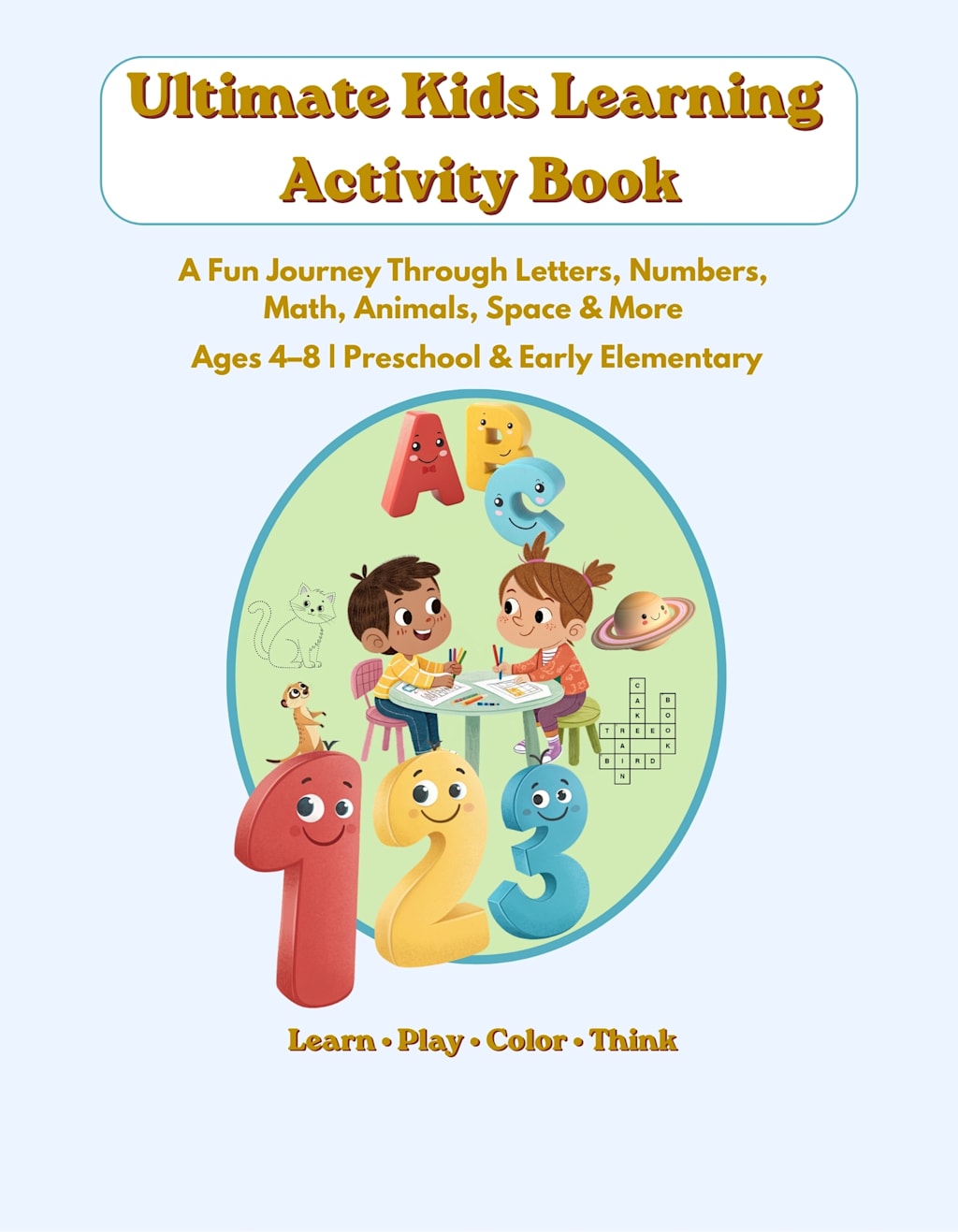
A Fun Journey Through Letters, Numbers, Math, Animals, Space & More

Not long ago, I visited a family member during a quiet weekend afternoon. Their young son was sitting on the couch with a tablet in his hands, switching quickly between educational videos, games, and cartoons. Every few minutes he seemed to lose interest and move on to something else. Nothing held his attention for very long.
At first, this did not seem unusual.
Most children today grow up surrounded by screens. Tablets, smartphones, televisions, and digital entertainment have become part of daily life for many families. Educational apps are often promoted as useful learning tools, and some of them truly can be helpful when used in moderation.
Still, something about that afternoon stayed in my mind.
After some time, the tablet battery died. The child became restless for a moment until someone placed a simple educational activity workbook on the table nearby. It contained tracing exercises, coloring pages, puzzles, mazes, and beginner learning activities designed for younger children.
I honestly expected him to ignore it.
Instead, he quietly opened the book and started working through the pages one by one. He traced letters carefully. He solved small puzzles. He colored pictures with complete concentration. Nearly an hour passed without complaints, distractions, or boredom.
That surprised me more than I expected.
It made me wonder whether children sometimes need slower and simpler learning experiences more than adults realize. In a world filled with fast-moving digital entertainment, maybe quiet hands-on activities offer something different that many children still genuinely enjoy.
Over the past few years, conversations about children and screen time have become increasingly common. Parents, teachers, and child development experts often discuss the effects of constant digital stimulation. Some families try to limit screen exposure, while others search for ways to balance technology with more traditional learning methods.
I do not believe technology itself is the problem.
Educational videos, learning platforms, and interactive games can absolutely support children in many positive ways. However, I think there is an important difference between consuming information passively and actively participating in learning.
When children complete physical activities like tracing letters, solving mazes, coloring pictures, or writing numbers, they become more involved in the process. They are not simply watching content move across a screen. They are thinking carefully, using their hands, correcting mistakes, and practicing patience.
That type of participation may seem simple, but it can play an important role during early childhood.
Children between the ages of four and eight are still developing many foundational skills. At this stage, learning is not only about memorizing facts or recognizing letters and numbers. It is also about building focus, confidence, coordination, creativity, and curiosity.
Hands-on activities naturally support many of these areas at the same time.
For example, tracing letters helps improve handwriting and fine motor skills. Coloring encourages creativity and concentration. Mazes and puzzles introduce problem-solving and logical thinking in a playful way. Even small accomplishments, like finishing a page independently, can help children feel more confident in their abilities.
I have also noticed that quieter educational activities often create calmer environments for children.
Digital entertainment usually moves very quickly. Videos change scenes constantly. Bright colors flash across screens. Sounds and notifications compete for attention every second. Activity books feel completely different. Children move at their own pace without pressure or constant stimulation.
Many parents now actively search for screen-free educational options because they want children to spend more time creating instead of endlessly scrolling or watching. Some families use activity books during travel, quiet afternoons, or homeschooling lessons. Others simply appreciate having educational tools that encourage children to slow down and focus.
Another thing that stood out to me was how activity books often combine learning with imagination.
Many educational workbooks include themes related to animals, space, numbers, puzzles, vehicles, and creative games. This variety helps children remain interested while introducing multiple educational concepts naturally. Instead of feeling repetitive or stressful, the activities feel playful and exploratory.
Recently, I spent time looking through several educational activity books designed for younger learners. Some focused only on handwriting practice, while others included a wider mixture of tracing exercises, beginner math, puzzles, coloring pages, and educational games.
One thing I appreciated was how some workbooks approached learning in a relaxed and encouraging way rather than making children feel pressured to perform perfectly. That balance between education and enjoyment may actually be one of the most important parts of early learning.
Children are often more willing to learn when they feel curious and emotionally comfortable.
I think many adults underestimate how meaningful simple learning moments can become during childhood. Sitting quietly with crayons, solving a puzzle independently, tracing shapes carefully, or completing a maze may sound ordinary, but these small experiences help children practice patience, creativity, and confidence step by step.
Sometimes the simplest educational tools continue working because they allow children to engage with learning naturally.
Of course, every child is different. Some children enjoy digital learning platforms more, while others prefer physical books and creative activities. Most likely, the healthiest approach is balance rather than completely rejecting one method or another.
Still, I believe hands-on educational activities continue to matter far more than many people expect.
In a world full of constant notifications, fast entertainment, and endless distractions, giving children opportunities to slow down, think independently, and create something with their own hands may be more valuable today than ever before.
The more I observe children interacting with educational activities, the more convinced I become that simple learning tools still have an important place in childhood development. They may not look as exciting as modern technology, but they often provide something children still deeply need: focus, creativity, imagination, and the joy of learning at their own pace.
About the Creator
Meshal Sprout
Author of fun & educational kids books | Inspiring creativity & imagination
Enjoyed the story? Support the Creator.
Subscribe for free to receive all their stories in your feed.
Comments
There are no comments for this story
Be the first to respond and start the conversation.