
Chapter 3 — The World Beyond Our Door Wasn’t Shown to Me by My Parents
Fifty Years Old, I Came to My Own Wu River
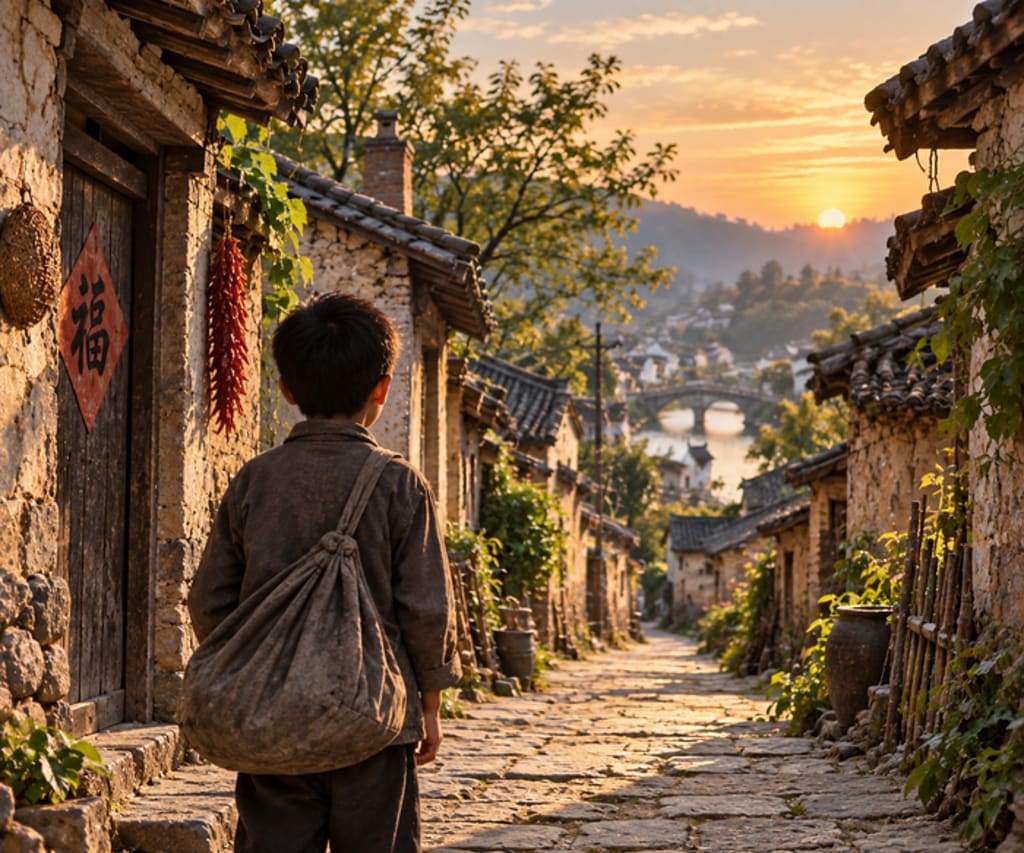
When I was a child, some of the neighborhood kids would occasionally
call me by a nickname:
“Old Sheep.”
When I played with them, I hardly talked. Sometimes I could go an entire
day without saying much at all. I was a little clumsy, too, and probably
looked slow and wooden. When they called me “Old Sheep,” I didn’t really react. I was the same way at school. I was always nervous in class. When the teacher asked a question, I
never raised my hand. Not when I didn’t know the answer. Not even when I did. I still remember something that happened when I was four or five. I was in kindergarten then. One day, several neighbors were at our house. One of the men picked up
my book and asked whether I recognized the characters on the page. I no longer remember exactly which characters they were.
I think I had only learned the Chinese character 人, meaning “person.”
Then he pointed to, or perhaps wrote, a similar-looking character. I
remember it as possibly 入, meaning “enter.” I didn’t recognize it. I still said it was 人. He made a sarcastic remark. I can no longer remember exactly what he
said. He and another male neighbor burst out laughing. My face grew hot. I felt humiliated, and I thought I must be stupid. It was the first time
I can remember becoming the focus of several people’s attention and
being laughed at like that. My mother stood diagonally across from me, watching. She said nothing. My father sat there with a slight smile on his face. He said nothing
either.
Afterward, neither of my parents mentioned what had happened. They did
not use it as a reason to teach me to read. Around the same age, something else happened that I have never
forgotten. A man who lived directly across from us was squatting in the street
outside our house with my younger brother. I was about five, and my brother was around three. The neighbor was
already an adult, probably about thirty. I no longer remember what they were doing. I vaguely recall that he may
have been drawing something on the ground. I walked over and started to squat down beside them. I had barely bent my knees when he turned toward me and shouted:
“Go away!”
There was actually still a smile on his face, but I could sense a trace
of annoyance. His voice was sharp, and at the same time he flung one hand forcefully
to the side, telling me to leave. I stood up immediately. I said nothing and walked away. A distant uncle of mine was standing nearby. When the neighbor drove me away, my uncle laughed. I could not understand it. My brother was allowed to squat there. The moment I tried to join them,
I was sent away. We were both children. We were both his neighbors. Why did he treat my
brother and me so differently? He was free not to like me. He was free not to want me around. What I could not understand was why his reaction to me had been so
strong.
For many years afterward, I remembered that neighbor across the street.
He liked playing with my brother, but he hardly paid any attention to
me. When I was about five or six, there was a pond near our house. One winter, it froze over. That day there were two children and an adult by the pond. The two
children walked out onto the ice, and I followed them. I had taken only a few steps when the ice suddenly broke beneath one
foot. I was terrified. One leg plunged in deeply enough that my foot touched the bottom of the
pond. The water came about halfway up my padded winter pants, soaking
both the pants and my boot. My other leg did not go in as deeply, but that boot got wet too.
The pond was not actually very deep. But when the ice suddenly gave way
beneath me and my body dropped, I was terrified. I hurried back to the edge of the pond. One of the children told me to go home right away. The adult said the
same thing: my clothes and shoes were wet, and I should go home and have
my parents change them. I did not leave. It was winter. My wet padded pants clung to my leg, and my wet shoes
wrapped around my feet. I could feel the damp fabric against my body. I
was cold. But I was thinking about something else: If I went home like this, would my father and mother scold me? I was afraid of being scolded. So even though the others kept telling me to go home, I stayed.
I stood by the pond in my wet pants and shoes for at least another half
hour. Only when the others were ready to leave did I go with them. When I finally got home, my parents did not seem to scold me for what
had happened. At that age, when something happened to me outside the house, I usually
did not tell my parents when I came home. I did not tell them what happened at school. I did not talk about my
grades. Later, when I had conflicts with other people, even when I got
into fights, I rarely told them. We hardly talked to each other in the first place. I did not know how to
tell my parents these things, and over time I came to feel there was no
need to.
There was another reason as well: I did not want to cause them trouble. Eventually, I became used to handling whatever happened outside on my
own. Sometime before I was ten---I no longer remember exactly how old I
was---an elderly man who lived not far from us died. There were probably two houses between his home and ours. After he died, his family put loudspeakers on the roof and played
funeral music continuously. During the day, I could stand outside our
house and see people coming and going from theirs. When I passed their
gate, I could see people standing in the courtyard. The funeral music was still playing at night. At that time, I was still sleeping in the kitchen.
At around nine o’clock, I went to bed. After I had been lying there for
a while, the funeral music finally stopped. Once everything became quiet, I grew frightened. I thought about the old man who had died that day. I thought about dead
people. Then I thought about ghosts. I lay in bed staring at the kitchen window. Sometimes I would look away. Then, when I suddenly looked back, I would
have the feeling that something had just passed by the window. In fact,
I never actually saw a shadow. So I would stare at the window again. I lay there like that for a long time, unable to sleep. My parents slept nearby. If I had wanted to go to them, it would have
been easy.
But that night it never even occurred to me to look for them. It did not occur to me to tell them I was afraid. I simply lay there alone, staring at the window. Eventually, perhaps because I had stared for so long and become so
tired, I slowly fell asleep. I never told my parents about that night. I also had a very practical problem in class. My nose ran constantly. Normally, I might need to deal with it every twenty minutes or so, but a
class period lasted forty-five minutes. Classrooms were strict then. We were expected to sit upright and remain
quiet. Blowing my nose made too much noise, so I did not dare do it
during class. Nor would I raise my hand and ask to leave the room for
that reason.
Once my nose became blocked, I could not breathe normally through it.
After a while, I would start to feel light-headed. I was still listening to the lesson, but the discomfort of a blocked
nose and difficult breathing was always there. I could not ignore it. Sometimes all I could think was: Please let class end. Please let class end. As soon as the bell rang, I hurried to deal with my nose. Sometimes I tore a piece of paper from a notebook to use. Sometimes, if
I had no paper, I used none. Afterward, I washed my hands. I did very poorly in school when I was young. From kindergarten through third grade, I was usually near the bottom of
my class.
In first and second grade, my homeroom teacher happened to be a woman
from our village. She was the same neighbor who, years later, when I was
eleven or twelve and carrying water, stood in the street and laughed
that I looked like a woman who did not know how to work. When tests were handed back, the papers were distributed from the
highest score down. I was often last, second to last, or third to last, so my name was
usually one of the final ones called. When I went up to collect my paper, the teacher would sometimes make one
or two sarcastic remarks about me in front of the class. I no longer remember exactly what she said. After she spoke, some of the students would laugh.
It happened more than once. I was already a quiet child. When they laughed at me, I felt unhappy, but I did not know what to say. Then, in fourth grade, something completely unexpected changed the way I
studied. There was a male teacher at school whose main job was managing school
operations. He also taught music. In music class, he would usually play an electronic keyboard and teach
us songs one line at a time. One day, class began normally. We sang through a song as usual. Then he stopped. He sat in the middle of the front of the classroom and began talking to
us about studying, about life, and about the kind of future a person
might have. I remember that he spoke seriously, with emotion and conviction.
The entire class was silent. He talked for a long time, almost the whole remainder of the period. The sentence I remember most clearly was:
“Education is a way forward.”
He talked about what might happen if you studied, and what might happen
if you did not. Where we lived, the population was relatively dense, and the land lay in a river-valley region of hills and mountains. There was very little broad, level farmland; much of the cultivated land consisted of terraces. Rural families did not have much land, and farming alone was not enough to make a living. People had to find other sources of income as well. For a child from the countryside, if you did not continue your education and had neither money nor connections, it was very difficult to leave the village or town, and very difficult to find a formal, stable job. But if you kept studying and made it into college, you had a chance to study in a city, find work there, and stay. As I understood it then, if you made it into a very good university, you might even have a chance to work in government, at a university, or in a research institute.
Studying and not studying could lead to two completely different lives. At the time, the world I knew was mostly the village where I lived, and
beyond that, the town. Before that day, no one had ever explained to me that studying, the
future, and the life a person would eventually live were connected. My father and mother had never told me what studying had to do with the
kind of life I might have. No one had ever told me what education had to do with my future work or
career. For the first time, I understood that what I did in school now could
affect the life I would have later. Before the class was even over, I already had a feeling: I really should study hard.
The next day, the way I behaved in class changed. Before, I had sat there and listened, but I had never thought that I had
to make sure I actually learned what was being taught. After that, I began to listen seriously. When my Chinese teacher assigned homework, I had always done the written
work, but I often did not memorize the passages we were supposed to
memorize. Now I started memorizing them. In math, I began listening carefully too, working through things little
by little until I understood them. My grades improved quickly. I remember that after about one semester, I had gone from near the
bottom of the class to somewhere in the middle.
In fourth grade, I also became the class sanitation monitor. Our classroom had a concrete floor. In many places the surface had worn
away, exposing the sand underneath. Whenever we swept, so much dust rose
into the air that you could barely see the people standing in the room. The class was divided into five groups, with one group assigned to clean
each day from Monday through Friday. Our group always did the best job. I worked very hard. Eventually the teacher realized that our group was
doing so well mainly because I was doing more of the work, and she put
me in charge of the classroom cleaning. From then on, no matter which group was on duty, I had to stay after
school until they finished and then check whether the room was clean
enough.
I was usually the last person to leave the classroom. Later, the teacher gave me the classroom key. A cord was threaded through it. At first, I wore it around my neck every
day. Each afternoon, I was responsible for locking the classroom. The next morning, I had to arrive early and unlock it. Sometimes, when I reached school, several classmates were already
standing outside the classroom. They were waiting for me. I would walk up, take the key from around my neck, and open the door. We did not get a television until quite late in my childhood. By then, some other families had already had televisions for a while. There was a boy my age in the neighborhood whom I often played with. For
a period of time, I frequently went to his house to watch cartoons.
Because I went so often, I sometimes happened to be there while his
family was eating. I saw that they ate meat often. At our house, we ate meat about once a month. One day, I came home and said to my mother:
“I want to eat meat too. I saw them eating meat.”
My mother said:
“Then why don’t you go be their child?”
I said nothing more. Although I was quiet, I was not without friends. I had several friends I had known since I was very young. I rarely caused trouble for my friends, and I rarely asked them for
anything. But if a friend asked me for help, I usually said yes. At the time, loyalty between friends mattered a great deal to me. In the
language I would use now, I was very loyal to my friends. If someone bullied one of them, I felt I should step in. My first fight later on was connected to that. I had one friend. When I was about six, I followed him home after school one day. His mother gave him some money, and he took several of us to a nearby
shop.
The shop was not far from my house, but I had never been inside. For a few mao, he bought a packet of chicken-flavored instant noodles. I had never eaten instant noodles before. Outside the shop, he tore open the plastic package and took out a small
packet from inside. Only later did I learn that it was the seasoning packet. He poured the seasoning into the bag of noodles. Standing beside him, I immediately smelled something intensely savory
and fragrant. It was also the first time I learned that instant noodles came with a
little packet of seasoning inside. He crushed the noodles through the bag, then shook it so the seasoning
would mix with the broken pieces.
Then he gave each child a little. He put a small pinch into my hand. I immediately put it in my mouth. The moment I tasted it, I was stunned. The flavor was intense---deeply savory and fragrant, with a hint of
sweetness. The noodles were crisp and easy to chew. It was the most deliciously savory thing I had ever tasted. I kept thinking: How can anything taste this good? This is so good. For my friend, coming home from school, getting a little money from his
mother, and going to the shop to buy something to eat seemed perfectly
ordinary. For me, it became an experience I never forgot. Decades later, I can still remember the taste of that small handful of
instant noodles.
Another friend, Feng, had been my friend since kindergarten. I first went to his house when I was about seven. His home was very clean. They had a sofa, with white covers draped over
the armrests. It was there that I saw a canned drink for the first time. Before then, the drinks I had seen mostly came in glass bottles with
metal caps that had to be opened with a bottle opener. The labels were
fairly simple. A can looked completely different to me. It had more colors and graphics, and at the time I thought it looked
very sophisticated. I remember the can as being white. Looking back now, it may have been
Jianlibao, but I cannot be sure. There was already very little left in it when I arrived.
I watched Feng take another sip or two. I did not ask him for any. He seemed to want to share some with me. I remember him saying something to his mother, and she smiled. I do not
know exactly what they said. Then he walked away with the nearly empty can. A little while later, he came back and handed it to me. I remember there being perhaps a third of a can left. I took one sip, maybe two. It barely had any taste. I found that strange and did not drink any more. At the time, I guessed that perhaps he had filled the empty can with
some water before bringing it back to me. But I cannot be sure. It was the first aluminum can I had ever seen, and the first time I had
ever drunk from one.
Feng and I were very close. For a long time, he was probably my best
friend, and we were almost inseparable. His family was better off than mine. His parents often gave him spending
money. I remember that, for him, having ten yuan in his pocket was not a
particularly big deal. Even when we were still very young, he often took me into town to eat. Sometimes we went to a roadside stall for liangpi, cold noodles made
from wheat or rice starch. A serving probably cost less than one yuan
then. Feng would buy two, one for each of us. I thought the liangpi was delicious. Sometimes he took me to a restaurant in town for noodles with shredded
pork. A bowl cost a little more than one yuan at the time.
Sometimes we ate huimian, a broad-noodle soup, or roujiamo, a
meat-filled flatbread, or bought other snacks. Feng paid for all of it. I had no money of my own and never paid. I never asked Feng to take me somewhere to eat. If he suggested going, I went with him. If he did not mention it, I did not go on my own. I did not think, Someday when I have money, I’ll go eat these things
myself. If I had been on my own, I would not even have known where to go, what
to order, or how to walk into a restaurant and eat there. My parents had never taken me to a restaurant. They had never even taken me to eat liangpi from a roadside stall,
though a serving cost less than one yuan.
When I was in sixth grade, I made another friend from a neighboring
village. He was the first friend I remember having who was not from our village. He was a year or two older than I was. When I was in sixth grade, he was
already in middle school. One Saturday, he rode over on his bicycle and asked if I wanted to go
with him to the county seat to visit his aunt. I did not own a bicycle, but I had learned to ride using my father’s. The two of us set off on his one bicycle. One of us pedaled while the
other sat on the back, and we took turns along the way. Part of the road to the county seat followed the main highway, and part
of it was on narrower roads.
One stretch of the smaller road ran alongside a river and passed through
several villages. All of it felt new to me. When we came to an uphill stretch, we got off and pushed the bicycle. The trip was tiring, but I was happy. After somewhere between an hour and two hours, we reached the county
seat. It was the first time I had really been there. I immediately noticed that the streets were different from those in our
town. The streets in the county seat were straighter and more orderly, with
many trees planted along both sides. The streets in our town looked as though they had simply grown into
place over time. They were not as straight, and the trees were not
planted in orderly rows along the roadside.
When we reached his aunt’s home, I felt a little nervous. It was the first time I had entered the home of someone I did not know
in the county seat. The house was small. There was a table against the wall in the little sitting area, with a
rice cooker nearby. There were four of us eating together. His aunt served rice from the cooker. The first thing I noticed was that their rice bowls were much smaller
than the ones we normally used at home. She put the dishes directly on top of the rice. I remember red-braised pork and some vegetables. At home, we used very little cooking oil, soy sauce, or seasoning. When that bowl of rice was placed in front of me, it smelled wonderful.
It tasted wonderful too. One bowl was not enough to fill me. I wanted another, but I did not ask. After we ate, we rode the bicycle around the streets near his aunt’s
house for a little while. Then the two of us rode the same bicycle all the way home. When I got back, I told my parents that my friend and I had ridden to
the county seat and visited his aunt. I no longer remember exactly what they said. After I started seventh grade, there was a Saturday when I was playing
with Feng. He said he wanted to go to the county seat to see his father, so we went
to his grandfather’s house first and got some money. His father was the manager of the county hotel.
At the time, the county hotel was the only three-star hotel in our county and the most upscale hotel there. It was government-owned. Important county meetings were held there, and senior officials visiting from above the county level were often received there. There were other hotels in the county seat, but they were in a completely different class. Both the rooms and the restaurants were expensive. Apart from government functions and some business owners, ordinary people rarely went there to spend money. As I remember it, a room cost a little over 300 yuan a night. For an ordinary person with a regular job in the county seat, that was roughly half a month’s income.
We took a bus to the county seat. After walking for a while, we reached the hotel. The guard at the
entrance knew Feng. We went in and first visited his father in a building behind the hotel
that looked like staff housing. We stayed in his father’s room for more
than an hour. Later, Feng took me into the hotel lobby. The entrance had a revolving glass door. The strongest feeling I had when I first walked into the lobby was
nervousness. I did not dare look around. I simply followed Feng. He went to the front desk and got a key. Then we went upstairs to the second floor. The hallway was carpeted. It was the first time I had ever stepped on carpet that thick and clean.
Once we entered the room, I discovered that there were many things I did
not know how to use. The toilet, for example. I had never used one before. I did not know how, so I had to ask Feng. The room had air-conditioning. The sheets, duvet, and pillows were all white. Looking out the window, I could see tall pine trees in the courtyard.
Everything was neat and well kept. All of it was unfamiliar to me. That night, each of us lay on a bed and watched television. At home, our television could receive only a few channels, mostly
general-interest stations. The same channel would show news, television
dramas, and other programs at different times of day.
The hotel television had many channels. It was there that I saw Phoenix Television for the first time. The thing I noticed most was how clear the picture was. I had never seen television that sharp before. The news anchors looked especially neat and polished. I also thought the captions, graphics, and moving images looked
beautiful. For the first time, I saw channels that seemed to show news
continuously, one story after another, and other channels that seemed to
show movies one after another. I had never seen those Hong Kong channels on the television available to
me at home. After we had watched for a while, Feng called room service and ordered
food.
That was new to me too. A little later, someone rang the doorbell. Feng told me to answer it. I opened the door and saw a hotel employee pushing a cart into the room. He put the food on the small table by the window. I remember two or three dishes and rice. I did not speak to the employee. After we ate, we went back to watching television. The next morning, I used a disposable hotel toothbrush and toothpaste
for the first time. The only detail about the toothbrush I can still say with certainty is
that it was white. Later, Feng took me to Cultural Street for dumplings. I remember Cultural Street being across from the county hospital, with a
dumpling shop near the entrance to the street.
Feng ordered lotus-root dumplings. It had never occurred to me that lotus root could be used as a dumpling
filling. Before then, the dumplings I had eaten were mostly filled with things
like radish, Chinese cabbage, or chives. What I remember most about the first bite was that the lotus root inside
was still crisp. I thought they were delicious. After that first visit, I went back to the county hotel with Feng many
times. Usually we went on Saturdays or Sundays. After a few visits, I was no longer as nervous as I had been the first
time. I gradually learned how to use the toilet, the air conditioner, and the
other things in the room. Those visits continued on and off for several years.
They continued even after I was no longer in school. Before I was ten, I once had a conversation with my grandmother at my
grandparents’ house. I no longer remember exactly how old I was. She told me something about the time I was born. According to the custom where we lived, after a child was born, the
father was supposed to go to the child’s maternal grandparents’ home to
announce the birth. The first time my grandmother told me the story, she said that after I
was born, my father did not want to go to my mother’s family. But someone had to deliver the news. In the end, one of my father’s distant cousins went instead. By family convention, I called him Uncle.
He went to my maternal grandparents’ home in my father’s place and told
them I had been born. At the time, I did not ask any more questions. A few years later, after an argument with my parents, I remembered what
my grandmother had told me and went back to ask her about it
specifically. This time she said:
“Your father was away on a business trip then, so he asked your uncle to
go.”
It was the second version of the story I had heard from her. The first time, she said my father had not wanted to go. The second time, she said he had been away on a business trip. I did not know which version was true, but at the time I doubted my
grandmother’s second explanation. When I was about eleven or twelve, around sixth grade, I was visiting my
grandparents one day. One of my grandfather’s nephews came to see them. I remember that he held a leadership position at a sports school,
perhaps as a vice principal or something similar. They sat in the courtyard talking. I stood nearby and listened. He was not speaking to me. During the conversation, I heard him say:
“I like kids who know how to fight.”
I remembered that sentence. Before then, fighting had seemed like something completely unrelated to
me. I was the “Old Sheep.” At the time, I even felt that if someone hit me, I might not hit back. But after hearing that sentence, the way I thought about fighting
shifted a little. I no longer saw it as something I would absolutely never do, something
that had nothing at all to do with me. Of course, I had no idea then that years later, fighting would actually
change my life. My mother’s family was very poor, even poorer than ours. My maternal grandparents lived about five kilometers away. My mother had two younger brothers and one younger sister. Her sister
was the youngest, and I called her my little aunt.
As I remember it, my father rarely visited my mother’s family. I can clearly remember only two occasions: once when my maternal
grandfather died, and once when one of my uncles was building a house.
Beyond those, I do not remember my father going there. When I was about eight or nine, my little aunt was not yet married. She
was around twenty, perhaps not even twenty yet. Once, she came to our house and stayed overnight, sleeping in my
brother’s room. My father normally went to his room to rest at around nine. That night, he did too. But sometime after nine, close to ten, he came back out. I was still in the living room watching television. He sat on the sofa for a while and then said to me:
“Go get your aunt. Tell her to come out and watch television.”
I thought it was very strange. The feeling was strong. My aunt had already gone to bed. I went to my brother’s room anyway. She was asleep. I said:
“My dad wants you to come out and watch television.”
She said:
“Oh.”
I did not go back to the living room. I went straight to where I slept. I do not know whether my aunt ever came out. From the time I was very young, I often went with my mother to visit her
family. By around six, we were regularly walking there. We had no real means of transportation, and my mother did not know how
to ride a bicycle, so we always walked. It was a long way and tiring on foot. At first, my mother took only me. Later, when my brother was old enough to walk that far, she took both of
us. Those visits continued for many years. And over those years, I gradually began noticing something that puzzled
me. Whenever we entered my mother’s village, there would sometimes be people
staring at me from a distance.
Once, there were two women. One kept looking at me while talking to the other. Another time, several men were standing together. One of them stared at me from far away. When we came closer, another man greeted my mother. On another occasion, a woman stood in the doorway of her house and
watched me from a long way off, continuing to stare until we came near. Those were not the only three times it happened. Over the years, as I went back to my mother’s village again and again,
similar things happened repeatedly. Usually I would glance at them and then pretend not to pay much
attention. But inside, I wondered about it. I did not repeatedly encounter this anywhere else.
It was mainly when I entered my mother’s village that people would stare
at me like that. I found it strange. Why did they keep looking at me? Why did so many people seem to notice me whenever I went to my mother’s
village? I never told my mother about it. She never explained anything to me either. When I was about twelve, my little aunt got married. She married a man
from her own village. I went to the wedding banquet. While we were eating, I again had the feeling that people were watching
me. At one point, I heard several men talking behind me and off to one side,
about one table away. One of them said:
“He really looks like that guy from our village.”
I did not catch the name. Another man replied:
“Well, he’s that man’s child. Of course he looks like him.”
I turned and looked back. The man who had spoken first was staring directly at me. The other man was not looking at me. He was smiling. I suspected they might have been talking about me. But I could not be sure. I did not know who the man from “our village” was supposed to be. I did not go over and ask. But those two sentences did not disappear. For many years afterward, they would come back to me. When I was in eighth grade, one evening after study hall, Feng and I
were coming downstairs. Someone upstairs suddenly threw down something like a snap-pop
firecracker. Normally, it would explode when it hit the ground. This time, it struck Feng on the head.
It did not explode. I saw who had thrown it. I was angry. As I grew older, I sometimes became especially sensitive to
things I thought were unfair. I cursed at the boy who had thrown it. He came downstairs. When he reached the ground floor, we fought. I hit him. The school found out and disciplined me. My father and mother were shocked when they heard. Relatives and neighbors were surprised too. They had never expected the quiet child who hardly spoke to get into a
fight. I remember someone saying:
“The old sheep has started kicking up his heels.”
A few days later, the same boy brought someone else with him. One evening after study hall, I was getting ready to go home. Before I had even made it out of the school gate, someone suddenly
kicked me from behind. I ran forward. When I looked back, I saw two people chasing me. I stopped and fought with them for a few moments, then ran again. They kept chasing me after I left the school grounds. Eventually, only one of them caught up. I fought with him for a few moments. Then he turned and ran back. I did not chase him. I kept running until I reached home. The school gatekeeper saw the whole thing. The next day, during class, the dean of students stood downstairs and
shouted up toward our classroom, asking whether I was in Class 2-2.
My classmates knew why he had come. Almost the entire class shouted down together:
“He’s not here.”
I knew they were protecting me. The dean found that strange. Eventually he came upstairs. He stood in the classroom doorway, called my name, and told me to stand. I had no choice but to stand up. A disappointed sigh went through the class. I followed him to his office. He asked:
“Were you fighting last night?”
I said nothing. He told me other people had seen it and asked again what had happened. I still said nothing. I did not want to tell on anyone. I did not want to tell him that two people had attacked me from behind
first. I felt it was my own business. I wanted to handle it myself. The school had already disciplined me after the first fight. The school had a rule then: the first fight brought a serious warning; the second meant being asked to leave. The school rarely used the word “expulsion.” It called it being “persuaded to withdraw.” That sounded different on paper, but in practice it meant leaving the school and no longer being allowed to study there. For an ordinary family without personal connections, parents had very little room to intervene or change the decision.
This time, the dean told me: Under school rules, this was my second offense. The school was going to ask me to leave. He asked whether I had anything to say. I shook my head. Even then, I did not go back and explain what had happened. He told me to return to the classroom and take all my things. When I went back, my homeroom teacher was teaching. I began clearing out my desk. My classmates knew what was happening. Two or three of them ran straight to the front of the room and told the
teacher that I had not gone looking for a fight---that the other two
boys had chased me and attacked me. My teacher looked uncomfortable. She seemed either unwilling to intervene or unable to do anything about
it.
And so I walked out of the school carrying my things. I felt a deep sense of desolation. But I missed that school very much. And I missed those classmates. After I left, several students from our class went to the dean and tried
to explain what had happened in the fight. The school did not change its decision. When I got home, my father said nothing. My mother said:
“You go around causing trouble out there, but there’s nobody in this
family who can take care of your problems for you.”
They did not talk to me about what I was supposed to do next. When I woke the next morning, the first thing I felt was a little
relief. I did not have to go to school anymore. All the pressure I had faced every day seemed suddenly to be gone. At the same time, it felt strange. Normally, at that hour, I should have been going to school. Now I did not have to. I did not know what I was supposed to do next. What I felt was relief, but also unfamiliarity. And confusion. When I was growing up, no one ever talked to me about planning a life. No one told me what I should study next, what kind of subject I might
pursue, or what kind of work I might do.
Back in fourth grade, the teacher who sometimes taught music had told
me:
“Education is a way forward.”
I really had worked harder because of those words. But now, suddenly, school had stopped. I did not know what would begin next.
About the Creator
Enjoyed the story? Support the Creator.
Subscribe for free to receive all their stories in your feed.
Comments
There are no comments for this story
Be the first to respond and start the conversation.