
Yuliia Bilous and Kateryna Datsko on Women Transforming Ukraine’s Transport Sector
How are Yuliia Bilous and Kateryna Datsko advancing women’s employment, retraining, and leadership in Ukraine’s transport sector through She Drives and Manage Change?

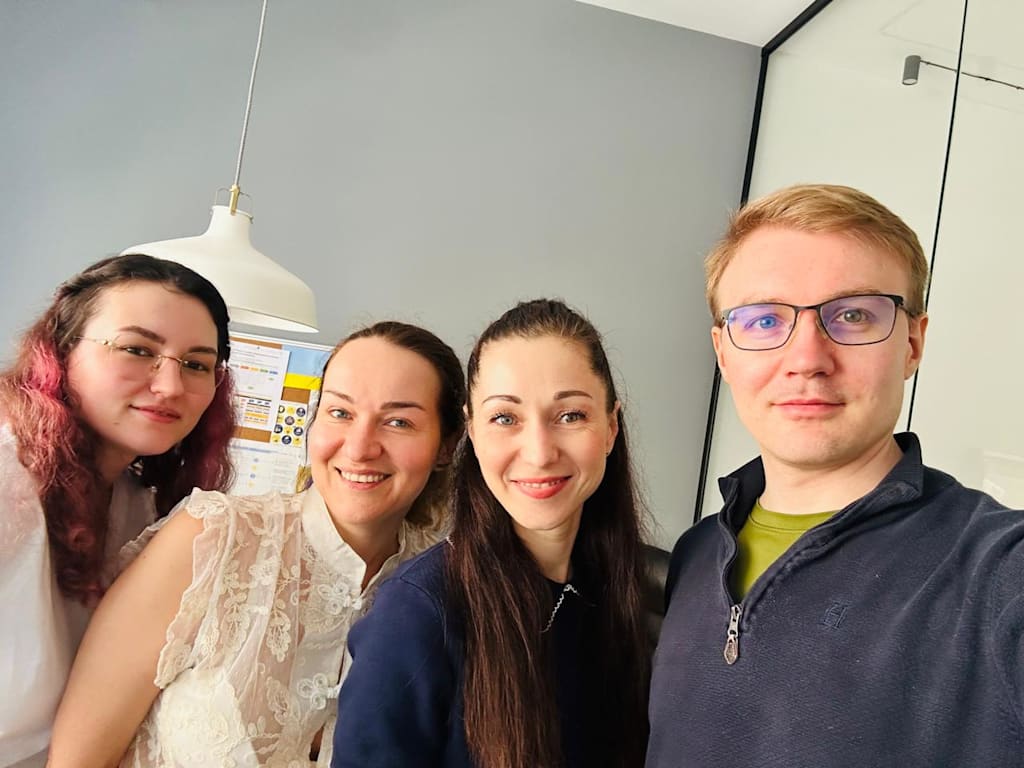
How are Yuliia Bilous and Kateryna Datsko advancing women’s employment, retraining, and leadership in Ukraine’s transport sector through She Drives and Lead Change?
Yuliia Bilous is a Ukrainian project and course manager in women’s transport leadership. She manages Керуй змінами (“Lead Change”), a programme supporting women’s professional development in Ukraine’s transport sector.
Kateryna Datsko is Executive Director of the NGO Foundation for Institutional Development and an expert on institutional capacity, compliance, and women’s transport leadership. She manages She Drives. Connected to Керуй змінами (“Lead Change”), she supports programmes advancing women’s retraining, employment, gender-equal workplace standards, and sectoral reform with Ukrainian and international partners.
With Scott Douglas Jacobsen, Yuliia Bilous and Kateryna Datsko discuss Ukraine’s She Drives and Lead Change initiatives, addressing driver shortages, women’s retraining, employment pathways, government and UN Women support, safety in frontline regions, non-cash compliance, stereotypes, inadequate workplace infrastructure, and gender-equitable corporate culture in municipal and private transport during wartime reform and sector modernization.
Scott Douglas Jacobsen: When did you first identify the gap in women’s transport employment?
Yuliia Bilous and Kateryna Datsko: We first identified this gap in 2024, when the Ministry identified that more than 6,000 drivers were lacking in municipal companies in Ukraine. So this was a challenge for Ukraine, and we started to research how we can work with this challenge.
We started to work with this problem at the operational level, including drivers, logistics, and forklift drivers, and then we worked with the leadership level.
Jacobsen: How supportive has the government been for these initiatives?
Bilous and Datsko: Actually, they initiated it. They identified this problem with all the research and statistics that they have, and then they started to reach out to some donor organizations who could support these initiatives, and to start searching for implementers, and we became the NGO that could implement these initiatives for women.
This initiative, She Drives, that Kateryna talked about, the first one we started working with was supported by UN Women here in Ukraine. Of course, they stand for empowerment for women and engaging them in economic growth and so on. So they decided to support this project, and it was implemented in close collaboration with the Ministry.
All further initiatives—a leadership program, a program for veterans, which contains not only women but all veterans, and one more project for women in the logistics sector for foreign economic activity managers, reskilling as well—were supported by the Ministry. We published all the materials on their website, and we spread the information through their informational channels. The Deputy Minister of the Ministry for Development of Communities and Territories also talked everywhere about all these projects, and this helped us to attract more attention and be more visible.
So we have strong communication support from the Ministry now. Yes, communication support.
Jacobsen: Transport in the east and the south is more dangerous than in the center and west of Ukraine. Does that become a consideration for women drivers—men too, obviously—but in terms of getting more women into transport in those regions, does it come up?
Bilous and Datsko: We have some participants from Kharkiv, but they do not study in Kharkiv; they study in Kyiv, and they live in Kyiv when we started our program She Drives. Maybe this is because we do not have partners from driver schools in Kharkiv, but now we think about dangers in this region, so maybe this is one of the reasons.
I want to say that our women are brave. They have a license in Kyiv, but now they work in Kharkiv.
You know, actually, after four years of the war, those women who stayed, who stood in these cities near the battle line, they are not afraid of anything, because they got used to living in these conditions. They are eager to have some occupation, to have some job, and they are interested in all these initiatives—women from Kharkiv, Zaporizhia, Dnipro, Kryvyi Rih, yes, Kryvyi Rih as well.
Jacobsen: What other unexpected challenges did you encounter while implementing the project?
Bilous and Datsko: We work on an agreement basis. We write down agreements with the driver schools, so we do not pay in cash, but through non-cash transactions between bank accounts based on the agreement. This is an official and legal approach.
Not every driving school is ready to work with international policies, because this involves compliance policies and due diligence. Some companies are not ready for these requirements, because small and medium enterprises are still building their corporate culture, and we are implementing international standards in accounting and financial policies in Ukraine. So maybe this is a challenge, and we must choose from a limited pool of driving schools. Only this. This is a challenge.
Jacobsen: What does the gender gap look like among transport drivers?
Bilous and Datsko: Yes, we have some statistics from analytical research from the World Bank, but now I will open it. We have new research from the World Bank in the Ukrainian transport sector. It was done with the Ministry and includes results of our project.
But the gap is huge. Huge, yes. We have some analytics on this. We need to clarify whether we are talking about the gap at the operational level or the leadership level, because it is different.
If you talk about drivers, yes, men dominate in this sphere. But if you talk about passenger electric transport, it is normal in Ukraine for women to be drivers—tram and trolleybus drivers—it is okay. But if you talk about buses, it is not normal, and in this sphere men dominate. Truck drivers—yes, especially men.
It is considered to be hard physical work in difficult conditions for women, without normal schedules, with night shifts and long working hours. As we have seen, one of the main problems in municipal enterprises is that they do not have enough conditions for women—even separate toilets for women, and some rooms.
The infrastructure is not developed enough. They do not have rooms for rest, and all the facilities—rooms for children, kindergartens—are not normal in municipal enterprises, and in the private sector too.
This is a challenge for our women.
Jacobsen: There is another factor you mentioned. It could be a rural and urban distinction, or an individual experience depending on the context, but the English academic term is “stereotype threat.” If an individual takes a test in a field not associated with their gender or ethnicity, they can feel they will be seen as less capable, and because of that anxiety, they may perform worse.
Similarly, I assume this applies to professions. In regions or areas where an individual may feel that stereotype threat about being a driver—especially a professional driver in transport—does this come up in commentary as well?
Bilous and Datsko: Yes, stereotypes are not only from enterprises or managers. We also see stereotypes from women themselves, because sometimes they do not believe in themselves. They think it is hard, dangerous, and involves responsibility—more responsibility than some other operational-level professions.
We also have stereotypes from passengers. It is not considered normal that a woman is a driver.
We have gaps in corporate culture. So we work with UN Women not only on reskilling programs, but also on corporate culture development and gender policies for municipal enterprises.
For us, this is a new area. In Ukraine, this is a new area, because now there is an ongoing corporate reform at the municipal level. In parallel, we work on compliance policies and gender policies, and we implement elements of corporate culture based on women’s rights, WEPs, gender equality, and women’s empowerment.
The Women’s Empowerment Principles are a UN Women policy. We work with enterprises, and in the second phase we plan to develop gender policies for our pilot enterprises in the municipal sector. UN Women will plan educational activities on these principles, and some enterprises may sign these policies.
On one side, there are municipal enterprises, and on the other side is UN Women in Ukraine. This is a new area in our project and something new for Ukraine.
Jacobsen: Thank you very much for the opportunity and your time, Kateryna and Yuliia.
Scott Douglas Jacobsen is a blogger on Vocal with more than 200 publications on the platform. He is the Founder and Publisher of In-Sight Publishing (ISBN: 978–1–0692343; 978–1–0673505) and Editor-in-Chief of In-Sight: Interviews (ISSN: 2369–6885). He writes for International Policy Digest (ISSN: 2332–9416), The Humanist (Print: ISSN, 0018–7399; Online: ISSN, 2163–3576), Basic Income Earth Network (UK Registered Charity 1177066), Humanist Perspectives (ISSN: 1719–6337), A Further Inquiry (SubStack), Vocal, Medium, The Good Men Project, The New Enlightenment Project, The Washington Outsider, rabble.ca, and other media. His bibliography index can be found via the Jacobsen Bank at In-Sight Publishing, comprising more than 10,000 articles, interviews, and republications across more than 200 outlets. He has served in national and international leadership roles within humanist and media organizations, held several academic fellowships, and currently serves on several boards. He is a member in good standing in numerous media organizations, including the Canadian Association of Journalists, PEN Canada (CRA: 88916 2541 RR0001), Reporters Without Borders (SIREN: 343 684 221/SIRET: 343 684 221 00041/EIN: 20–0708028), and others.
Image Credit: Scott Douglas Jacobsen.
About the Creator
Scott Douglas Jacobsen
Scott Douglas Jacobsen is the publisher of In-Sight Publishing (ISBN: 978-1-0692343) and Editor-in-Chief of In-Sight: Interviews (ISSN: 2369-6885). He is a member in good standing of numerous media organizations.
Enjoyed the story? Support the Creator.
Subscribe for free to receive all their stories in your feed.
Comments
There are no comments for this story
Be the first to respond and start the conversation.