
Your University Is Stuck in 2022. You Don't Have to Be.
Andrew Ng called it out. The system won't change. But students who stop waiting and start building are already winning — and they're doing it without permission.
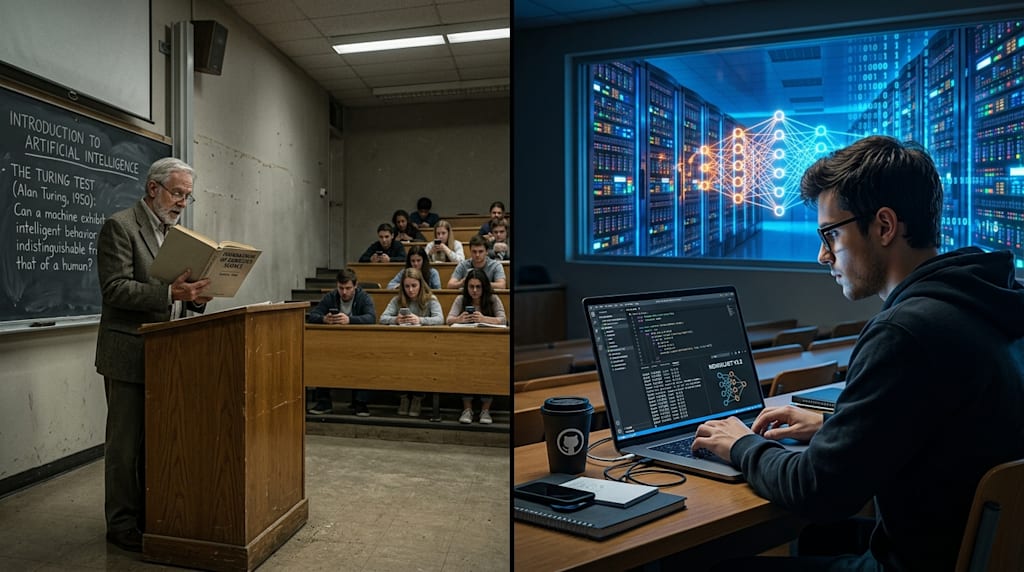
Andrew Ng says some universities are stuck in 2022.
The professors in the audience didn’t laugh. They knew what he meant. ChatGPT was released at the end of 2022. Since then, AI has iterated every six months. A university course takes three years from proposal to classroom.
Three years. By the time students get their copy of Introduction to Artificial Intelligence, GPT‑4 can already write code. The closed‑book exam asks: “In which year was the Turing Test proposed?” No one gets it wrong. No one ever uses it.
I
Universities want to change, but the system prevents it.
Last year, a computer science instructor added two hands‑on sessions on AI‑assisted data analysis to his class. Students said it was useful. They surrounded him for twenty minutes after class. The next week, a teaching supervisor sat in the back row, flipping through the syllabus. He was called in for a meeting. Reason: “Deviation from the syllabus.”
He deleted those two sessions. He went back to reading slides. Students scrolled through their phones. No one thought anything was wrong.
This is not one person’s fault. This is how the system runs.
The evaluation system does not value teaching. A professor’s promotion depends on publication count and National Natural Science Foundation grants. Rewriting an AI course from scratch, learning LangChain and RAG, spending six months, yields only a course update. On a CV, it is not worth a single line.
Supervisors look for “deviation from the syllabus,” not “usefulness.” Follow the syllabus, and you are safe. Add something new, and you take a risk. Who bears that risk? No one. So the optimal strategy is not to move.
Educational equity means you cannot force students to spend money. If a course requires students to pay for GPT‑4 API access, what about those who cannot afford it? So the only option is to teach what is free, what is outdated, what everyone can access. The result: students at top schools train models on A100s; students at ordinary schools use ChatGPT to translate English abstracts.
Both are called “AI courses.” The content is a generation apart.
II
Industry does not wait.
During an interview, the interviewer asks: “What have you done with AI?”
One student says: “I used ChatGPT to translate literature abstracts.”
Another student opens his laptop. A local knowledge‑base Q&A system is running. Qwen deployed via Ollama, hooked up to hundreds of pages of corporate annual reports. The interviewer throws out a casual question: “Why did gross margin drop in Q3 last year?” The screen pops out an answer, with original page citations attached.
The first student spent a semester memorizing definitions. The second spent two months on GitHub.
The interviewer chose the second. Not because he was smarter, but because he could get things done.
III
A former colleague took a position at a university teaching information processing. He says students now fall into two types.
One type waits for the teacher to teach. The teacher says the final exam covers definitions, so they memorize definitions. The teacher says no AI for assignments, so they do not use it. By graduation, their resume says “Proficient in Microsoft Office.”
The other type does not wait. The teacher reads slides in front; they set up environments in the back. The teacher says no AI for assignments, so they submit two versions: one “safe” version following the syllabus, and another with the full prompt chain and iteration log, sent privately to the teacher. “Professor, could you take a look and see if this works?”
The first type complains after graduation that the university taught them nothing. The second type already has a portfolio before graduation.
IV
Andrew Ng’s remark was polite.
He said “stuck in 2022,” meaning two years behind. But it is not about two years. Textbook approval takes three years. The supervision mechanism has not changed in a decade. The evaluation system carries inertia built over twenty years. When a teacher wants to change a course, the obstacle is not technical; it is an entire interest structure.
A teacher who has taught Python for ten years: you ask him to switch to teaching large‑model application development. He has to relearn everything, re‑prepare lectures, rewrite exams, and deal with supervisors again. None of this raises his salary or helps his promotion. It only adds hassle. So he keeps teaching Python. Not because he is lazy, but because the system gives him no incentive to change.
The salary gap between academia and industry is large. Top AI talent makes ten million dollars a year in Silicon Valley. In a university, they get a pension and research grants. No one can expect the latter to move faster than the former.
So do not wait.
V
If you are still in school, treat your course schedule as an index.
What is useful is not in the textbooks. It is in GitHub READMEs. In Hugging Face model cards. In those late‑night tutorial videos on YouTube that keep getting updated.
Open GitHub. Search “awesome‑LLM.” Run every project in the first README, one by one. If something does not run, check the Issues section. Other people’s error logs and fixes are more useful than any textbook. When you get one running, take a screenshot and save it in a folder. Collect five, and put them on your resume.
Do not wait for your university to offer an AI course. By the time you finish that course, it may already be outdated.
Do not ask “What can AI do for me?” Ask “What is something I could not do without AI, but with AI I could do well?” Then go do it. Build something, even if it is rough. Open your laptop and show it in an interview. It is worth more than any certificate.
VI
The night my colleague was called in, he sent a message: “I deleted those two sessions.”
He added: “But the assignments students did with AI, on their own, were way better than before. I did not flag them. I gave them high grades quietly.”
The system has not changed. But some people have found their own way out.
They are stuck in 2022.
You do not need to wait for them to get out.
Just get out yourself.
About the Creator
Jin
Writer of reamstories
https://reamstories.com/jin
Enjoyed the story? Support the Creator.
Subscribe for free to receive all their stories in your feed. You could also become a paid subscriber, letting them know you appreciate their work.
Comments
There are no comments for this story
Be the first to respond and start the conversation.