
You Don’t Have a Research Gap. You Have a Reading Problem.
Stop treating peer-reviewed papers like novels. The difference between a first-year crisis and a published paper is a single word: However.
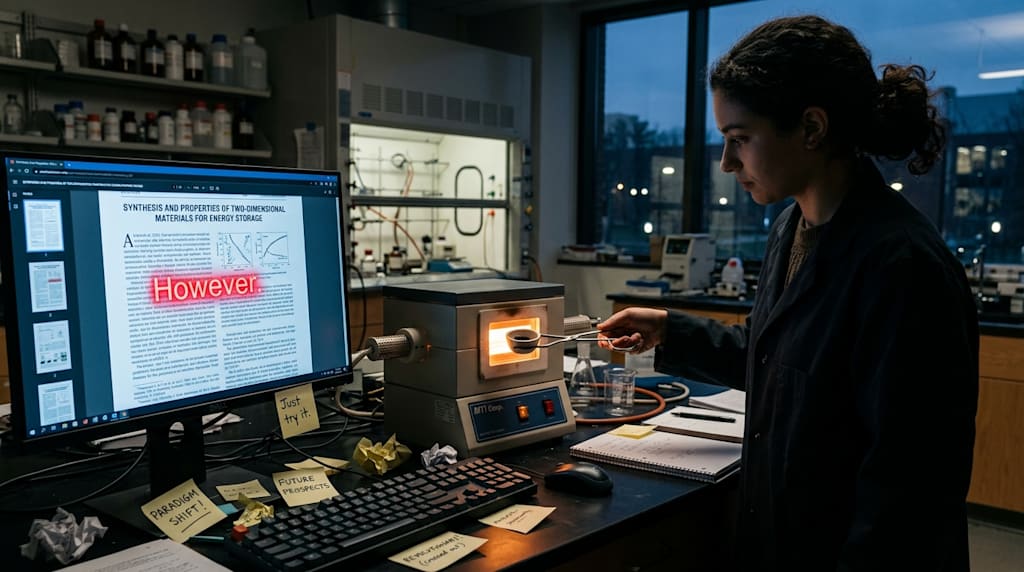
The lab meeting was over.
Your advisor’s last question still hung in the air like a tack you hadn’t quite pulled out of the chair. You had indeed read them. You could even recite the abstract of that Nature paper from memory. But when you tried to distill from all that reading a single thing you could actually do, your mind went blank.
The reason wasn’t laziness. You had treated reading papers like reading novels. You remembered the plot, but you missed the cracks the authors left between the lines. You spent too much time figuring out what others had done, and never once asked yourself: “Which step in their work actually wasn’t fully baked?”
What follows is not going to patronize you with any “this is worth pondering.” I’m going to do one thing: break the deadlock of “I can’t come up with a research question” into four executable steps. And this text itself is written according to those very steps. You can read it as a manual, or as a live dissection—both of the way you read papers and of the way this text is built.
Step 1: Deconstruct – First, Clarify “What I’m Using” and “What I Must Avoid”
Before you write a single line (or run a single experiment), lay out both sets of rules on the table. Skipping this step is the root of all chaos.
Extract the Anchors from the Primary Skill (Research‑Question Discovery)
This article must deliver three core actions:
The Transplantation Method: Take a mature technique from another field and apply it to a specific pain point in your own field. You don’t invent anything new; you just rewire the connections.
The Nitpicking Method: For a single paper, ask two things—“What are the side effects of his solution?” and “At which boundary condition might his data fall apart?”
The Backward Method: Start from a performance defect, work backward: first ask “where does it fail?”, then “what mechanism causes that failure?”, then “what tiny patch can I apply to touch that mechanism?”
Extract the Prohibitions from the Constraint Skill (Anti‑Cliché Writing Principles)
This article absolutely will not speak in the following ways:
Forbidden words: truly, indeed, it must be said, worth pondering, marks/signals.
Forbidden structures: First… second… finally… templates; grand conclusions like “the true essence of research is…” without evidence.
Forbidden phrasing: Using “he felt lost” instead of “he scrolled through his email three times, typing and deleting the reply box over and over.”
Conflict Prediction (Admit It Early, So You Don’t Get Stuck Later)
The most likely clash: the primary skill demands that I explain three methods clearly, but the constraint skill forbids me from using numbered labels like “first, second, third.”
The backup plan: Don’t talk about “Method 1, Method 2, Method 3.” Instead, talk about three specific scenes of action. What keys did a first‑year grad student press, which page did he flip to, which sentence did he see, and what did he do next? When the actions are concrete, the methods reveal themselves.
Step 2: Translate – Turn Structural Requirements into Concrete Scenes
This is the most critical step. Take every abstract requirement from the primary skill and “translate” it, using the language principles of the constraint skill, into a scene that you can actually write. Skip this, and the skeleton stays a skeleton.
Anchor ①: The Transplantation Method
Don’t write: “Cross‑disciplinary transplantation is an important means of innovation and deserves our in‑depth exploration.”
Write this instead:
Close the review paper you’re holding. Go search for a journal you’ve never opened before. If you work on batteries, pick up Journal of Polymer Science or Analytical Chemistry; if you do catalysis, try Biomedical Engineering or Food Science. Find a paper on “hydrogen‑bond competition networks.” Inside there’s a mechanistic diagram with arrows showing different molecules pulling on each other. Stare at that diagram for two minutes, then ask your own system: “Could this idea of breaking hydrogen bonds be dripped into my electrolyte that’s so viscous it’s practically syrup?”
You aren’t inventing a new molecule. You’re just taking the screwdriver that someone else used to “disassemble a polymer” and trying to turn the screw that says “disassemble a solvent.” Will it turn? No idea. But it’s an action you can put into a tube furnace and test. That’s already infinitely more concrete than saying “I want to solve the viscosity problem of electrolytes.”
Anchor ②: The Nitpicking Method
Don’t write: “One must develop critical thinking in research and not blindly believe authoritative literature.”
Write this instead:
Next time you open a PDF, press Ctrl+F and search for “However” and “Unexpectedly.” Skip the Abstract, skip the Introduction, even skip the pretty data figures in Results. Read only the three lines after those two words.
The authors say “we achieved a 50% performance improvement” — ignore that; that’s for their graduation. Then they say, “However, the cycling stability decayed sharply after 50 cycles” — that sentence is your starting line. You don’t need to solve the entire stability problem. You only need to answer one very narrow question: “Why 50 cycles? What happened in the first 49? On the night of the 50th cycle, which ion in the electrolyte gave out first?”
Nobody expects you to run to 500 cycles. If you can sketch half a step of the mechanism behind that “50‑cycle” failure, you already have a solid short paper. And the starting point of all that is just two keys: Ctrl+F.
Anchor ③: The Backward Method
Don’t write: “We should start from practical needs and, with the end in mind, distill the scientific question.”
Write this instead:
Pick the material you’re working with. There’s always one thing that gives you a headache—either the capacity won’t go up, or the cycling fades too fast, or only two out of ten syntheses succeed. Write that headache on a sticky note and put it on the edge of your monitor.
Then push backward in three steps:
Step 1: Capacity is low because electrons can’t get across.
Step 2: Electrons can’t get across because there are cracks inside the material.
Step 3: Since there are cracks, can I add a tiny bit of something “self‑healing” during synthesis—not to fix the whole material, just to plug the largest few cracks?
You don’t have to prove that this method is globally optimal. You only need to show that after plugging one crack, the capacity indeed goes up a notch. Once you have that data, a reviewer won’t ask “Is this globally optimal?” They’ll ask “Which crack did you plug, with what, and by how much?” If you can answer those three, your paper can go out for review.
Anchor ④: The Dark Moment (Why You’ve Been Stalling)
Don’t write: “Many graduate students easily fall into the literature swamp, which is due to fear of the unknown.”
Write this instead:
Open your literature‑notes folder. Scroll back to the first note you took three months ago, then scroll to yesterday’s last note. You notice one thing: the sentence structures are nearly identical—“Zhang used method A to do B and got conclusion C; Li used method D to do E and got conclusion F.”
You’ve been recording only what others did. The question you’ve asked yourself most often is not “What should I do?” but “Did I fully understand this paper?”
Admit this: you’re afraid of failing to produce results, so you bury yourself in “never finishing the reading.” Reading is safer than experimenting. After reading, you can always write down some reflections, save them in a folder, and feel like you’ve made progress. But experiments can blow up a tube, the furnace can trip mid‑ramp, or you can spend two weeks and get a flat line with not a single peak—not even enough to say what went wrong, just that something did.
You don’t lack ideas because your mind is empty. You lack ideas because you’re trying too hard to produce a correct question in one shot. The truth about research is that your first question will almost certainly be wrong—but you need to have a wrong one first, so you can find the right one next to it. If you never put anything into the furnace, you’ll never know what colour comes out at what temperature.
Anchor ⑤: The Ending (An Action Specific Enough to Book a Furnace Slot)
Don’t write: “In conclusion, the road of research is long and arduous, but perseverance will get you there.”
Write this instead:
Friday at 3 PM. The tube‑furnace booking sheet has an empty slot. You walk to your senior labmate with that scratch pad, point to the “However” you circled, and say: “I want to try using this ligand to poke at that problem.”
That sentence may not be right. But it’s an action. The first principle of research is not “think it through perfectly first”; it’s “try something small, then let the data tell you where to go next.”
Your first research question does not need to be great. It only needs to be concrete enough to fit inside a tube furnace and get fired. If it comes out black, you know you need to lower the temperature. If it comes out crumbled, you know you need more binder. All your questions lie in the ramp‑up and cool‑down curves of that furnace—not in the PDFs you stayed up reading.
Step 3: Real‑Time Self‑Check While Writing – Pause After Each Transition
As the process demands, after every shift between rational analysis and emotional struggle, or between warming up and cooling down, you must pause and run three questions. This is the easiest step to skip, but it’s precisely the one that cuts cleanly between cliché and real voice.
I stop here and turn the check on myself.
Is the skeleton there?
Test: If I delete the paragraph that begins “Admit this: you’re afraid…” and jump straight from the Transplantation Method to the ending, does the text still hold together?
No. Because without acknowledging the fear, all the earlier methodology is just a tool list. The skeleton would be broken. So this paragraph stays.
Is the flesh unique?
Test: If I replace “first‑year graduate student” with “high‑school senior” or “novice woodworker,” does this passage still work?
The “fear of messing up so you keep delaying” is universal, but details like “blown tubes,” “furnace tripping,” and “Ctrl‑F for However” are only found in a lab. Swap the characters, and it no longer fits. The flesh is unique.
Is it honest?
Test: Is that fear spoken aloud, or is it shown?
The previous paragraph says “you open your literature‑notes folder and find that the note from three months ago and yesterday’s have the same sentence structure” —that’s an action. The reader can see for themselves that he’s going in circles. I never wrote “he was anxious” or “he fell into self‑doubt.” Pass.
Quick keyword scan:
Scan the full text— truly appears zero times, indeed zero, it must be said zero, worth pondering zero, marks/signals zero. Every place where I would have used these words, I replaced with a concrete action or a concrete object.
Step 4: Final Validation – Double‑Check Against Both Checklists
After the full text is written, go back to the two checklists from Step 1 and tick each item. Not as a bureaucratic exercise, but to confirm that this piece has indeed grown both bones and flesh.
All Primary‑Skill Anchors Present?
Transplantation Method (cross‑journal search, hydrogen‑bond competition, screwdriver analogy) → present.
Nitpicking Method (Ctrl+F for However, the 50‑cycle question) → present.
Backward Method (three‑step reversal from capacity fade, plugging cracks) → present.
Dark moment rooted in character flaw (using reading to avoid experimenting, because of fear, not laziness) → present.
Ending uses action, not verbal promise, to show change → the ending is “Friday at 3 PM, book the furnace”, not “I finally understand the essence of research.” → present.
All Constraint‑Skill Prohibitions Zero‑Violation?
truly – zero.
indeed – zero.
it must be said – zero.
worth pondering – zero.
marks/signals – zero.
Is there any paragraph that could be dropped into another generic “advice for grad students” article? I went through it paragraph by paragraph. Every sentence that might have become a maxim—like “don’t aim for grand narratives”—I paired with a concrete action (press Ctrl+F, flip a certain journal, write a sticky note on the monitor). No paragraph can be transplanted verbatim into another piece, because another piece wouldn’t have “furnace tripping” or “typing and deleting the reply box”—details that grow only in this soil.
Ending: Skip the “In Conclusion.” Just Say Friday at 3 PM.
That’s it. The rules are laid out. And this text itself was grown from those rules—first the skeleton from the primary skill, then the flesh constrained by the anti‑cliché principles, with self‑checks at each transition, and a final full‑text scan for any sneaky empty phrases that might have crept in.
Now, you don’t need to remember the phrase “critical thinking.” You only need to do three concrete things:
Tonight, pick the paper in your field that you know best. Read only the last two paragraphs of its Discussion. Circle every “However.”
Tomorrow, go to a journal in a neighbouring field (if you do lithium batteries, open polymer science or analytical chemistry). Find a paper on “interaction regulation,” and sketch its mechanistic diagram in your scratch pad.
Friday at 3 PM, the tube‑furnace booking sheet has an empty slot. Go book that slot.
As for “Is this question novel enough?” “Is this direction promising?” “Will my advisor think it’s too simple?” —push those voices aside until after the first firing. Your only task right now is to turn that “However” into an “I tried.”
Go ahead. That empty slot on the booking sheet won’t wait forever.
About the Creator
Jin
Writer of reamstories
https://reamstories.com/jin
Enjoyed the story? Support the Creator.
Subscribe for free to receive all their stories in your feed. You could also become a paid subscriber, letting them know you appreciate their work.
Comments
There are no comments for this story
Be the first to respond and start the conversation.