
Wormholes: The Cosmic Tunnels of the Universe
How to travels wormholes?

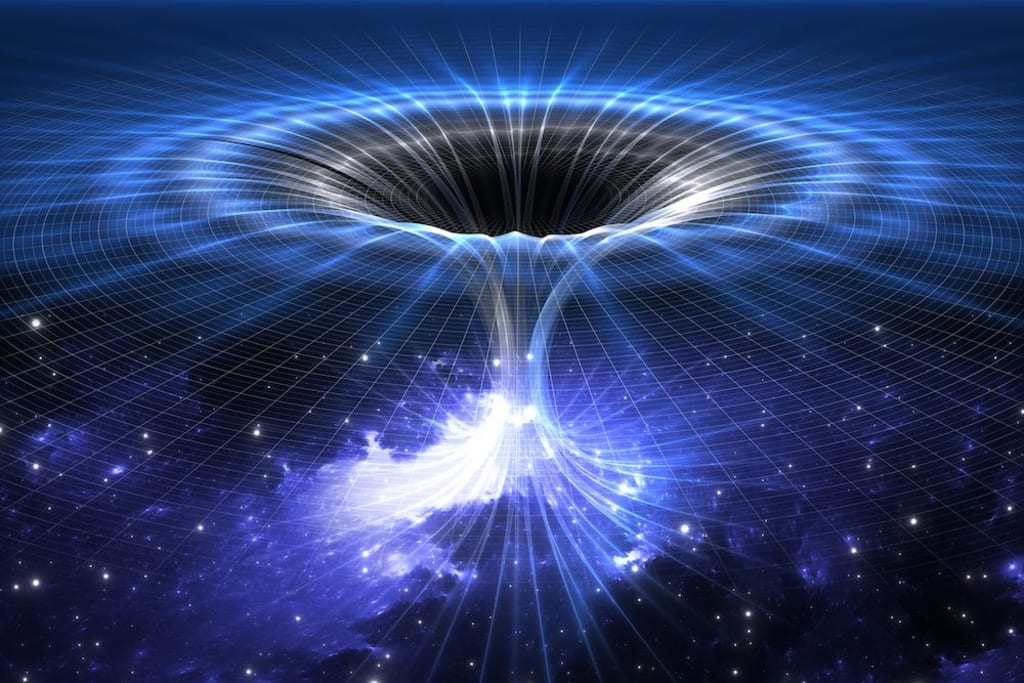
Wormholes, often depicted in science fiction as shortcuts through space and time, are fascinating theoretical constructs that captivate the imagination of scientists and the public alike. Though no direct evidence for their existence has yet been found, the concept of wormholes offers intriguing possibilities for understanding the universe's structure and the potential for faster-than-light travel.
What is a Wormhole?
In essence, a wormhole is a hypothetical tunnel-like structure that connects two separate points in spacetime. Imagine the universe as a two-dimensional sheet of paper. If you fold the paper so that two points on its surface touch, a wormhole would be like a shortcut passing through the third dimension, connecting those points directly. In the context of our four-dimensional universe (three dimensions of space and one of time), a wormhole would link distant regions of space or even different points in time.
Wormholes The Science Behind
The idea of wormholes comes from the field of general relativity, which was developed by Albert Einstein. According to Einstein's equations, spacetime can be warped by massive objects, such as stars and black holes. This warping can theoretically create a wormhole.
The first type of wormhole solution proposed was the **Schwarzschild wormhole**, which emerges from the equations describing a non-rotating black hole. However, this type of wormhole is highly unstable and would collapse almost immediately after forming. More promising are the **Einstein-Rosen bridges** (another type of theoretical wormhole), but these too face significant challenges, particularly in terms of their stability and the exotic matter required to keep them open.
Exotic Matter and Stability
For a wormhole to remain open long enough for something to pass through, it would require "exotic matter" with negative energy density. This kind of matter is not known to exist naturally but is a theoretical requirement based on our current understanding of physics. The negative energy would act against the natural tendency of the wormhole to collapse due to gravitational forces.
The need for exotic matter is one of the main obstacles to the practical use of wormholes. Without it, even if a wormhole could be created, it would likely close before anything could pass through it. The existence of exotic matter is speculative, and it challenges our understanding of the laws of physics as they are currently known.
Wormholes in Popular Culture
Wormholes have been a staple of science fiction for decades, serving as plot devices in books, movies, and television shows. For example, in the film *Interstellar*, a wormhole near Saturn allows astronauts to travel to distant galaxies in search of a new home for humanity. The concept is also central to the plot of the *Star Trek* series, where the "Bajoran Wormhole" serves as a gateway to a distant part of the galaxy.
These fictional portrayals often take liberties with the science, but they help to spark interest and curiosity about the mysteries of the universe and the potential for future space exploration.
Possibilities The of Wormholes
If wormholes do exist, they could revolutionize our understanding of space and time. They might allow for faster-than-light travel, making interstellar journeys feasible within human lifetimes. Wormholes could also potentially enable time travel, opening up new and profound questions about causality and the nature of the universe.
However, the practical realization of wormholes, if possible at all, is far beyond our current technological capabilities. It would require advances in physics that are currently theoretical and speculative.
Wormholes remain one of the most intriguing concepts in theoretical physics. They challenge our understanding of the universe, pushing the boundaries of what might be possible. While we are still far from proving their existence or harnessing their potential, the study of wormholes offers a glimpse into the mysteries of spacetime and the limits of human knowledge. As our understanding of the universe deepens, who knows what new discoveries might one day turn the science fiction of wormholes into science fact?
About the Creator
Enjoyed the story? Support the Creator.
Subscribe for free to receive all their stories in your feed.
Comments
There are no comments for this story
Be the first to respond and start the conversation.