


Wireless Networking: Advancements and Future Trends
In today's interconnected world, wireless networking has become an integral part of our daily lives. From smartphones and laptops to smart homes and IoT devices, the reliance on wireless connectivity continues to grow rapidly. Over the years, significant advancements have been made in wireless networking technologies, and the future holds even more exciting possibilities. In this article, we will explore the advancements in wireless networking and discuss some of the future trends that are shaping the industry.
Advancements in Wireless Networking:
1. 5G Technology: One of the most significant advancements in wireless networking is the introduction of 5G technology. 5G promises lightning-fast speeds, ultra-low latency, and massive connectivity. With speeds up to 100 times faster than 4G, 5G will revolutionize the way we communicate and connect. It will enable technologies like autonomous vehicles, remote surgery, and immersive augmented and virtual reality experiences. 5G networks will be capable of handling a massive number of devices simultaneously, making it an ideal choice for the ever-expanding Internet of Things (IoT) ecosystem.
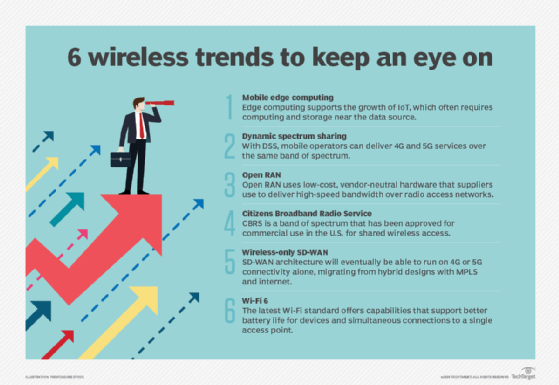
2. Wi-Fi 6: Also known as 802.11ax, Wi-Fi 6 is the latest generation of Wi-Fi technology. It offers significant improvements over its predecessor, Wi-Fi 5 (802.11ac), in terms of speed, capacity, and efficiency. Wi-Fi 6 can handle more devices simultaneously and provides higher data rates, making it suitable for dense environments like stadiums, airports, and smart cities. It also introduces features like target wake time (TWT) and orthogonal frequency-division multiple access (OFDMA), which enhance battery life and enable better utilization of the available spectrum.
3. Mesh Networks: Traditional wireless networks rely on a single router to provide coverage, which can result in dead zones and poor connectivity in larger spaces. Mesh networks offer a solution to this problem by using multiple interconnected access points to create a seamless network. Each access point acts as a node, working together to provide broader coverage, eliminate dead zones, and ensure a reliable connection throughout the area. Mesh networks are particularly useful in homes, offices, and large-scale deployments like outdoor venues and smart cities.
Future Trends in Wireless Networking:
1. Internet of Things (IoT): The proliferation of IoT devices is set to continue in the coming years. These devices require reliable and efficient wireless connectivity to communicate and share data. As the number of IoT devices grows, wireless networks will need to evolve to accommodate the increased demand. Technologies like 5G and Wi-Fi 6 are well-suited to handle the massive scale of IoT deployments, enabling a wide range of applications such as smart homes, industrial automation, healthcare monitoring, and more.
2. Edge Computing: Edge computing is a paradigm where data processing and storage occur closer to the source of data, reducing latency and bandwidth requirements. In wireless networking, edge computing can be achieved by deploying computing resources at the network edge, such as access points or base stations. This approach enables faster processing and real-time decision-making, making it essential for applications like autonomous vehicles, augmented reality, and smart cities.
3. Security and Privacy: As wireless networks become more pervasive, ensuring the security and privacy of transmitted data becomes paramount. With the rise of IoT devices and the potential vulnerabilities they introduce, wireless networks need to implement robust security measures. Future wireless networking technologies will focus on enhancing encryption, authentication, and access control mechanisms to protect against threats such as hacking, data breaches, and unauthorized access.
4. Wi-Fi 6E: Building upon the foundation of Wi-Fi 6, Wi-Fi 6E is an extension that utilizes the unlicensed spectrum in the 6 GHz frequency band. This additional spectrum provides more channels and bandwidth, enabling faster and more reliable wireless connections
About the Creator
SUSILKUMAR S
I am dedication and commitment to their craft have earned them a loyal following, and they continue to captivate their audience with fresh, well-crafted content on a regular basis. Their blog serves as a reliable destination for individual
Enjoyed the story? Support the Creator.
Subscribe for free to receive all their stories in your feed.
Comments
There are no comments for this story
Be the first to respond and start the conversation.