
Why Visual Learning Matters for Language Learners
An ESL Teacher’s Perspective


When I first started teaching English as a second language, I believed that clear explanations were enough. I would write a new word on the board, give a definition, use it in a sentence, and ask students to repeat it. Some students learned quickly, but many forgot the word by the next lesson. I could see the problem clearly: they had heard the word and copied it, but they had not truly connected with it.
That changed when I began using more visuals in my classroom.
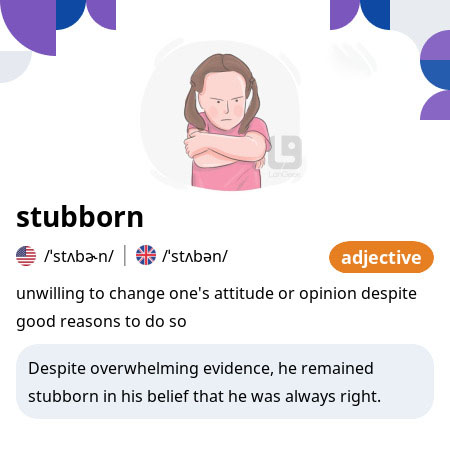
Instead of teaching the word “stubborn” only through a definition, I showed a picture of a child refusing to move. Instead of explaining “pour,” I used an image of water moving from a bottle into a glass. Instead of giving a long explanation of “crowded,” I showed a busy subway platform. Suddenly, students understood faster. More importantly, they remembered.
Visuals Make Meaning Immediate
For language learners, especially beginners, definitions can sometimes create more confusion. If I explain a new English word using more English words, I may unintentionally make the lesson harder. A picture, however, often gives meaning immediately.
In my ESL classes, visuals helped reduce the distance between the word and the concept. Students did not have to translate every word into their first language first. They could look, understand, and then attach the English word to the image in their minds.
This matches what researchers have found about learning from words and pictures. Richard Mayer’s cognitive theory of multimedia learning explains that people process verbal and visual information through separate but connected channels. Learning becomes more meaningful when students select important information, organize it, and connect words with images.
Pictures Help Vocabulary Stay in Memory
One of the biggest challenges in ESL teaching is not introducing new vocabulary; it is helping students remember it later. I have seen students recognize a word during class but forget it in speaking or writing. Visual learning helps solve this because it gives students another path to recall.
This idea is closely related to Dual Coding Theory, first proposed by Allan Paivio. The theory suggests that information connected to both verbal and visual systems can be easier to remember because learners have more than one way to retrieve it. The Stanford Encyclopedia of Philosophy describes Dual Coding Theory as an explanation for the strong memory effects of imagery.
In practice, I saw this every week. When I asked, “What does ‘fragile’ mean?” students sometimes hesitated. But when I reminded them of the picture of a broken glass or a box marked with a warning label, the word came back quickly. The image acted like a bridge to the vocabulary.
Visual Learning Builds Confidence
Many ESL learners are afraid of making mistakes. They may know a word but avoid using it because they are not sure of its meaning. Visuals give them more confidence.
For example, when teaching verbs like “push,” “pull,” “drag,” and “lift,” I used simple images and gestures. Students could compare the actions visually, not just memorize translations. This was especially useful for words with similar meanings. A dictionary definition may explain the difference, but a picture makes the difference easier to feel.
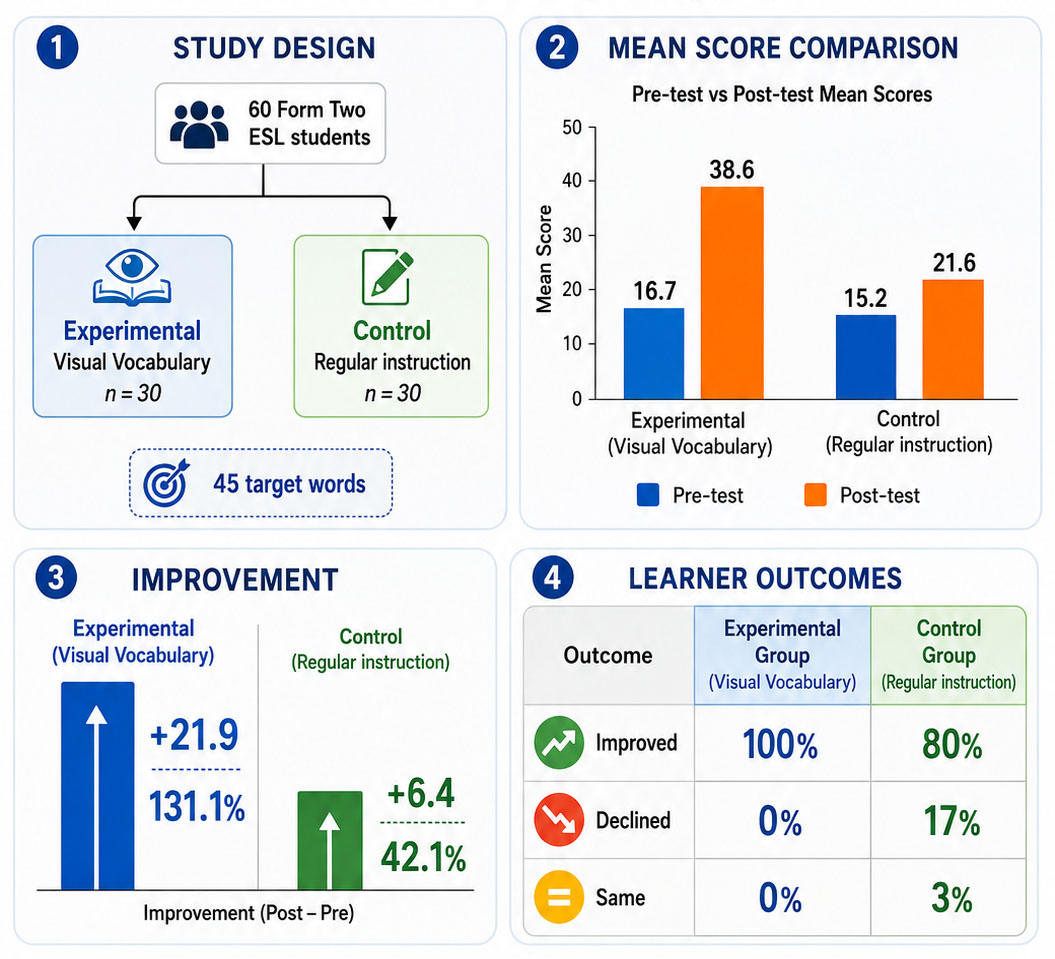
Research on ESL vocabulary learning supports this classroom experience. One study on Visual Vocabulary with 60 ESL learners found that students who learned target words with visual vocabulary showed significant improvement, and the researchers concluded that the approach was effective for learning and understanding new words.
Visuals Support Different Types of Learners
In every class, I have students with different strengths. Some are strong readers. Some learn through listening. Others need examples, movement, color, or context. Visual learning does not replace reading, listening, speaking, or writing, but it supports all of them.
When I use an image before reading, students predict the topic more easily. When I use a picture during speaking practice, students have something concrete to describe. When I use a visual dictionary, students can review vocabulary without depending only on translation.
Mayer’s research also emphasizes that people often learn more deeply from words and pictures together than from words alone. In his review of multimedia learning research, he reported consistent support for the “multimedia effect,” where learners performed better when words were paired with pictures.
Visuals Make Abstract Language More Concrete
Not all words are easy to show. Words like “freedom,” “honesty,” “confusion,” or “responsibility” are abstract. At first, I avoided visuals for these words because I thought pictures would be too simple. Later, I learned that conceptual images can be very powerful.
For “confusion,” I might show a person looking at several signs pointing in different directions. For “responsibility,” I might show someone taking care of a plant, a pet, or a younger sibling. These images do not replace explanation, but they give students a starting point.
This is important because language is not only a list of definitions. Words carry situations, emotions, and cultural meaning. Visuals help learners see the context in which a word is used.
Technology Makes Visual Learning Easier
When I began teaching, I used printed flashcards, drawings, magazine pictures, and objects from the classroom. Today, digital tools make visual learning much easier. Picture dictionaries, vocabulary apps, videos, and interactive exercises allow students to connect words with images instantly.
A 2023 experimental study developed an English Vocabulary with a Picture Application to improve daily vocabulary memorization. The study used picture mnemonics based on multimedia learning theory and compared learning outcomes between an experimental group and a control group.
From my perspective as a teacher, this matters because students need repeated exposure. A picture shown once in class is useful, but a picture they can revisit during self-study is even better.
Visual Learning Should Be Purposeful
Visual learning is powerful, but it must be used carefully. Not every image helps. A picture that is too decorative, too confusing, or unrelated to the target word can distract students. I learned to choose visuals that are clear, direct, and connected to the lesson goal.
For vocabulary, the best visuals usually do three things: they show the meaning clearly, they support the example sentence, and they help students remember the word later. A beautiful image is not always the best teaching image. A useful image is one that makes meaning easier.
About the Creator
Ali Shahdoost
Linguaphile and digital content creator exploring the beauty of language, culture, and communication. I share engaging content on vocabulary, linguistics, language learning, and the stories behind words.
Enjoyed the story? Support the Creator.
Subscribe for free to receive all their stories in your feed.
Comments
There are no comments for this story
Be the first to respond and start the conversation.