
Why the Emperor’s Door Always Faced South
The Hidden Story of "南"

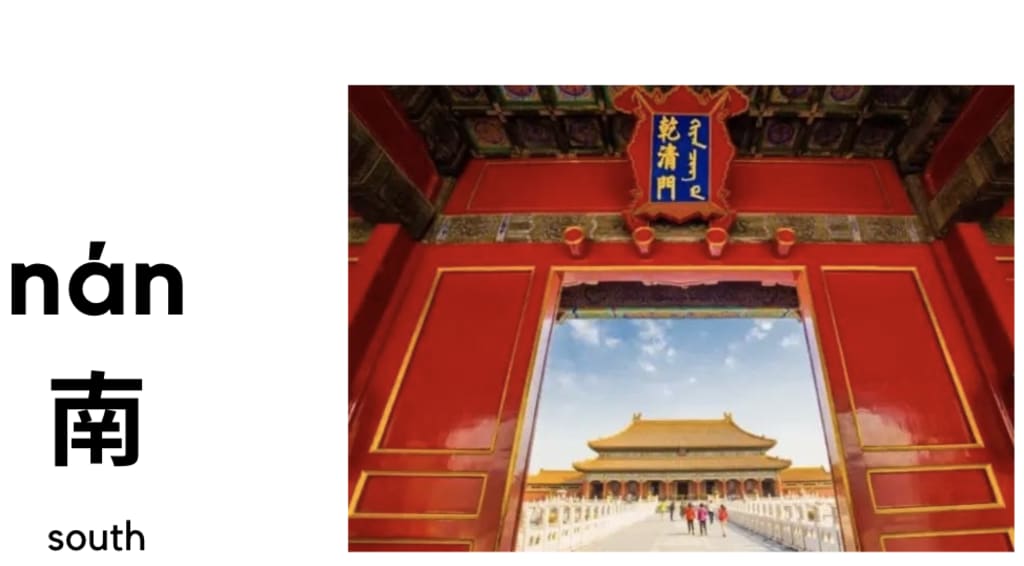
Have you ever thought about why certain Chinese characters look the way they do? Unlike alphabets, Chinese characters are deeply tied to culture, history, and even geography. One such fascinating example is "南" (nán), the character for "south." Behind its simple strokes lies a rich tapestry of stories about nature, emperors, and ancient Chinese wisdom. Let’s dive into the hidden meaning behind this character and discover why it’s a perfect reflection of China’s traditions.
A Land Defined by Geography
To understand "南," we need to start with China’s geography. Ancient Chinese scholars observed that the country’s land was shaped by its natural features: towering mountains in the north, flowing rivers like the Yangtze in the south, and waterways that mostly run from west to east. This topography wasn’t just a random fact of nature; it influenced how people lived, traveled, and built their cities.
The fertile lands of the south were ideal for farming, while the northern mountains provided protection from invaders. Waterways served as lifelines for trade and communication. In this way, the land itself shaped how people understood direction, movement, and prosperity.
The Emperor and His South-Facing Door
Now let’s imagine ancient China, where the emperor ruled as the "Son of Heaven." His palace wasn’t just a residence—it was a symbol of power, carefully designed to align with natural forces. The emperor’s throne always faced south. Why? Because the south was associated with light, warmth, and growth, thanks to the sun's path through the sky. Facing south meant embracing these positive forces, while having one’s back to the north symbolized turning away from cold winds and potential threats.
This tradition wasn’t just symbolic; it was practical. In northern China, where many dynasties ruled, homes and buildings were often oriented southward to maximize sunlight and warmth. The emperor’s palace reflected this ideal on a grand scale, showcasing harmony between human ambition and the natural world.
The Symbolism Within "南"
Now that we understand the cultural significance of "south," let’s break down the character itself. "南" is more than a set of strokes—it’s a visual representation of the emperor’s palace and the prosperity it faced.
Look closely at the character. The outer frame resembles the facade of a house or palace, while the symbol "¥" inside represents wealth or resources. Together, they tell a story: this is the emperor’s grand home, where treasures and power reside, and its doors are always open to the south, inviting light and fortune.
It’s amazing how much meaning can be packed into just a few strokes, isn’t it?
A Window Into Ancient Wisdom
Chinese characters like "南" aren’t just tools for writing—they’re windows into the minds of the people who created them. Through characters, we can see how ancient Chinese culture revolved around balance and harmony with the natural world. The character "南" isn’t just about direction; it’s a reminder of how geography, architecture, and philosophy came together to shape Chinese civilization.
Unlocking the Secrets of Chinese Characters
The story of "南" is just the beginning. Did you know that many Chinese characters have similar hidden meanings, often tied to history, legends, or practical observations about the world? Learning these characters is like solving little puzzles that reveal something new each time.
If you’re curious about exploring more stories like this and mastering Chinese characters in a fun, easy way, you’re in luck! Our Chinese Character Course is designed to make learning meaningful and enjoyable. Through engaging stories, cultural insights, and simple techniques, you’ll discover that Chinese characters aren’t just symbols—they’re treasures waiting to be uncovered.
Ready to start your journey? Join us at https://chinesevoyage.org/ and unlock the secrets of the Chinese language one character at a time. Let’s make learning an adventure!
About the Creator
Murphy Yan
founder of Chinese Voyage, a language learning platform
Enjoyed the story? Support the Creator.
Subscribe for free to receive all their stories in your feed.
Comments
There are no comments for this story
Be the first to respond and start the conversation.