
Why My Child Knows the Alphabet Song But Can't Read: The Missing Reading Skills Most Parents Overlook
Knowing the alphabet song is not the same as knowing how to read. Understanding the missing skills can make reading development much less confusing

My four-year-old destroyed the ABC song at Thanksgiving dinner. He hit every letter. Even L-M-N-O-P without slurring it into one word. Grandma teared up. My brother gave me that look, the one that said I was winning at this. I sat there feeling like I'd unlocked some secret level of parenting. Three days later I held up a flashcard with the letter B and asked him what letter it was.
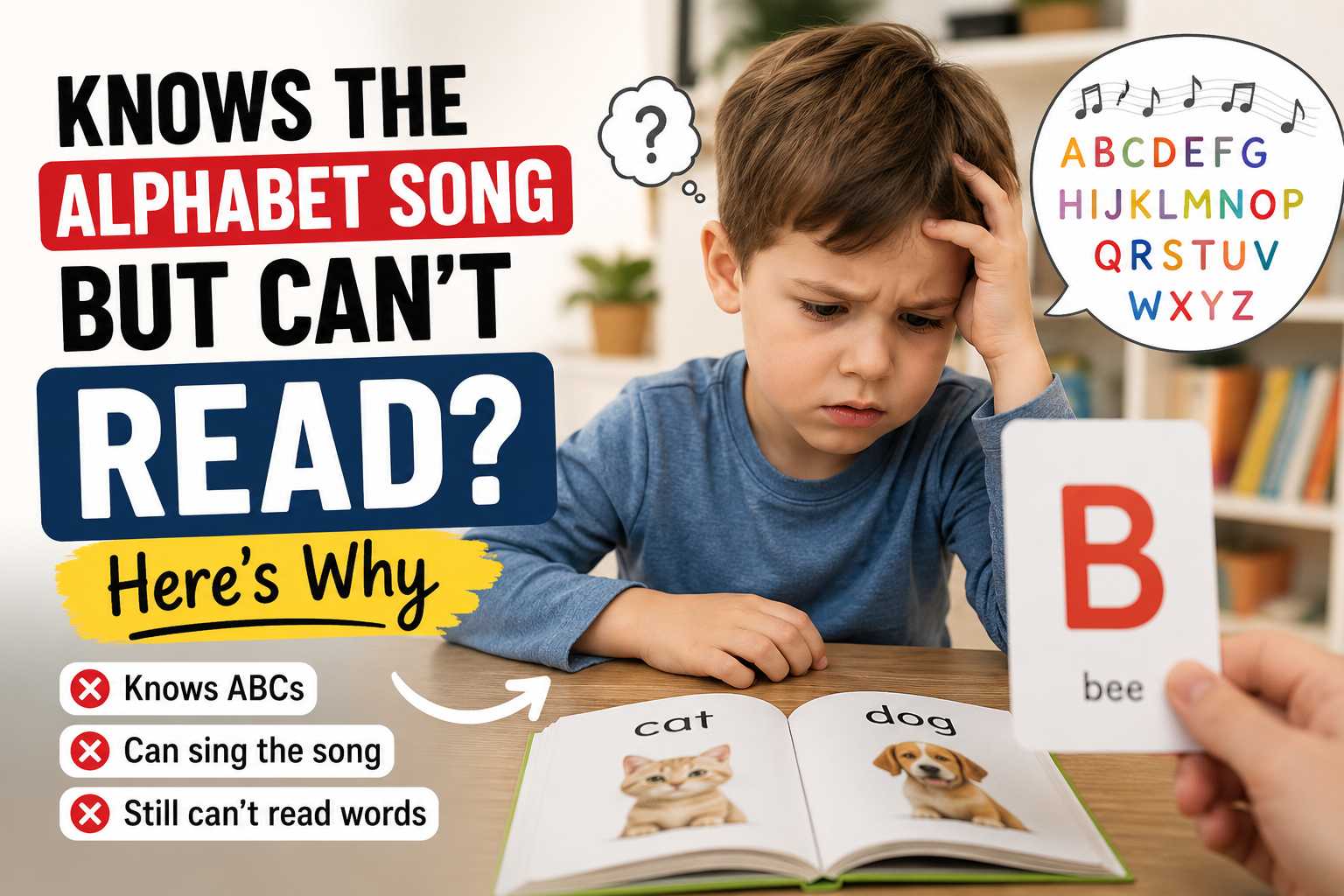
He stared at the card. Then he stared at me. Then he sang the entire alphabet song from the beginning, got to B, and pointed at it. My stomach dropped. He didn't know the letter. He knew the song. Those two things had nothing to do with each other.
That moment started a long winter of confusion. I kept asking myself why my child knows the alphabet song but can't read. I thought the song was the gateway. Every parenting blog I'd ever skimmed implied you teach the ABCs and then reading follows. Nobody warned me about the giant canyon sitting between those two skills.
Why the ABC Song Doesn't Teach Reading Skills
The Song Is Just a Song
The alphabet song is a memory trick. Kids memorize a sequence of sounds in order, the same way they memorize "Twinkle Twinkle Little Star." My son could rattle off A-B-C-D-E-F-G faster than I could. But if I pointed to a random letter on the fridge magnets, he drew a blank half the time. If I asked him what sound the letter M made, he looked at me like I'd asked him to explain taxes.
This is the gap most parents miss. The song teaches order. Reading requires recognition. A child can sing every letter perfectly and still not know that the squiggle we call "S" actually makes a hissing noise. A child can know the alphabet song but not know letters when they see them out of context. My kid could sing the whole thing while jumping on the couch. Put a book in front of him and point to the word "cat," and he had no idea those three symbols meant anything at all.
The Difference Between Letter Names and Letter Sounds
Names Are Not Sounds
I spent weeks trying to figure out what I was doing wrong. Then a preschool teacher at the park said something that stopped me mid-coffee sip. She said my son needed to learn sounds, not names. The letter B isn't "bee." It's /b/. The letter M isn't "em." It's /m/. I felt stupid. I'd been drilling him on letter names for months, thinking that was the foundation. The foundation was actually the sounds those letters make when you smash them together into words.
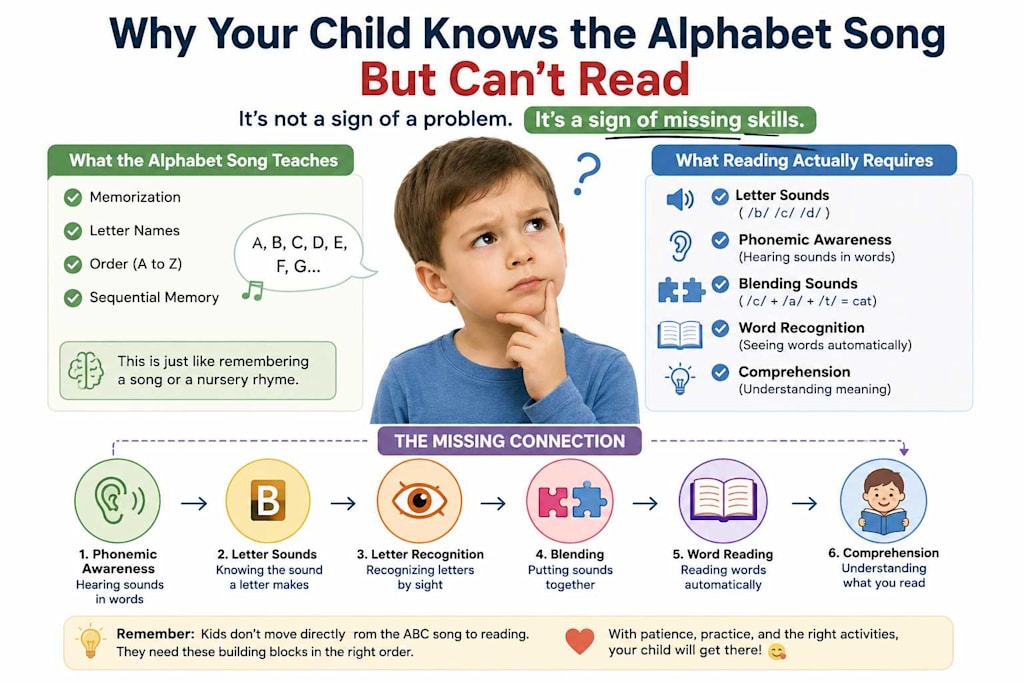
This is where reading readiness skills actually begin. Not with the song. Not with flashcards of letters in isolation. With hearing that words are made of tiny sound pieces. A child who knows letters but can't read words usually missed this step. They memorized visual symbols or sequences without connecting them to the auditory world. My son could hear a dog bark and tell me it was a dog. But if I asked him what sounds he heard in the word "dog," he couldn't pull it apart.
The Hidden Skills Between Singing and Reading
The Skill I Never Knew Existed
The missing skill most parents never see is phonemic awareness. I'd never heard this term before I started panicking. Phonemic awareness means hearing that "cat" has three separate sounds: /c/ /a/ /t/. It means recognizing that "bat" and "cat" share a middle sound. It means taking the /h/ off "hat" and hearing "at." None of this requires paper. None of it requires letters. It's all ears.
My son had zero of this at first. I would say "what rhymes with dog?" and he'd name a color. I would say "listen to the word 'sun.' What sound do you hear at the beginning?" and he'd tell me the sun is hot. These phonemic awareness activities felt awkward at first. I felt like I was speaking a foreign language. But slowly, after a few weeks of silly car games, he started hearing it. He'd shout "bag starts with /b/!" from the back seat. That was the first real reading progress I'd seen.
What Is Phonemic Awareness and Why Does It Matter?
What Phonemic Awareness Actually Looks Like
Real phonemic awareness happens in small moments. You ask your kid to clap once for each sound in "pig." They clap three times. You ask them what word you're making when you say /f/ /i/ /sh/ slowly. They say "fish." You ask them what word you get if you take the /c/ off "cat." They say "at." These tiny games look like nothing. But they build the actual machinery a child needs to decode words later. Without this machinery, a child knows letters but can't blend sounds into anything meaningful.
Why Some Children Know Their ABCs but Can't Read Words
Why Kids Get Stuck Here
Kids learn the ABC song through rote memorization. It's sequential memory. Like learning the days of the week. My son could start at A and march to Z without thinking. But ask him to start at J, and he had to sing the whole song to get there. That's not reading. That's a party trick.
Some children struggle after learning the ABC song because the song gives parents a false checkpoint. We think "he knows the alphabet" means "he's ready for books." The reality is that a child can sing ABCs but doesn't know letters in any meaningful way. He knows the tune. He doesn't know that those sounds connect to printed symbols, or that those symbols connect to sounds in words, or that words can be broken apart and rebuilt. The alphabet song and reading skills are related the same way knowing the names of all the tools in a garage relates to fixing a car.
Signs Your Child Is Progressing Normally
When to Relax
I drove myself crazy for months before I learned that age differences and developmental variation matter more than I thought. Some kids crack reading at four. Others don't click until seven. Both ranges sit inside the normal window. My neighbor's daughter was reading chapter books at five. My son could barely recognize his own name at the same age. I thought I'd failed him. Turns out he was just on his own timeline.
Normal Development Looks Messy
Common reading timelines vary wildly. A child might know the alphabet song at three, letter sounds at five, and blending at six. That progression is fine. Another kid might skip the song entirely and start blending early. Also fine. The signs the situation is completely normal include: your child is under six, they show interest in books and stories, they can eventually learn letter sounds with practice, and they don't have other language delays. If they're engaged and progressing slowly, the alphabet song gap is usually just a speed bump.
When Should Parents Be Concerned?
When to Ask Questions
I don't want to pretend every case fixes itself. Some kids need extra support. Parents should pay closer attention if a child is six or older and still cannot learn letter sounds after months of consistent practice. Or if they can't rhyme at all. Or if they mix up directions constantly, struggle to remember simple instructions, or show other language delays. These don't automatically mean dyslexia or a learning disability. They just mean an evaluation might help.
I talked to a reading specialist after my son turned five and still couldn't tell me what sound the letter T made. She told me early screening is cheap and easy. She also told me most kids she sees are completely normal and just need the right approach. So don't panic. But don't wait forever either. Trust your gut if something feels off beyond the usual slow start.
Simple Activities That Build Reading Skills at Home
Games That Actually Work
We stopped doing flashcards. That was the first good decision I made. Instead we played sound games in the car. I'd say "I spy something that starts with /m/." Not "starts with M." The sound. He'd guess "mirror" or "mom." We'd do blending games. I'd break a word into sounds and he'd guess it. "/d/ /o/ /g/." He'd shout "dog!" It felt more like a game than school.
Sound Games in the Real World
Simple reading readiness activities work better than formal lessons at this age. We wrote letters in shaving cream on the bathroom mirror. We pointed out letters on cereal boxes and said the sounds, not the names. We read the same five books over and over until he started predicting words. Letter recognition skills built slowly through repetition in real contexts, not through drills. The key was keeping it light. The moment I turned it into homework, he shut down.
Why Reading Development Happens in Stages
The Sequence Nobody Explains
I stumbled across something called structured literacy after months of random guessing. Reading development follows a sequence. Most parents don't know this. I didn't. The sequence looks roughly like this:
Phonemic awareness comes first. Hearing sounds in words. Then letter sounds. Connecting sounds to symbols. Then letter recognition. Seeing the symbol and knowing it instantly. Then blending. Smashing sounds together to read a word. Then word reading. Actual decoding. Then reading fluency. Speed and comprehension.
Once I realized there were several stages between singing the alphabet and actually reading, I became curious about how reading skills are usually introduced and organized. I spent a few nights digging around online and found a breakdown of literacy sequencing at . It mapped out the progression better than anything I'd seen. I wasn't looking to buy anything. I just wanted to see how the pieces fit.
Why Different Reading Approaches Teach Skills Differently
Comparing Different Paths
Different literacy approaches teach these skills in different orders. Some programs push letter names first. Others start with sounds. Some blend early. Others wait. Structured literacy concepts vary from program to program. I had no idea there was this much variation until I started comparing them.
After understanding the basic reading progression, I wanted to see how different structured approaches handled those same skills and what educators were saying about them. I came across a discussion comparing approaches at . Again, not an endorsement. Just part of my research.
Why different programs teach skills differently comes down to philosophy and curriculum sequencing. Some models believe in whole language first. Others believe in explicit phonics first. Literacy progression models disagree on the best starting point. I don't know which one is right. Probably depends on the kid. But seeing how many different roads lead to reading made me relax.
What I Learned
The ABC song is cute. It's fun at parties. It makes grandparents cry. It is not reading. Reading is sounds. Reading is blending. Reading is looking at a word and hearing it in your head. My child knows the alphabet song but can't read because those are two different jobs. One is memory. The other is decoding.
Many children make this transition successfully once parents shift focus. Stop drilling the song. Start playing with sounds. Stop worrying about letter names. Start building letter recognition through everyday moments. Parents can focus on sounds, blending, and recognition rather than worrying about the song itself. The song was never the problem. Thinking it was the whole solution was.
My son is six now. He still sings the ABCs when he's happy. But last week he read the word "stop" on a street sign by himself. He sounded it out. /s/ /t/ /o/ /p/. He looked at me with this huge grin. I grinned back. That moment beat Thanksgiving by a mile.
About the Creator
Understandshe
I write about healing, self-growth, and the messy but beautiful journey of becoming. Honest lessons, real stories, and gentle insights you’ll also find on UnderstandShe.
Enjoyed the story? Support the Creator.
Subscribe for free to receive all their stories in your feed.
Comments
There are no comments for this story
Be the first to respond and start the conversation.