
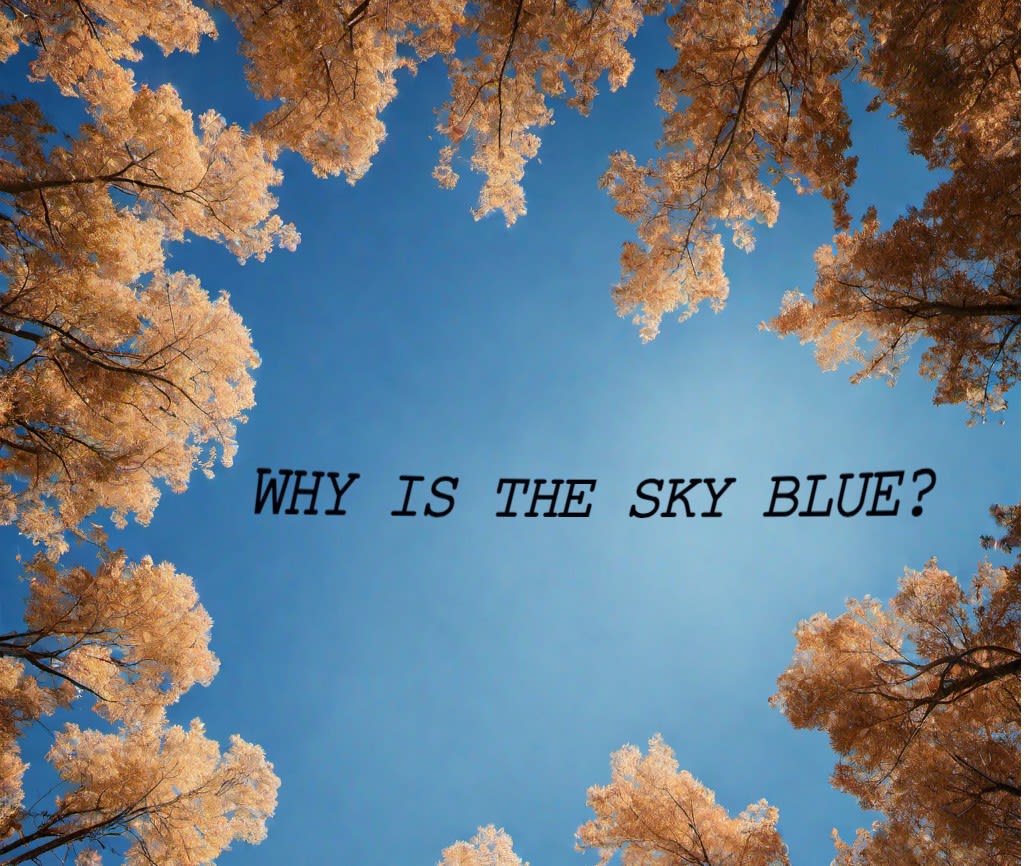
Sometimes I wonder why the sky is blue? So I learned a little bit about it and here is a simple explanation about it.
The blue color of the sky is a fascinating natural phenomenon that has intrigued humans for centuries. The explanation behind the blue hue lies in the way sunlight interacts with the Earth's atmosphere, specifically through a process called Rayleigh scattering.
Sunlight is composed of different colors, each having a specific wavelength. This range of colors is known as the visible spectrum and spans from violet, with the shortest wavelength, to red, with the longest wavelength. When sunlight reaches the Earth's atmosphere, it encounters tiny particles such as molecules of nitrogen and oxygen, as well as dust and water droplets.
The size of these particles and molecules is much smaller than the wavelength of visible light, making them ideal scatterers of light. As sunlight passes through the atmosphere, the shorter wavelengths (blue and violet) are scattered more effectively by these small particles and molecules compared to the longer wavelengths (red and yellow).
The blue and violet light is scattered in all directions, including towards our eyes. As a result, when we look up during the day, we see the scattered blue light coming from all around the sky, giving it a blue appearance.
The scattering process is more effective for shorter wavelengths like blue and violet because their smaller size allows them to interact more readily with the particles in the atmosphere. In contrast, longer wavelengths like red and yellow are less affected by scattering, so they continue traveling through the atmosphere with less deviation from their original path.
At sunrise and sunset, the sun is lower on the horizon, and its light must pass through a larger portion of the Earth's atmosphere before reaching our eyes. This increased atmospheric path length causes more scattering of the shorter wavelengths, which is why the sky appears to have warm colors like red, orange, and pink during these times. The blue and violet light is scattered away, leaving the longer wavelengths to dominate the sky's color palette.
While Rayleigh scattering is the primary reason for the sky's blue appearance, other factors can also influence the color of the sky. For instance, pollution and dust in the atmosphere can alter the scattering process, leading to variations in sky color. In some regions, the presence of fine particles or pollutants can cause the sky to appear more hazy and less blue.
Understanding why the sky is blue not only satisfies our curiosity about the natural world but also has practical applications. Researchers studying the atmosphere and climate rely on the knowledge of scattering processes to interpret satellite and remote sensing data accurately.
In conclusion, the blue color of the sky is a result of Rayleigh scattering, where sunlight's shorter wavelengths (blue and violet) are scattered more effectively by molecules and particles in the Earth's atmosphere, leading to the blue appearance of the daytime sky. At sunrise and sunset, the increased atmospheric path length causes more scattering of the shorter wavelengths, leaving longer wavelengths to dominate the sky's color, creating the beautiful hues we observe during these times. This natural phenomenon, which has captivated scientists and artists alike, exemplifies the intricate interplay between light and matter in the atmosphere and our understanding of the world around us.
in a simplyer way to understand
The sky is blue because of a process called Rayleigh scattering. When sunlight enters the Earth's atmosphere, it encounters tiny particles and molecules. These small things scatter the blue and violet light more than other colors. As a result, we see the scattered blue light from all around the sky, and that's why it looks blue during the day.
During sunrise and sunset, the sunlight has to pass through more of the atmosphere, so the blue light scatters away, leaving warm colors like red and orange to dominate the sky's appearance.
So, the sky is blue because of the scattering of blue light by the tiny particles in the atmosphere, and it looks colorful during sunrise and sunset because the blue light is scattered away, leaving other colors to shine.
Thank you for reading!
About the Creator
Enjoyed the story? Support the Creator.
Subscribe for free to receive all their stories in your feed.
Comments
There are no comments for this story
Be the first to respond and start the conversation.