
Why Is Education Still Measuring Monkeys on How High They Climb?
How Our Obsession with “Success” Metrics Is Stifling Creativity—and What We Can Do About It.

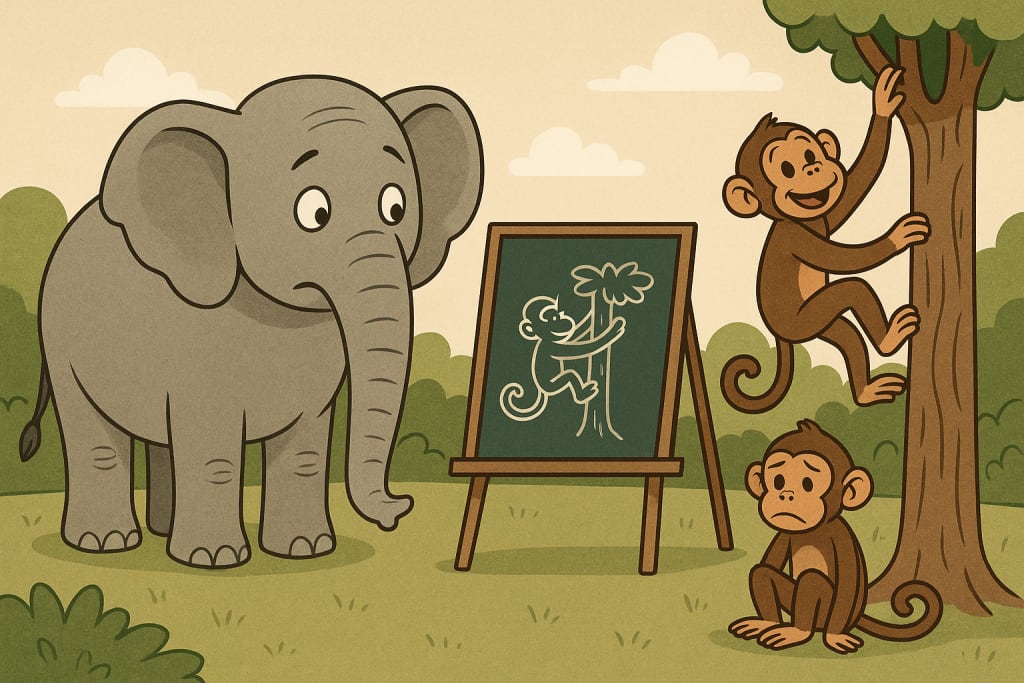
“What if the problem with education isn’t the kids, the teachers, or even the funding—but the fact that we’re asking the wrong questions? We’ve spent decades trying to ‘fix’ schools by doubling down on grades, standardized tests, and college degrees. But what if these metrics aren’t just outdated… they’re actively sabotaging what real learning looks like?
Imagine a world where schools didn’t rank students like athletes in a race, but nurtured them like gardeners tending unique plants. What if the goal wasn’t to climb higher, but to grow differently?”
1. The Tyranny of “Success” Metrics: When Numbers Lie
Schools are judged by graduation rates, test scores, and college enrollment numbers—numbers that often mask deeper inequities. A 2024 OECD report found that while 80% of students in industrialized nations graduate high school, only 30% feel prepared for real-world problem-solving. Why? Because we’re measuring compliance, not curiosity.
In India , the obsession with metrics like board exam percentages and entrance test rankings has created a crisis of burnout. While precise JEE/NEET participation figures vary, over 1.5 million students take these exams annually, with fewer than 1% securing top-tier placements.
This hyper-competitive environment fuels anxiety: a 2024 NCERT report highlighted that high student-to-teacher ratios and limited resources deter risk-taking and creativity in Indian classrooms.
Meanwhile, systemic critiques argue that rote learning remains prevalent , with 80% of school principals blaming it for poor learning outcomes.
The root issue? Metrics designed for factories, not minds. Industrial-era education systems prioritized efficiency, uniformity, and output—perfect for mass-producing factory workers but disastrous for nurturing thinkers.
Today, as automation replaces repetitive jobs, countries like India must ask: Will we prepare students to compete with machines, or to master the uniquely human skills they can’t replicate?
2. The Myth of the “Average Student”: Why Personalization Isn’t a Luxury
The factory-model education system assumes a one-size-fits-all path: sit still, memorize facts, regurgitate them on demand. But neuroscience shows that humans learn best through play, collaboration, and failure—a truth embraced by outlier schools like Finland’s HundrED -certified institutions, where project-based learning replaces standardized testing.
In India, institutions like Rishi Valley School and Pathways World School are experimenting with learner-centered models. At Rishi Valley, students in rural Andhra Pradesh engage in interdisciplinary projects—like designing low-cost water filters for local villages—blending science, ethics, and community service. Yet these remain niche experiments in a system where over 80% of principals cite rote learning as a systemic flaw.
Contrast this with global trends: Overcrowded classrooms (e.g., pupil-teacher ratios exceeding 40:1 in many Indian states) and inadequate infrastructure continue to compromise education quality.
A 2024 NCERT report noted that only 20% of secondary schools offer structured programs on emotional well-being , underscoring systemic gaps in adapting to diverse learner needs.
3. Redefining “Failure”: The Hidden Curriculum of Fear
In most classrooms, mistakes are penalized. Yet innovation thrives on iteration. Consider Singapore’s School of the Future (a conceptual example), where students earn “failure credits” for experiments that don’t work. In India , the Atal Tinkering Labs (ATLs)—initiatives under NITI Aayog—aim to foster a culture of trial-and-error.
Students in ATLs build prototypes like solar-powered irrigation systems or AI-enabled waste sorters, learning resilience through hands-on problem-solving.But stigma around failure persists.
A 2024 NCERT report noted that high student-to-teacher ratios and limited resources deter risk-taking and creativity in Indian classrooms.
Contrast this with Finland, where “no one fails before age 13” policies allow students to retake exams without penalty.
A radical alternative: Portfolio-based assessments. While schools like Big Picture Learning (U.S.) pioneered this model, Indian alternatives include Swaraj University in Rajasthan, which replaces exams with self-assessed portfolios and mentor-led feedback. Employers increasingly value these tangible demonstrations of skill over GPAs—especially in India’s gig economy, where freelancers and startups prioritize adaptability over degrees.
4. The Emotional Intelligence Gap: Why Empathy Matters More Than Algebra
Schools prioritize STEM and literacy while ignoring emotional and social skills—competencies that employers now rank as critical. A 2024 NCERT report found that only 20% of secondary schools offer structured programs on emotional well-being.
In India, experts argue that limited institutional focus on emotional intelligence training leaves students ill-prepared for collaborative workplaces.
Efforts like CBSE’s Life Skills Education Curriculum (introduced in 2021) aim to bridge this divide, teaching mindfulness, communication, and conflict resolution. In urban centers like Bengaluru, schools like Inventure Academy integrate “design thinking” to pair empathy with problem-solving—students have designed apps to connect homeless communities with shelters.
Yet challenges remain. In rural India, where teacher shortages are rampant, soft skills often fall by the wayside. The solution? Community-driven mentorship. Programs like Pratham’s Digital Learning Initiative use WhatsApp to deliver bite-sized SEL (Social-Emotional Learning) modules to students in remote areas, proving that innovation can thrive even with limited resources.
5. A Call to Redesign, Not Reform: Radical Alternatives for Real Change
Micro-Schools: Small Is the New Standard
Tiny, community-driven pods like Pod School in Mumbai and The Peepal Grove School in Andhra Pradesh blend personalized learning with real-world mentorship. In one project, students partnered with local NGOs to map groundwater depletion, merging data science with civic action.
AI-Driven Personalization: Beyond the “One-Size” Algorithm
In India, platforms like ApniPathshala are redefining digital education through its "Empowering Digital Education for Children Across India" initiative. By establishing 1,000+ learning pods nationwide, ApniPathshala bridges the digital divide by providing children from diverse backgrounds access to essential computer skills in safe, community-driven spaces.
The government’s DIKSHA platform aims to democratize AI-driven education.
Unschooling: Letting Students Lead
In India, unschooling remains rare but growing. Networks like Swaraj Abhiyan’s Free School Movement promote child-led learning in rural communities, challenging the notion that education must happen within four walls.
“Education isn’t outdated because it’s old—it’s outdated because we’re clinging to a definition of ‘success’ that no longer serves us. The next generation doesn’t need more tests; they need spaces where curiosity, collaboration, and creativity are the new metrics. The question isn’t ‘How high can we climb?’ It’s ‘Why are we climbing the same tree?’ Let’s build ladders where everyone can reach their own heights—or choose to plant a new forest altogether.”
About the Creator
NEXTGEN EDUCATOR
Education isn’t broken—it’s outdated. I use this space to challenge the status quo, amplify fresh ideas, and push the boundaries of what learning can look like in the next generation.
Enjoyed the story? Support the Creator.
Subscribe for free to receive all their stories in your feed.
Comments
There are no comments for this story
Be the first to respond and start the conversation.