
Who Gives Tsinghua and Peking University Their Value?
The students are elite. The platform is elite. The truth is the loop between them.
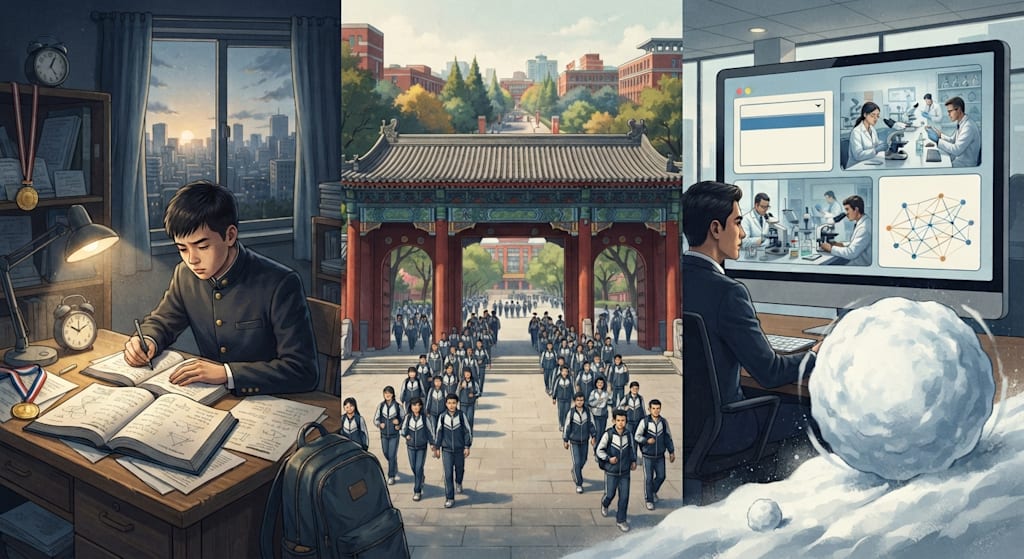
A contest-admitted student had Advanced Algebra on his desk in senior year. He did not need to take the gaokao, but he still woke at 6:30 and left the study room at 11 p.m. Some classmates had already worked in university labs. Some read English paper abstracts. Some had taught themselves general physics.
This was life before Tsinghua and Peking University, not after.
Another group is the top gaokao scorers in each province. In high school they were usually first in their school. Some never left the top three in their grade. When they arrive at Tsinghua or Peking University, the first class meeting shows them a different scale. Half the room has competition experience. Someone discusses a math theorem like last night’s dinner. Someone in freshman year is already running data with a senior student. They have not figured out the course selection system.
The gap is common. It shows that the value of a Tsinghua or Peking University undergraduate does not start at enrollment. These students were screened before they arrived, by the gaokao, competitions, the Strong Foundation Plan, and recommended admission. Those who pass have learning ability, self-control, stress tolerance, and long-term planning that are usually far ahead of their peers.
So the claim that Tsinghua and Peking University would be just as strong with any group of students does not match reality. The students bring value.
The opposite claim, that the schools’ value comes entirely from the students, also fails.
A Tsinghua student looks for an internship and opens a top company’s campus recruitment page. The first field is university. The dropdown puts Tsinghua and Peking University in their own category. Below that are other 985s, 211s, and ordinary first-tier universities. The recruiter will not read every resume. The system screens first. People look second. Many resumes from ordinary universities never get seen.
Ability is not the filter here. Signal is. Companies face too many resumes. They use university as the first cut. The Tsinghua and Peking University label lowers the cost of identification.
Research works the same way. National key R&D programs, frontier projects, and major scientific facilities often have Tsinghua and Peking University as lead institutions. The projects do not go there because the names sound good. The schools have decades of teams, equipment, data, connections, and grant experience. An ordinary university may not qualify to take them on. A student who spends three or four years inside such a project touches literature, equipment, and academic networks that an ordinary university student may not reach after ten years of independent work.
Then there are selected graduates, recommended postgraduate admission, overseas exchanges, and alumni referrals. The rates, opportunities, and alumni density at Tsinghua and Peking University are hard for ordinary universities to match. A smart student without a platform, mentors, projects, and connections will struggle to release their ability.
The platform itself has value. It is not an empty name. It offers resources, opportunities, networks, and signals.
The question is whose value it is.
Top students and a top platform amplify each other.
Top students enter Tsinghua and Peking University. The schools produce alumni, research, and social influence. Their reputation rises. Society recognizes them more. They receive more resources and better students. They attract even stronger students.
The loop has run for decades. Students bring the fuel. The platform is the engine. Reputation and alumni networks provide access. Remove any one part, and the position of Tsinghua and Peking University today would not hold.
Earlier, some universities tried to pull the strongest students from ordinary schools into elite classes. They gave them the best faculty, conditions, and dorms. Four years later, those classes still lagged behind ordinary Tsinghua and Peking University classes. Resources can be stacked quickly. Study habits, cognitive levels, and peer ecology built over more than a decade cannot be copied in four years.
This is where platform and student body lock together.
Two extremes mislead people.
The first says Tsinghua and Peking University depend entirely on students. From this, some conclude that any school can work, and ordinary students can overtake Tsinghua and Peking University graduates. In reality, many companies filter campus applications by university list. A student may have ability and still never reach the submission page. The platform gap exists.
The second says the schools depend entirely on the brand. From this, some conclude that once you enter Tsinghua or Peking University, you can coast and still come out ahead. In reality, every year some students fail courses, drop out, or delay graduation. Some enter through competition with a narrow margin and fail calculus in freshman year. Some play games and barely graduate. When they job hunt, they can fall behind serious students at an ordinary 985.
So the value comes from both students and school. Each is a condition for the other.
If you are at Tsinghua or Peking University, do not confuse the platform with your own ability. The school gives you a higher starting point, better resources, and a stronger network. It does not guarantee success. What you have after you leave matters more.
If you are not at Tsinghua or Peking University, acknowledge the threshold and do not limit yourself. Some internships and companies are harder to reach, and some circles are harder to enter. You can still use work samples, skills, internships, graduate exams, certificates, and projects to offset the signal disadvantage. A harder road is still a road.
Society should neither worship famous schools nor dismiss them. A famous school can open doors. It does not decide where you end up. A strong platform can make ordinary effort go further and can release top talent. Society should also give students from non-famous schools more ways to show what they can do.
The recruiter opens the campus recruitment system. The university filter dropdown is still there. She checks Tsinghua and Peking University. The list drops to three pages. On the third page, she sees a resume from an ordinary first-tier university. The mouse pauses. Then she clicks next page.
About the Creator
Jin
Writer of reamstories
https://reamstories.com/jin
Enjoyed the story? Support the Creator.
Subscribe for free to receive all their stories in your feed. You could also become a paid subscriber, letting them know you appreciate their work.
Comments
There are no comments for this story
Be the first to respond and start the conversation.