
Which Online MBA Specializations Offer the Best Career Growth and Earning Potential in 2027?
Explore the online MBA specializations that can boost earning potential, expand career opportunities and prepare professionals for leadership roles in 2027.

Choosing an online MBA specialization involves more than identifying which business careers offer the highest salaries. Professionals also need to consider how their existing experience, industry demand and long-term career goals influence the value of a graduate business degree.
Finance, business analytics, technology management and marketing can all lead to rewarding leadership opportunities. However, the specialization that produces the strongest financial return for one professional may offer fewer advantages to someone with a different background.
The most effective approach is to evaluate salary potential alongside career flexibility, transferable skills and opportunities for advancement.
Which Online MBA Specializations Are Most Relevant to High-Growth Careers?
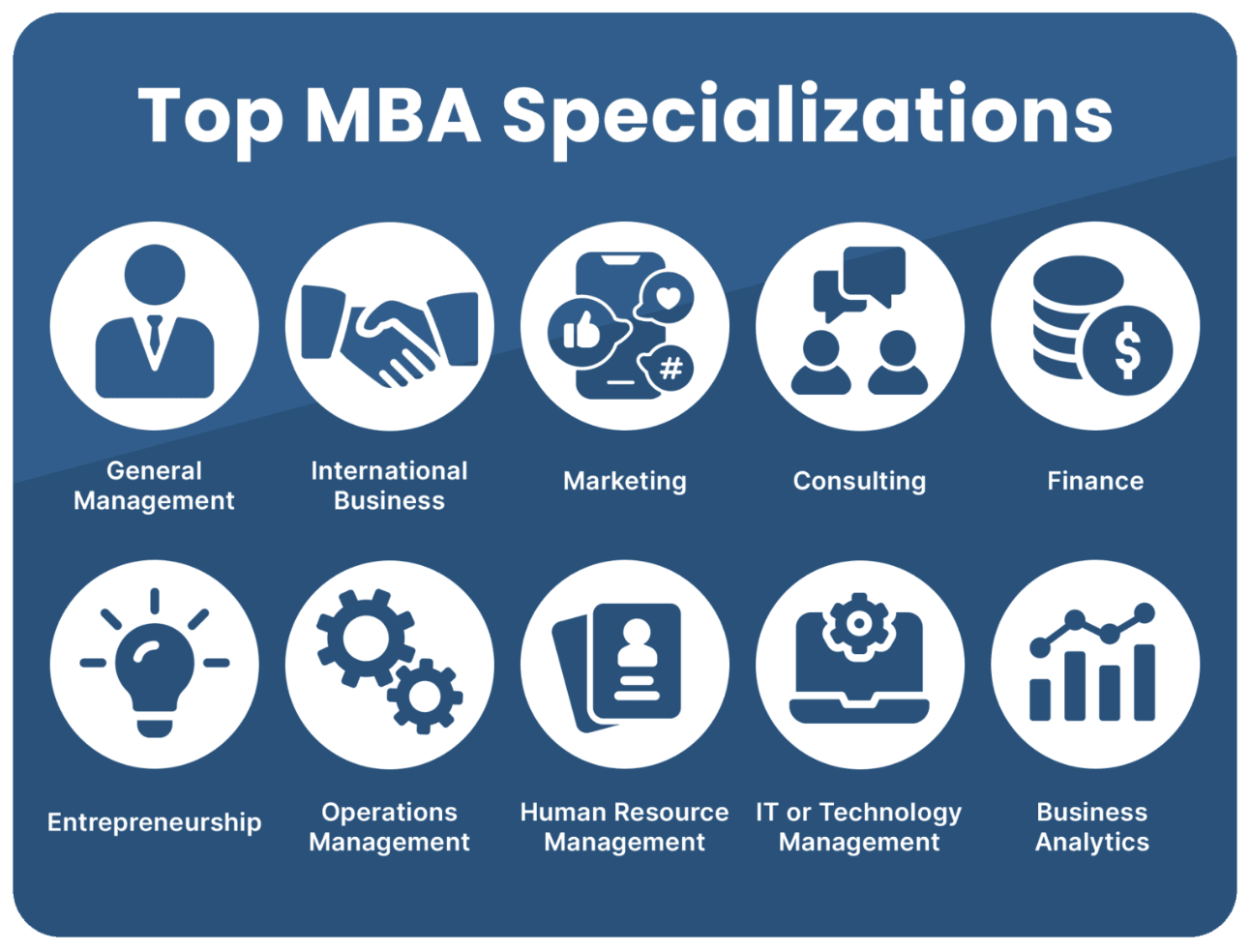
Several MBA specializations prepare professionals for management positions across industries. Each develops a different combination of technical, analytical and leadership capabilities.
Finance: Focuses on financial planning, investment analysis, corporate valuation and risk management. Graduates may pursue careers in corporate finance, banking, financial consulting and financial leadership.
Business Analytics: Develops skills in data interpretation, predictive modeling and evidence-based decision-making. Potential career paths include business intelligence, analytics management, operations strategy and consulting.
Technology and Innovation Management: Combines business leadership with technology strategy, digital transformation and innovation. This specialization may appeal to professionals interested in technology consulting, product management and organizational transformation.
Marketing: Covers consumer behavior, brand management, market research and revenue growth strategies. Graduates may advance into marketing management, product marketing and commercial leadership.
Operations and Supply Chain Management: Emphasizes process improvement, resource allocation, procurement and operational efficiency. Career opportunities include supply chain leadership, operations management and business transformation.
Human Resource Management: Prepares professionals for organizational development, talent strategy, workforce planning and people leadership.
The strongest choice depends on the responsibilities a professional wants to assume, rather than the popularity of a particular specialization.
Which MBA Specializations Have the Strongest Salary Potential?
Finance, business analytics and technology-focused management are frequently associated with well-compensated business roles. However, salary outcomes depend heavily on the position, employer, industry, geographic market and level of responsibility.
A finance graduate moving into corporate financial leadership may experience substantial earning growth. Similarly, an analytics professional who advances from reporting responsibilities to enterprise-level decision-making may qualify for more senior positions.
Marketing and operations can also offer strong compensation opportunities, particularly when professionals manage significant budgets, revenue targets or large teams.
The following comparison illustrates how different specializations connect to career advancement.
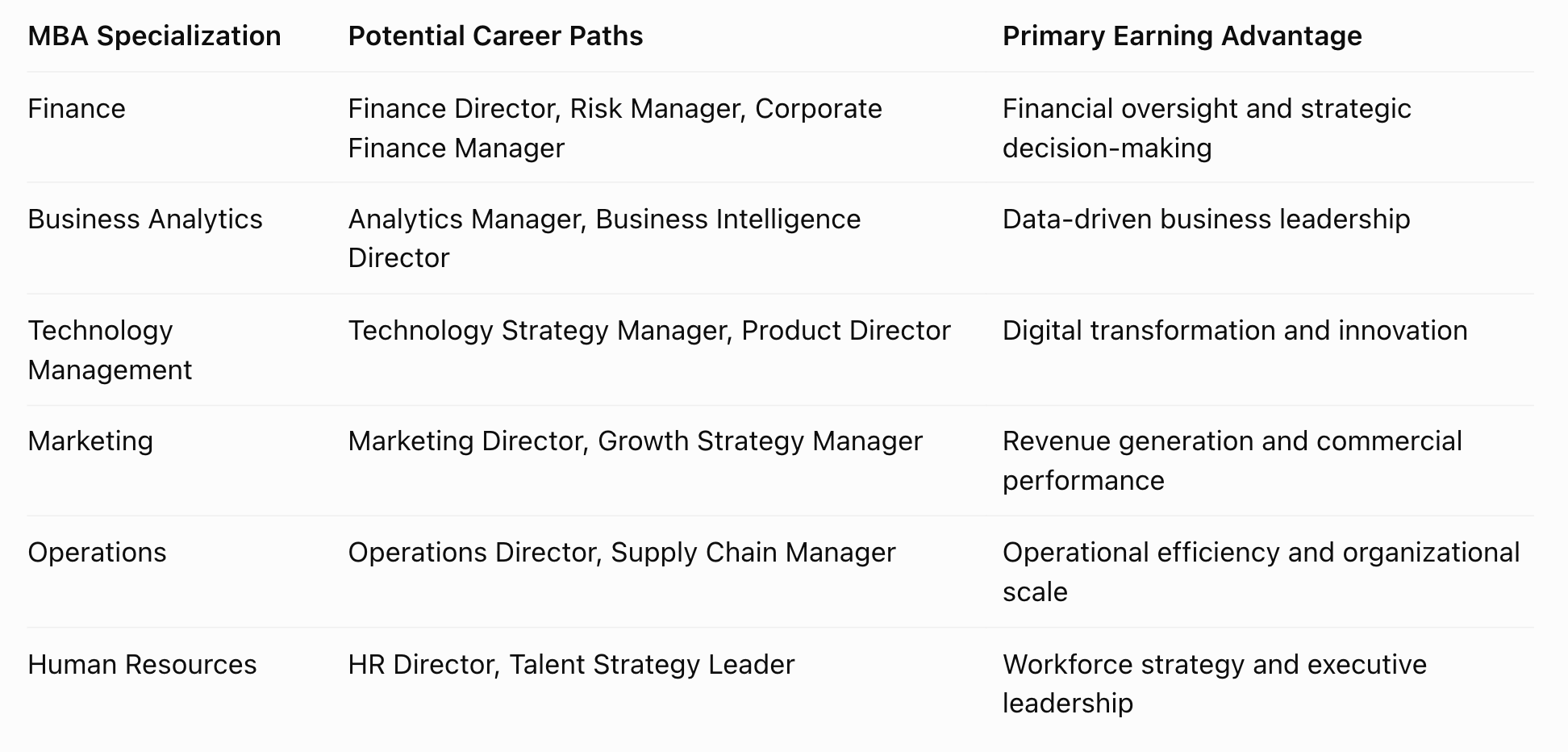
These are potential career paths, not guaranteed outcomes from completing an MBA.
Rather than selecting a specialization solely because its associated job titles have attractive salaries, prospective students should consider whether they can realistically transition into those roles.
Does MBA Specialization Matter More Early or Later in Your Career?
The importance of an MBA specialization changes as professionals gain experience.
For individuals beginning their careers, a specialization can help establish expertise in a particular business discipline. Coursework, applied projects and internships may provide evidence of relevant skills when professional experience is limited.
Mid-career professionals often benefit from choosing a specialization that strengthens their existing capabilities or supports a planned career transition.
Senior professionals may find that strategic leadership, organizational influence and measurable business results carry greater weight than the specialization listed on their degree.
Michael McMahon, Ed.D., Vice President for Enrollment Management at Saint Mary's University of Minnesota, brings an enrollment leadership perspective to this decision. His responsibilities include graduate and online enrollment strategy, making program fit and educational objectives particularly relevant considerations.
For prospective students, this reinforces an important distinction: an MBA should be evaluated according to the professional development it supports, not simply the credential it provides.
A working professional seeking promotion within an existing organization may need different coursework from someone planning to enter an entirely new industry.
Which MBA Specializations Provide the Most Career Flexibility?
Career flexibility is an important consideration because business responsibilities continue to evolve as organizations adopt new technologies and operating models.
Business analytics is particularly transferable because organizations across finance, healthcare, retail, manufacturing and technology rely on data to guide decisions.
General management and strategy-focused MBA pathways also provide broad exposure to business functions, potentially preparing professionals for cross-functional leadership.
Finance offers opportunities in corporate planning, risk management, investment analysis and financial operations. Marketing connects to brand development, customer acquisition, market research and commercial strategy.
Technology management can support movement between digital operations, product development and business transformation.
At the UC San Diego Rady School of Management, Eric Yorkston, Associate Dean of Academic Programs and Associate Teaching Professor of Marketing, works at the intersection of academic program leadership and marketing education. His background includes research in branding and consumer behavior, areas that illustrate how specialized business knowledge can remain relevant across different industries and managerial responsibilities.
Professionals seeking flexibility should look beyond specialization names and examine whether the curriculum develops skills applicable to multiple functions.
For example, a marketing professional who understands financial analysis, customer analytics and business strategy may be better positioned for broader commercial leadership than someone whose experience remains limited to campaign execution.
Should You Choose an MBA Specialization Based on Your Current Experience?
Existing professional experience should play a significant role in specialization selection.
A specialization that builds on established skills may create a more practical route toward promotion. Conversely, entering an unfamiliar discipline may require additional technical training, projects or entry-level experience before a career transition becomes realistic.
Common combinations include:
Engineering professionals: Business Analytics, Operations or Technology Management.
Accounting and finance professionals: Finance, Corporate Strategy or Financial Technology.
Sales and marketing professionals: Marketing, Business Analytics or General Management.
IT professionals: Technology Management, Business Analytics or Innovation.
Human resources professionals: Human Resource Management, Organizational Leadership or People Analytics.
Operations professionals: Supply Chain Management, Operations Strategy or General Management.
These combinations are starting points rather than fixed career rules.
For example, an engineer interested in executive leadership may benefit more from finance and organizational strategy than from further technical specialization.
Similarly, an experienced sales manager aiming for a chief revenue officer position may prioritize financial planning, strategic management and organizational leadership over introductory marketing courses.
The objective is to identify which additional capabilities will help bridge the gap between current responsibilities and future career goals.
How Can You Narrow Down the Right Online MBA Specialization?
Prospective students can simplify the decision by answering two questions.
Question 1: Are you seeking advancement within your current field or a transition into a new one?
Professionals seeking advancement may benefit from deepening their existing expertise. Career changers should prioritize specializations that provide transferable skills and opportunities to demonstrate new capabilities.
Question 2: Do you prefer analytical, technical, commercial or people-focused responsibilities?
Different preferences suggest different pathways:
Analytical and financial responsibilities: Finance or Business Analytics.
Technology and innovation: Technology Management or Business Analytics.
Revenue growth and customer strategy: Marketing or General Management.
Organizational leadership and talent development: Human Resource Management or General Management.
Process improvement and operational strategy: Operations or Supply Chain Management.
Students should then review actual course descriptions, faculty expertise, learning formats and applied projects.
Two universities may offer similarly named specializations while emphasizing substantially different competencies.
How Do You Calculate the Return on Investment of an Online MBA?
Return on investment is one of the most important considerations when selecting an online MBA program.
Tuition is only one part of the calculation. Students should also account for fees, financing costs, study-related expenses and any income lost if they reduce working hours.
A simple payback calculation is:
Payback period = Total MBA investment ÷ Additional annual earnings
Consider a hypothetical professional who invests $24,000 in an online MBA and subsequently earns an additional $8,000 annually.
Their simplified payback period would be:
$24,000 ÷ $8,000 = 3 years
However, this calculation assumes the full salary increase is attributable to the MBA and remains consistent. It also excludes taxes, financing costs and the time value of money.
A more useful evaluation should consider several potential outcomes.
For example, one specialization might provide a faster route to a modest promotion, while another could require additional experience but create opportunities for substantially greater responsibility later.
Students should also assess program accreditation, employer recognition, professional networking opportunities and career support.
A higher-priced MBA is not automatically a better investment, and a lower-priced program does not necessarily deliver stronger returns.
Conclusion
The best online MBA specialization for career growth depends on the relationship between professional experience, future responsibilities and the skills employers value.
Finance and business analytics can support careers involving complex financial and analytical decisions. Technology management offers opportunities connected to innovation and digital transformation, while marketing, operations and human resources remain important pathways into organizational leadership.
Prospective students should evaluate the curriculum, career flexibility, total investment and realistic advancement opportunities before choosing a specialization.
An online MBA can support long-term professional development, but its financial value ultimately depends on how effectively graduates apply their education to new responsibilities and career opportunities.
Frequently Asked Questions
1. Which online MBA specialization is best for earning a higher salary?
Finance, business analytics and technology management can lead to high-paying managerial positions. However, the best specialization depends on professional experience, industry demand and the level of responsibility associated with the target role.
2. Is an online MBA in business analytics worth pursuing?
Business analytics can be valuable for professionals interested in data-driven decision-making, consulting, operations and business strategy. Its value depends on curriculum quality, practical skills development and the student's ability to apply analytical knowledge professionally.
3. Which MBA specialization is best for working professionals?
Working professionals often benefit from specializations that complement their existing experience. Finance may suit accounting professionals, while technology management or business analytics may be relevant to individuals with technical backgrounds.
4. Can an online MBA help professionals change careers?
An online MBA can support career transitions by providing business knowledge, applied projects and professional connections. However, changing into highly specialized fields may require additional technical skills or relevant work experience.
5. Does an MBA specialization matter for senior leadership positions?
Specialization can provide useful expertise, but senior leadership positions generally place substantial emphasis on strategic judgment, organizational performance, communication and experience managing complex business decisions.
6. How should students compare online MBA programs?
Students should examine accreditation, curriculum, faculty qualifications, tuition, flexibility, career services and available graduate outcomes. They should also determine whether the program offers coursework aligned with their intended career direction.
About the Creator
Dan Woodland
Dan is a freelance writer and contributor who explores a wide range of topics, from business, entrepreneurship, technology, design, marketing, and finance to emerging trends, culture, and everyday ideas that spark curiosity.
Enjoyed the story? Support the Creator.
Subscribe for free to receive all their stories in your feed.
Comments
There are no comments for this story
Be the first to respond and start the conversation.