
What Is Early Childhood Development?
Understanding how children grow, learn, and build abilities from birth through age eight

A toddler struggles to pull on a coat while an adult waits nearby. After a few attempts, the adult holds the sleeve open and shows the child where to place an arm. The child tries again. It is an ordinary moment, but it raises an important question: What does a child need to move from needing help to doing something independently?
That question sits at the heart of understanding early childhood development. We notice children becoming taller, using new words, and handling familiar routines with greater confidence. What we do not always notice is how many abilities come together during these moments—or how our explanations, expectations, and responses influence the experience.
Early childhood development concerns changes in children’s bodies, thinking, communication, emotions, relationships, and everyday functioning. Looking closely at those changes helps us understand the child in front of us and choose a useful next step.
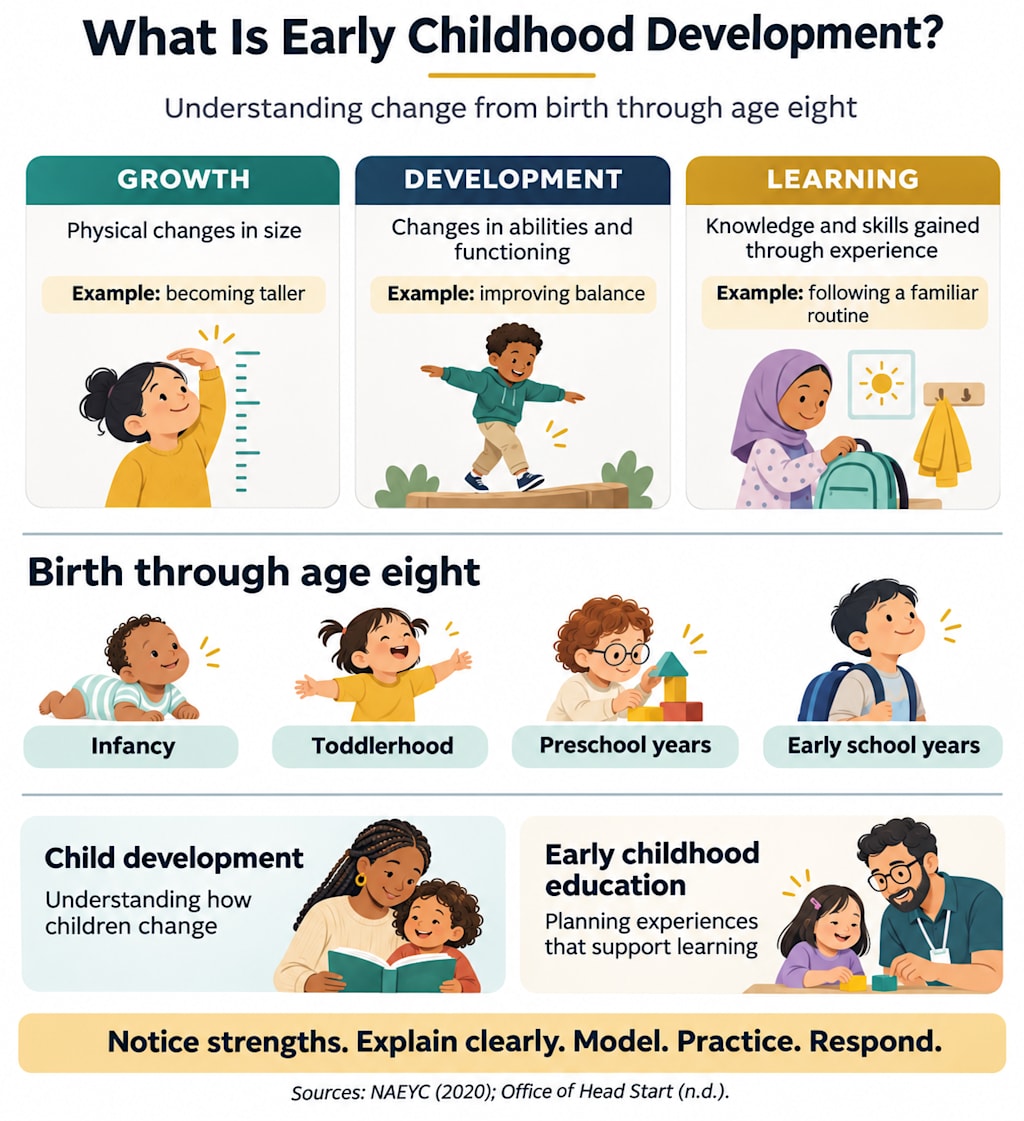
Development, growth, and learning: Three connected ideas
We often use development, growth, and learning interchangeably. For this discussion, it helps to distinguish them.
Growth refers to measurable physical changes, such as becoming taller or gaining body mass. Development is broader, encompassing changes in abilities and functioning over time. Learning involves gaining or changing knowledge, skills, and understanding through experience, practice, and instruction.
Consider a child learning to fasten a coat. Growth affects how the coat fits. Developing coordination influences how the child handles the zipper. Learning includes remembering how to connect the pieces and pull upward. These processes overlap within one familiar task.
The distinction matters because “Try harder” does not tell us what support is needed. A child who cannot grip the zipper may benefit from a larger pull. A child who does not understand the sequence may need another demonstration. A child who can complete the task slowly may simply need more time.
Imagine watching that same child the following week. Instead of asking only whether the coat is fastened, we could notice which part the child completes independently. Perhaps connecting the zipper still requires help, but pulling it upward no longer does. That observation gives us a more precise description of progress.
Looking beyond one visible skill
Children’s experiences rarely involve only one area of development. Head Start’s early learning framework organizes development into five central domains: approaches to learning; social and emotional development; language and literacy; cognition; and perceptual, motor, and physical development (Office of Head Start, n.d.). These categories offer useful ways to organize observations. HeadStart.gov
Picture two children building a pretend bus from chairs. One arranges the seats while the other makes tickets. Their activity might include moving materials, discussing roles, recognizing marks on paper, solving disagreements, and deciding what happens next.
If an adult focuses only on whether they count the tickets correctly, much of the experience goes unnoticed. A fuller observation might reveal that one child explains ideas clearly but needs help sharing materials. The other may negotiate comfortably while needing a model for organizing the seats.
This is where thoughtful planning begins. Before deciding what to teach, we need a clear picture of what the activity asks children to do.
Why everyday conditions matter
Children bring more than their current skills to an experience. Their physical comfort, relationships, and surroundings also deserve attention. The nurturing care framework connects early development with good health, adequate nutrition, responsive caregiving, safety and security, and opportunities for early learning (World Health Organization et al., 2018). who.int
Imagine introducing a sorting activity just before lunch in a noisy room. A child pushes the materials aside. One interpretation is that the child does not understand sorting. Another possibility is that the timing or environment is making participation difficult.
An adult could move to a quieter space, offer the activity later, or begin with fewer objects. These are possible adjustments to try, followed by observation. The purpose is to gather better information before making a judgment about the child.
I find this a useful reminder: the activity we planned and the experience a child actually has may be different. Paying attention to that difference gives us something concrete to improve.
Early childhood begins before preschool
For this article, early childhood includes birth through age eight, consistent with the scope used by the National Association for the Education of Young Children (NAEYC, 2020). This includes infancy, toddlerhood, preschool, and the early school years. NAEYC
Including infancy helps us recognize learning within caregiving. An infant looks toward a sound, reaches toward an object, or makes a noise that receives a response. There may be no lesson plan, but there is an exchange.
The Center on the Developing Child at Harvard University (2017) describes responsive exchanges between children and adults as serve and return. An adult notices a child’s signal and responds, creating an opportunity for continued interaction. Download Resources
For example, a baby looks toward a soft toy. A caregiver notices, brings it within view, and talks about it. The caregiver then pauses and watches. The next response might be a movement, a sound, or a shift in attention.
The practical value of this example is its simplicity. Supporting development can begin with noticing what already has a child’s attention.
Toddlerhood: Making room for supported attempts
Imagine a toddler who wants to pour water independently. Handing over a full, heavy pitcher creates a different task from offering a small pitcher with a little water.
An adult might demonstrate holding the handle, tipping slowly, and stopping before the cup fills. The child then tries while the adult stays nearby. If water spills, the adult can show how to wipe it up.
This example illustrates how to make a task manageable without removing the child’s opportunity to participate. The adult provides a clear starting point, and the child’s attempt reveals what support is needed next.
Perhaps the child understands the sequence but struggles with the pitcher’s weight. Perhaps the pouring motion needs another demonstration. Those observations suggest different responses. Repeating the same instruction louder would provide little additional information.
Preschool: Connecting explanations with meaningful practice
Now imagine a pretend grocery store in a preschool classroom. An adult introduces baskets, play food, signs, and shopping bags. Before children begin, the adult demonstrates one way to sort the food and explains where materials belong.
Children can then choose roles and develop the activity. One might become the cashier; another might organize deliveries. The adult can join briefly to model a useful phrase or help children work through a problem.
NAEYC (2020) describes a continuum that includes self-directed play, guided play, and direct instruction. Effective practice draws on approaches suited to the learning purpose rather than relying exclusively on one end of that continuum. NAEYC
In the grocery store example, a demonstration provides an entry point. The children’s participation gives the adult information about what they understand and where another explanation might help.
The early school years still belong in the picture
Including children through age eight keeps our attention on development after preschool. A classroom may introduce more formal academic tasks, but the practical questions remain familiar: What does this activity require? What does this child already understand? What support will make the next attempt clearer?
Consider a child asked to write about a story. The assignment involves understanding the story, organizing an idea, forming sentences, and managing the physical act of writing. An unfinished page does not explain which part was difficult.
An educator might ask the child to explain the idea aloud, show an example, or help begin the first sentence. Each response addresses a different possible obstacle.
This example also shows why an outcome alone tells an incomplete story. Looking at how a child approaches the task can make the next instructional decision more useful.
Child development and early childhood education
Child development and early childhood education are closely related, but they serve different purposes.
Child development examines how children change and the factors connected with those changes. Early childhood education concerns the intentional organization of care, environments, relationships, and learning experiences.
A developmental question might be, “What abilities are involved in taking turns?” An educational question might be, “How should I introduce and support turn-taking during this activity?”
Imagine children sharing one set of building materials. Knowing that cooperation involves several abilities does not automatically tell the educator what to do. The educator still needs to decide how to explain the routine, model useful language, arrange materials, and respond when difficulties arise.
Developmental understanding informs those choices. Educational planning turns that understanding into something children can experience.
Families contribute essential information to this process. Head Start’s framework recognizes families as children’s primary caregivers, teachers, and advocates (Office of Head Start, n.d.). HeadStart.gov A child who appears unfamiliar with a classroom activity may already perform a similar task at home using different objects or language. Asking about that experience can reveal a better starting point.
Seeing the next step more clearly
Understanding early childhood development changes what we pay attention to. The coat zipper becomes a sequence of actions. The spilled water becomes an opportunity to examine the materials and demonstration. The unfinished page becomes a reason to look more closely at the task.
Adults can begin with a manageable habit: describe what the child actually did before deciding what it means. “She connected the zipper with help and pulled it up independently” offers more useful information than “She cannot dress herself.”
From there, we can select a clear explanation, demonstrate a step, adjust a material, and watch the next attempt. These everyday decisions connect an understanding of development with purposeful support—and give children a clearer path toward increasing independence.
References
Center on the Developing Child at Harvard University. (2017, June 19). 5 steps for brain-building serve and return. https://developingchild.harvard.edu/resources/handouts-tools/5-steps-for-brain-building-serve-and-return/
National Association for the Education of Young Children. (2020). Developmentally appropriate practice: A position statement of the National Association for the Education of Young Children. https://www.naeyc.org/resources/position-statements/dap/contents
Office of Head Start. (n.d.). Interactive Head Start early learning outcomes framework: Ages birth to five. https://headstart.gov/interactive-head-start-early-learning-outcomes-framework-ages-birth-five
World Health Organization, United Nations Children’s Fund, & World Bank Group. (2018). Nurturing care for early childhood development: A framework for helping children survive and thrive to transform health and human potential. World Health Organization. https://www.who.int/publications/i/item/9789241514064
About the Creator
Learning by Design
Instructional Design & eLearning educational articles.
Enjoyed the story? Support the Creator.
Subscribe for free to receive all their stories in your feed.
Comments