
What Are The Vedas? Understanding Hinduism's Ancient Sacred Texts
Join us as we delve into the significance of the Vedas and their timeless role in guiding spiritual knowledge and practice.

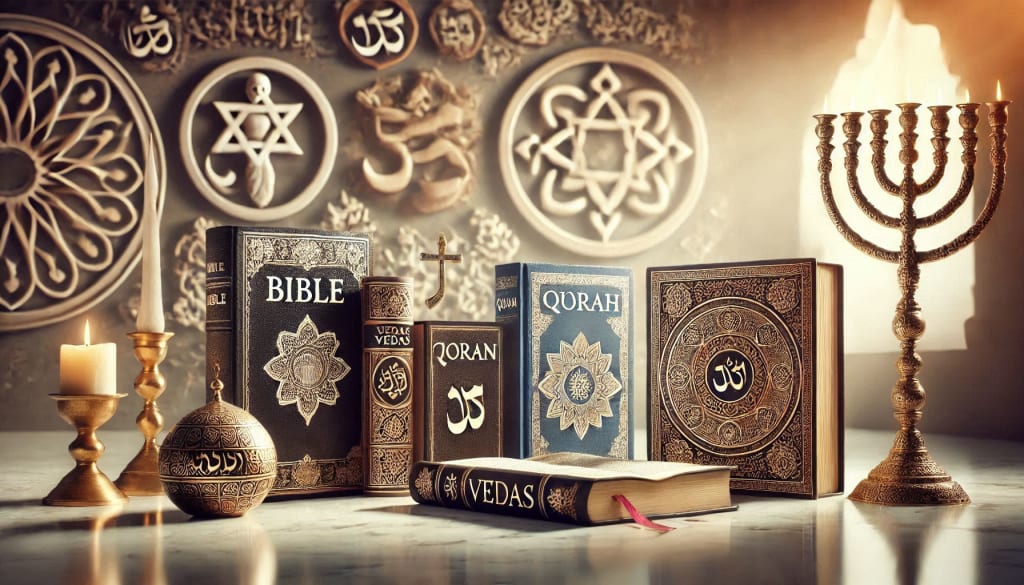
In every religion, there is a sacred book that is highly respected, like the Bible in Christianity. So, what is the sacred book of Hinduism? What is the Bible of Hinduism?
Just like when you get a machine, you have a manual that explains how to use it, similarly God has sent us into this world, and He has the manual, which is the sacred book, right? And then there are the teachers, who are the prophets who came down.
The Sacred Book of Hinduism
Religious traditions around the world have their sacred books. Christianity has the Bible, Islam has the Quran, Judaism has the Torah, Confucianism has their own, Taoism has the Tao Te Ching, Sikhism has the Guru Grantha Sahib, Buddhism has the Tipi Takas, the three baskets of knowledge, and similarly, the Parsees have their own, the Zend Avesta.
So, what is the book of the Hindus? The book of the Hindus is the Vedas, and this is based on a very subtle concept according to Hindu philosophy: knowledge is eternal, divine knowledge, just like God is eternal, His knowledge is also eternal. Ever since God has existed, His knowledge has existed.
So, to say that there is a holy book that exists from such and such a period in time seems a little illogical. What about the people who came before that?
They had no access to being saved. If there is a sacred book that is the basis of being saved, then what about the people who came before that? Right, so there must be some knowledge that has existed ever since God has existed. Our scriptures say that eternal knowledge of God is the Vedas.
The Nature of the Vedas
The Vedas were not the name of a book; they referred to God's knowledge. Every time God engages in creation, He manifests that knowledge, and that knowledge would come down through the ears.
The Guru would speak it to his disciple, the disciple would hear it and pass it on to his disciple. That is how the Vedas were coming down, and since they were coming through the ears, and the ear is called "Shruti," hence another name for the Vedas is Shruti.
Also Read : How Many Times to Chant Gayatri Mantra
Veda Vyasa and the Written Vedas
However, 5,000 years ago, Veda Vyasa, who was an avatar of God Himself, felt that the people of Kali Yuga would not be Shruti-dhari, they would not have the capacity to hear and remember.
So, He put that knowledge into a book, He wrote it down, and that became the physical Vedas. That is the Bible of Hinduism, the physical Vedas.
The Eternal Vedas
The world says that the most ancient scripture in history is the Vedas. But we say, no, that's an inaccurate statement. Don't say "most ancient," that means it had a beginning.
This is the eternal scripture that has ever existed, and that is why what the Vedas are explaining is not Hinduism as such. The word Hinduism came up later in history; it was a name that was given when the invaders came to conquer India.
All those who were on this side of the Hindu Kush were called Hindus, but the word Hinduism is not there in the Vedas. They talk about Sanatana-Dharma, the eternal religion, the eternal principles, the internal science of how to purify yourself, how to elevate yourself. That is Sanatana-Dharma, and that is now loosely being called Hinduism.
Respecting All Sacred Texts
So, you have holy books in all the other traditions, and we respect all of them because the same truth is being explained by the great prophets.
In the Hindu mind, we respect all the scriptures, we respect knowledge, we respect spirituality, and devotion wherever we see it. But at the same time, we must understand the specialty of our own tradition.
Now, how did the Bible come about? After Christ, many of His disciples wrote Testaments, and there were about 50 different Testaments, about 50!
So, two hundred years after Christ, by the throw of dice, four of them got selected, these were the Bible by Matthew, Luke, John, and Mark, and on the basis of that, the New Testament got created.
If you see in the Buddhist tradition, five hundred years after the Buddha, His teachings were compiled and put in the form of a book.
But still, we respect them as books of knowledge, and in the Vedas, this is the eternal knowledge of God, and hence it is the authority on which principles or spiritual principles are determined.
The Authority of the Vedas in Hinduism
So, every Acharya in Hinduism, every writer, has accepted the Vedas as authority and then expounded that in their own writings. So, if Tulsidas writes the Ramayan, he says, "I'm writing it in accordance with the Vedas." If Veda Vyasa writes the Bhagwat, he says, "I am writing on the authority and testimony of the Vedas." That creates a body of scriptures called Vedic literature, which is the basis of knowledge in our Hindu tradition.
About the Creator
Rahul Prabhakar
I specialize in writing articles on education and technology, creating content that caters to anyone eager to learn and deepen their understanding.
Enjoyed the story? Support the Creator.
Subscribe for free to receive all their stories in your feed.
Comments
There are no comments for this story
Be the first to respond and start the conversation.