
WHAT ARE THE BLACK HOLES?
"Exploring the Mysteries of the Universe's Dark Abyss: Black Holes Unveiled"
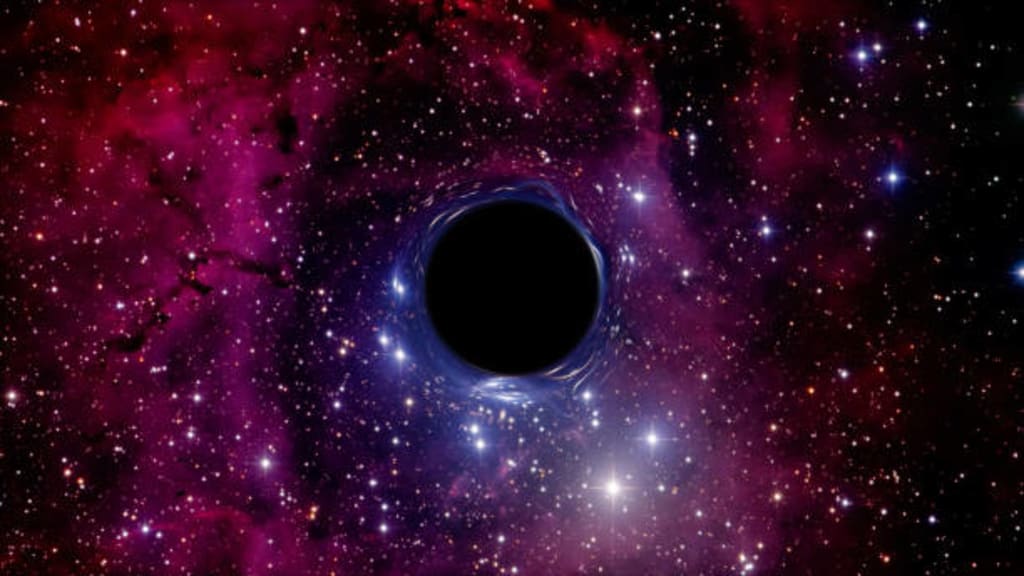
Black Holes: Explaining the Fascinating Phenomenon Made of Matter
Black holes are one of the most fascinating phenomena in the universe. They are mysterious objects that defy our understanding of the laws of physics and are made of matter. In this article, we will explore what black holes are, how they are formed, and what makes them so fascinating.
What are black holes?
Black holes are regions in space where gravity is so strong that nothing, not even light, can escape. They are called "black" because they do not emit any radiation that can be detected by telescopes. The only way we can detect a black hole is by observing its effects on nearby matter, such as stars or gas clouds.
How are black holes formed?
Black holes are formed when massive stars run out of fuel and collapse under their own gravity. When a star collapses, its outer layers are blown off into space, leaving behind a small, extremely dense core. If the core is more massive than about three times the mass of the sun, the gravity is strong enough to create a black hole.
There are also supermassive black holes that are found at the centers of galaxies. These are thought to be formed by the merging of multiple smaller black holes or by the collapse of massive clouds of gas early in the universe's history.
What makes black holes so fascinating?
Black holes are fascinating for several reasons. First, they are some of the most extreme objects in the universe. The gravity near a black hole is so strong that it distorts space and time, causing bizarre effects such as time dilation and gravitational lensing.
Second, black holes challenge our understanding of the laws of physics. They seem to violate some of the fundamental principles of physics, such as the conservation of information. According to current theories, any matter that falls into a black hole is lost forever, and the information it contained is destroyed.
Finally, black holes are also fascinating because they are a window into the history of the universe. By studying the effects of black holes on nearby matter, we can learn about the conditions in the early universe and how galaxies and stars formed.
In conclusion, black holes are fascinating objects made of matter that challenge our understanding of the laws of physics. They are formed when massive stars collapse under their own gravity and are some of the most extreme objects in the universe. While there is still much we don't know about black holes, they offer a tantalizing glimpse into the history of the universe and the mysteries that await us.
Properties of Black Holes
One of the most intriguing properties of black holes is their event horizon. The event horizon is the point of no return, where the gravitational pull of the black hole is so strong that nothing can escape, not even light. Another interesting property is the Hawking radiation, which is a theoretical process where black holes emit radiation and eventually evaporate over an extremely long period of time.
Black holes also have a significant effect on the space and time around them. They warp the fabric of space-time, causing it to curve and stretch in bizarre ways. This effect is known as gravitational lensing and can be used by astronomers to observe distant objects in the universe.
Conclusion
Black holes are some of the most fascinating and mysterious objects in the universe. They are formed from the collapse of massive stars and have incredibly strong gravitational fields that warp space and time. While much is still unknown about black holes, they continue to captivate scientists and the general public alike.
About the Creator
Enjoyed the story? Support the Creator.
Subscribe for free to receive all their stories in your feed.
Comments
There are no comments for this story
Be the first to respond and start the conversation.