
What are the best websites for transcription practice?
Practice smarter with transcription platforms that help you improve accuracy, speed, and listening skills.
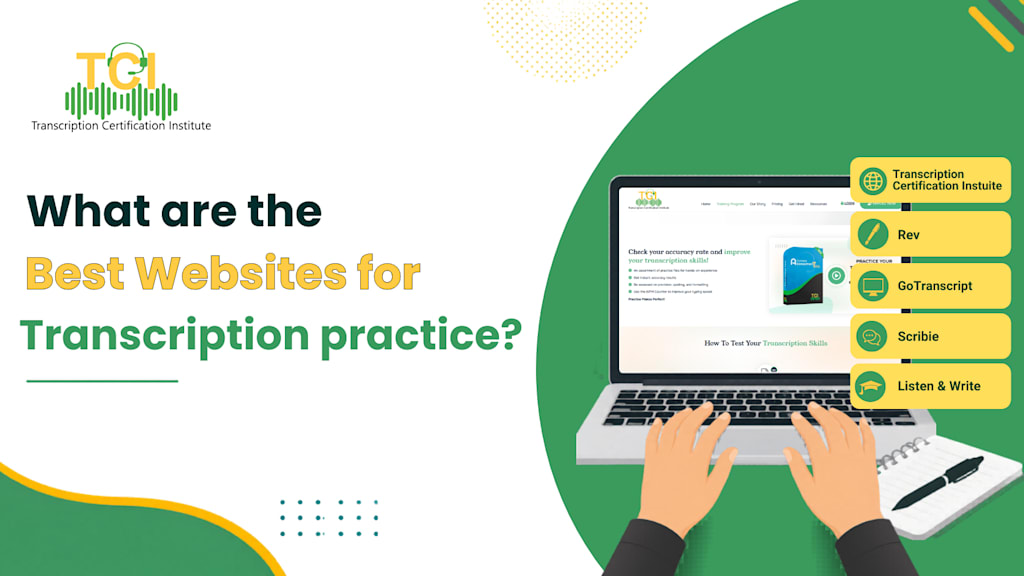
So you want to become a transcriptionist - or maybe you already are one, and you're trying to pass that dreaded accuracy test before landing a better-paying gig. Either way, you've probably realized that typing fast isn't enough. You need practice. Real, structured, feedback-driven practice.
The good news? There are some genuinely excellent free (and affordable) resources out there. Here's a breakdown of the best websites for transcription practice, including what makes each one worth your time.
1. Transcription Certification Institute - Best for Structured Skill Assessment
If you're serious about transcription, TCI's free Accuracy Assessment Tool is one of the most practical resources available. It doesn't just let you practice - it grades you.
Here's how it works: you choose from a library of practice audio files (with varying accents, pacing, and audio quality), transcribe them, then upload your work to get instant accuracy feedback. The tool compares your transcript side-by-side with the correct version and evaluates your spelling, formatting, punctuation, and precision. There's also a built-in WPM (Words Per Minute) counter, so you can track your typing speed over time.
Why it stands out: The first three practice tests are completely free, and the feedback is automated and immediate. No waiting, no subjectivity. The audio files are deliberately diverse - because in real transcription work, you rarely get a perfect studio recording with a single clear speaker.
Best for: Beginners preparing for platform entry tests (Rev, GoTranscript, TranscribeMe), and anyone who needs objective data on where they're going wrong.
Pro tip from TCI: Use high-quality headphones, work in a quiet space, avoid constant pausing to build real-time transcription stamina, and always proofread before submitting. If something is genuinely unclear, use tags like [inaudible] rather than guessing.
2. Rev - Best for Learning Real-World Standards
Rev is a well-known transcription platform, and it can also be a useful resource for improving your transcription skills. Their public style guide is widely respected and helps beginners understand formatting, grammar, speaker labeling, timestamps, and accuracy expectations used in professional transcription work.
Simply studying the guide can improve your understanding of real-world transcription standards.
Rev’s entry test is also a strong way to measure your skills. Even if you don’t plan to work with them, attempting their qualification test can help you evaluate your speed, listening ability, and overall accuracy against professional-level expectations.
3. GoTranscript - Best for Challenging Audio Variety
GoTranscript is another major transcription platform that offers a qualification test as part of its hiring process. Their audio files tend to be more challenging than some competitors - multiple speakers, background noise, heavy accents - which makes them excellent practice material even if you're not applying.
Their style guidelines are also worth studying. GoTranscript uses a slightly different format than Rev, which is a good reminder that professional transcriptionists need to be flexible and style-guide-aware.
4. Scribie - Best for Beginners Who Want to Earn While They Learn
Scribie has a lower barrier to entry than most platforms, making it a good option if you want to practice with real audio files and get paid a modest amount at the same time. Their three-step grading process (transcribe, self-review, peer review) is also educational - you'll learn a lot from having your work evaluated by others.
The pay is low at entry level, but treat it as paid practice and it makes more sense.
5. YouTube + A Text Editor - The Underrated Free Method
This one surprises people, but it works. Find interviews, podcasts, lectures, or documentaries on YouTube - especially ones without auto-generated captions, or with poor ones - and transcribe them manually. Then compare your work to the auto-generated transcript (or a manually uploaded one if available).
Why does this work? You get exposure to every imaginable audio quality, accent, subject matter, and speaking style. It's completely free. And you can choose content in your area of interest or expertise, which accelerates learning.
Pair this with a free tool like oTranscribe (otranscribe.com), which lets you control audio playback with keyboard shortcuts while typing in the same window. It's a simple but effective setup.
6. Typesy or Keybar - For the Typing Speed Problem
If your accuracy is fine but your speed is holding you back, the bottleneck might not be transcription-specific at all - it might just be typing. Sites like Keybr (keybr.com) use adaptive exercises to build muscle memory for weak keys, while Typesy offers structured touch-typing courses.
A comfortable baseline for most transcription jobs is around 60 WPM with high accuracy. If you're below that, dedicating a few weeks to typing drills before focusing on audio practice will pay dividends.
A Few Things That Separate Okay Transcriptionists from Great Ones
Once you've been practicing for a while, the gap between average and excellent usually comes down to a few habits:
- Learning style guides deeply. Clean verbatim and full verbatim are different. Legal transcription has different rules than general transcription. Medical transcription has its own world entirely. Know which format you're working in and follow it religiously.
- Building ear training, not just typing speed. The ability to hear a mumbled word, a dropped syllable, or a heavily accented phrase correctly - that's a skill you develop over time. It's not just about typing fast; it's about listening well.
- Proofreading every single time. Even experienced transcriptionists make mistakes. A final read-through catches them. Most quality platforms will penalize you for errors that a two-minute proofread would have caught.
- Consistency under fatigue. Real transcription work is repetitive. Your accuracy at minute 5 of a file and minute 45 should be the same. That takes practice and focus discipline.
Final Thoughts
The best transcriptionists aren't just fast typists - they're precise listeners, careful editors, and format-aware professionals. The websites above give you the tools to become all three.
Start with TCI's free practice tool to get a baseline on your accuracy. Use GoTranscript and Rev's style guides as your formatting bibles. Practice on real audio from YouTube when you want variety. And track your WPM so you know where you stand.
Progress in transcription is measurable. That's one of the best things about it. Put in the practice hours with the right resources, and the improvement will show up in your scores.
About the Creator
Mahesh Kumar
Representing Transcription Certification Institute, a Nashville, TN, based company that provides comprehensive online general transcription training certification courses.
Enjoyed the story? Support the Creator.
Subscribe for free to receive all their stories in your feed.
Comments
There are no comments for this story
Be the first to respond and start the conversation.