
What Are the 5 Pillars of Islam? A Clear Simple Guide for Every Muslim
Understanding Shahada, Salah, Zakat, Sawm and Hajj in plain language with the reasons behind each one
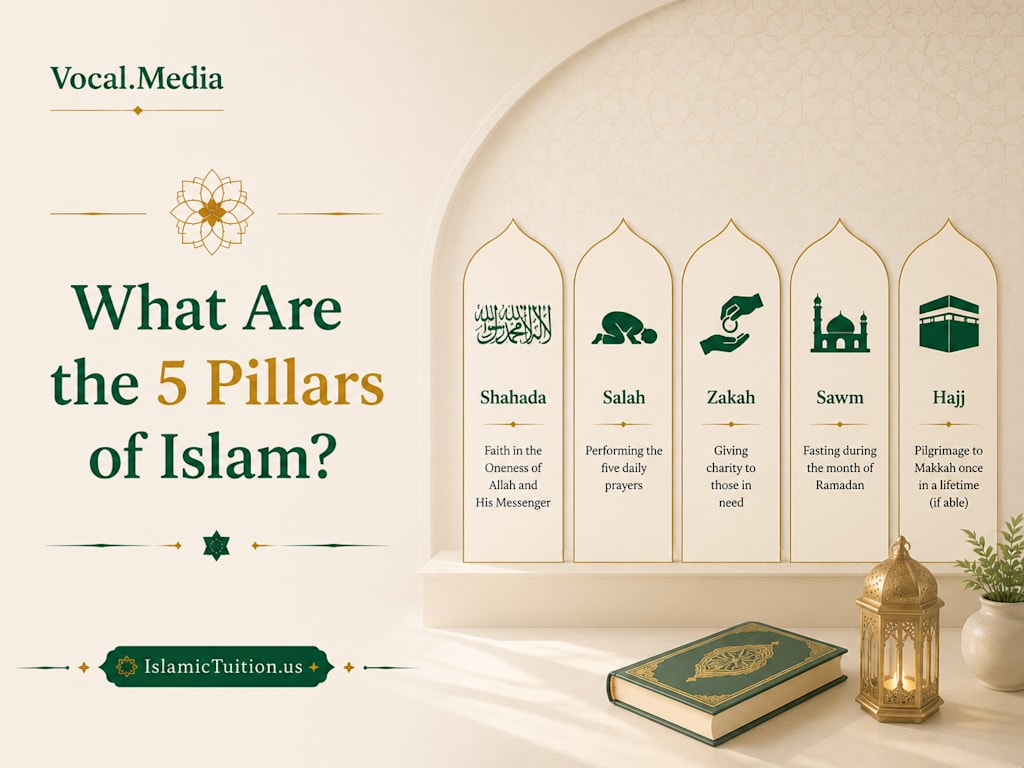
The 5 Pillars of Islam are the five core acts of worship that form the foundation of a Muslim's religious life. They are called pillars because, like the pillars of a building, they hold everything up. Remove one and the structure is incomplete. Together they cover belief, worship, giving, fasting, and pilgrimage, five different dimensions of a Muslim's relationship with Allah SWT.
In Arabic they are known as Arkan al-Islam. Every Muslim regardless of background, culture, or school of thought recognises these five as the fundamental obligations of Islamic practice. Understanding them clearly, not just naming them, is what connects practice to meaning.
Pillar 1: Shahada - The Declaration of Faith
The Shahada is the testimony that there is no god worthy of worship except Allah and that Muhammad ﷺ is His messenger.
Ash-hadu an laa ilaaha ill-Allah, wa ash-hadu anna Muhammadan rasool-Allah.
This is both the entry point into Islam and its daily foundation. A person becomes Muslim by sincerely declaring the Shahada with understanding. But it is not just a one-time declaration. It is recited in the Adhan five times daily, repeated in every Salah, and returns to the believer throughout their life as the anchor of everything they believe and practice.
The Shahada has two parts. The first affirms Tawheed, the absolute oneness of Allah, with no partners, no equals, and nothing comparable. The second affirms Prophethood, that Muhammad ﷺ was Allah's final messenger whose teachings, preserved in the Quran and Sunnah, guide every aspect of a Muslim's life.
Pillar 2: Salah -The Five Daily Prayers
Muslims pray five times every day at fixed times: Fajr before sunrise, Dhuhr at midday, Asr in the afternoon, Maghrib at sunset, and Isha at night.
Each prayer involves a specific sequence of standing, bowing, and prostrating, accompanied by recitation of Surah Al-Fatiha, other Quranic verses, and specific supplications. The prayer begins with Wudu, ritual purification of the hands, face, arms, head, and feet, and faces the direction of the Kaaba in Makkah.
Salah is described as the pillar of Islam, the act of worship that holds everything else in place. The Prophet ﷺ said that the first thing a person will be asked about on the Day of Judgment is their Salah. Teaching children Salah practically from age 7, as the Prophet ﷺ instructed, gives them a habit of connection to Allah that shapes every other Islamic practice.
Pillar 3: Zakat - Obligatory Charity
Zakat is the annual obligation to give 2.5% of qualifying savings held above a minimum threshold (Nisab) to specific categories of recipients defined in the Quran. It applies to savings, gold, silver, and certain business assets held for one full lunar year.
The word Zakat means purification and growth. Giving Zakat purifies the wealth that remains by acknowledging that a portion of it belongs to those in need, and purifies the heart from the attachment to material possession that the Quran warns against repeatedly.
Zakat recipients are specified in Surah At-Tawbah (9:60): the poor, the destitute, those in debt, travellers in need, and several other categories. This specificity ensures that Zakat functions as a structured wealth redistribution system, not simply an act of optional generosity.
Pillar 4: Sawm - Fasting in Ramadan
During the month of Ramadan every adult Muslim who is healthy and able fasts from the time of Fajr to Maghrib, abstaining from food, drink, and marital relations during the daylight hours.
Ramadan is the month in which the Quran was revealed, as confirmed in Surah Al-Baqarah (2:185). It is a time of intensified worship, extended Quran recitation, increased charity, and spiritual reflection. Many Muslims aim to complete a full reading of the Quran during this month, something that this guide on [How Long Does It Take to Memorize the Quran](link to article 3) connects to in practical terms.
The fast concludes with Eid al-Fitr, one of the two major Islamic celebrations, marked by special prayer, feasting, giving of Fitrana (a small obligatory charity), and community celebration.
Children begin learning about Sawm from an early age, often keeping partial fasts as they grow toward the age at which fasting becomes obligatory at puberty.
Pillar 5: Hajj - The Pilgrimage to Makkah
Hajj is the pilgrimage to Makkah performed once in a lifetime by every Muslim who is physically and financially capable. It takes place during the Islamic month of Dhul Hijjah and involves a specific set of rituals over five days, tracing the footsteps of Ibrahim ﷺ and his family.
Over two million Muslims from every country in the world perform Hajj together each year, the largest annual gathering of people on earth for a single unified purpose. The experience of standing at Arafat, the plain outside Makkah, alongside millions of fellow Muslims from every background, language, and nationality, is described by almost every Hajji as the most powerful experience of their life.
Hajj concludes with Eid al-Adha, the second major Islamic celebration, commemorating Ibrahim's ﷺ willingness to sacrifice his son in obedience to Allah SWT.
Teaching the Five Pillars to Children
Understanding the five pillars as a connected system rather than five separate obligations changes how they are experienced. Shahada gives the reason, we worship Allah because He alone deserves it. Salah is how we worship daily. Zakat is how we worship through what we own. Sawm is how we worship through what we consume. Hajj is the physical journey that unites the entire Ummah.
About the Creator
Muhammad
Senior Educator & Operations Manager at Islamic Tuition | Dedicated to student success | Creating meaningful Islamic learning experiences, one student at a time
Enjoyed the story? Support the Creator.
Subscribe for free to receive all their stories in your feed.
Comments
There are no comments for this story
Be the first to respond and start the conversation.