
Understanding How People Learn: The Role of Learning Theories in Instructional Design
Exploring how behaviorism, cognitivism, and constructivism shape the way we teach, learn, and design meaningful educational experiences.

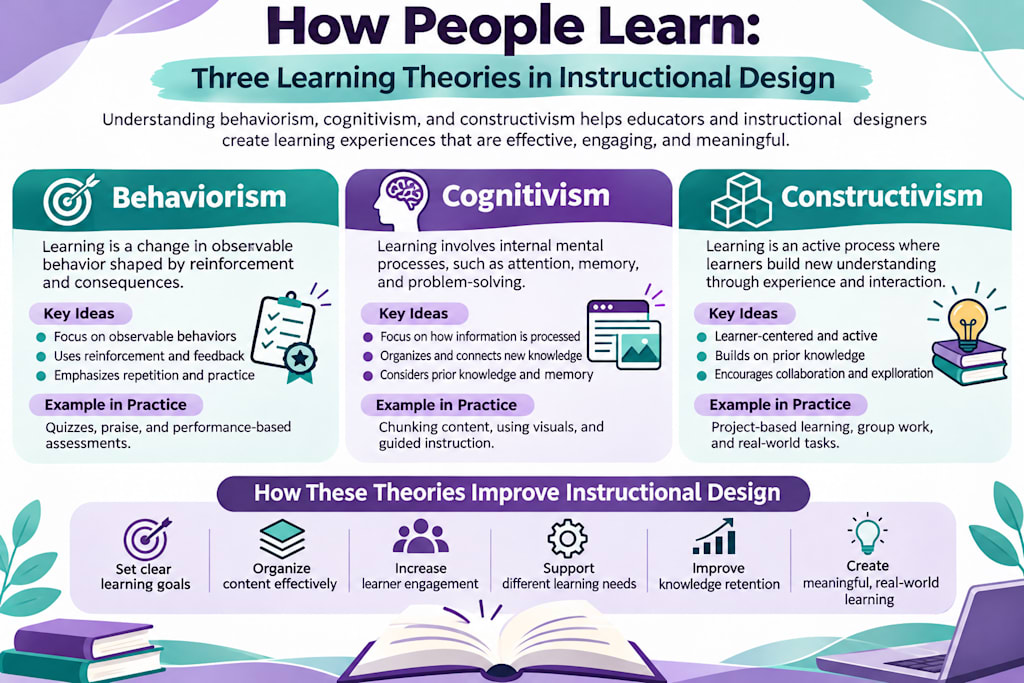
Education is more than presenting information and expecting someone to understand it. There is a process to learning that involves how people respond to instruction, process information, and draw on their experiences to develop knowledge. For instructional designers, understanding this process is important because the way information is presented can influence how successfully someone learns.
I have always believed that when someone is learning something unfamiliar, they need a foundation to build upon. Explain the information, demonstrate what needs to be done, and provide opportunities to practice. As learners become more comfortable, they can begin to make connections, solve problems, and apply what they know independently.
This perspective connects with three major educational learning theories: behaviorism, cognitivism, and constructivism. Although each theory approaches learning differently, understanding their purposes can help instructional designers make better decisions about how learning experiences should be developed.
Behaviorism: Establishing a Foundation Through Structure
Behaviorism focuses on observable behaviors and how they are influenced by environmental conditions, reinforcement, and consequences. From this perspective, learning can be demonstrated through changes in performance or behavior (University of Phoenix, n.d.).
Of the three theories, behaviorism most closely reflects my preferred approach to introducing unfamiliar information. I believe learners benefit from knowing what is expected before they are asked to demonstrate a skill.
Consider an employee learning a new workplace procedure. The trainer explains the process, demonstrates each step, and provides an opportunity for guided practice. As the employee performs the procedure, feedback helps reinforce correct actions and identify mistakes that need correction.
This approach provides structure while allowing learners to develop confidence through repetition and practice.
However, observable performance does not always tell us whether someone fully understands the information. A learner may successfully repeat a procedure without understanding why each step matters. This is where another learning theory becomes valuable.
Cognitivism: Understanding What Happens During Learning
Cognitivism examines the mental processes involved in learning, including attention, memory, information processing, and problem-solving. Unlike behaviorism, which emphasizes observable performance, cognitivism considers how learners organize and connect information internally (University of Florida, n.d.).
This theory adds an important element to instructional design because completing a task correctly is only one part of learning. Learners also need to understand the information well enough to remember and apply it later.
For example, imagine an online training module that introduces employees to several unfamiliar procedures at once. Even when the information is accurate, presenting too much content without organization can make the experience difficult to follow.
An instructional designer can address this by dividing information into manageable sections, using relevant visuals, explaining unfamiliar terminology, and connecting new concepts to previous knowledge.
I find this especially important when designing instruction for beginners. Someone encountering a subject for the first time may not have the background knowledge needed to make sense of complex explanations. Providing a clear introduction and gradually building upon it creates a more manageable learning experience.
Cognitivism reminds us that instructional design should consider not only what learners need to know but also how the information is organized and processed.
Constructivism: Building Knowledge Through Experience
Constructivism emphasizes the active role learners play in developing understanding. Rather than viewing knowledge as something simply transferred from instructor to learner, constructivism recognizes that people interpret new information through their existing knowledge and experiences (University of California, Berkeley, n.d.).
This theory introduces opportunities for exploration, reflection, problem-solving, and real-world application.
For example, after learning the steps involved in resolving a customer service issue, employees might work through a realistic scenario. They must evaluate the situation, determine which procedures apply, and explain their decisions.
The activity allows learners to move beyond following instructions and begin applying their knowledge.
Although I recognize the value of constructivism, I believe the amount of independence learners receive should depend on their familiarity with the subject.
Asking someone to solve an unfamiliar problem without first establishing a foundation can create unnecessary confusion. I prefer an approach where learners receive instruction and demonstrations before moving into activities that require independent decisions.
Constructivism becomes particularly valuable when learners have enough foundational knowledge to explore different situations and develop their own understanding.
Bringing the Three Theories Together
Understanding these learning theories has reinforced an important principle in my approach to instructional design: different instructional strategies serve different purposes.
Behaviorism helps establish expectations and reinforce performance. Cognitivism supports understanding, organization, and memory. Constructivism provides opportunities to develop knowledge through experience and application.
The University of Florida (n.d.) discusses how learning theories can inform instructional decisions, reinforcing the importance of selecting strategies that align with the intended learning experience.
Rather than treating the theories as competing approaches, I see opportunities to use them together.
Imagine developing a training program for employees learning a new software system.
The instruction might begin with clearly defined objectives and a demonstration of the required procedures. Employees then complete guided exercises and receive feedback on their performance. These activities reflect behaviorist principles.
Next, the instructional materials organize information into manageable sections, introduce terminology, and explain how different functions within the software relate to one another. These strategies support cognitive processing.
Finally, employees complete realistic scenarios requiring them to select appropriate functions, identify errors, and solve problems independently. This creates an opportunity for constructivist learning.
Each stage supports a different part of the learning process while contributing to the same instructional goal.
Improving Educational Practices Through Learning Theory
One of the most important responsibilities of an instructional designer is determining how to make learning accessible, understandable, and applicable.
Understanding learning theories provides a foundation for making those decisions.
It also encourages designers to consider the learners themselves. Someone with previous experience may be prepared for independent problem-solving, while a beginner may need additional explanations, demonstrations, and guided practice.
This does not mean every learner requires an entirely different course. Instead, instructional designers can develop learning experiences that provide appropriate support while allowing learners to progress toward greater independence.
For me, effective instructional design begins with clarity. Learners should understand what they are expected to accomplish, why the information matters, and how they can apply it.
As their knowledge develops, instructional activities can become more challenging and require greater independence.
Final Thoughts: Designing With Purpose
Learning theories offer more than explanations of how people learn. They provide instructional designers with different ways to examine the decisions they make when developing educational experiences.
Behaviorism emphasizes the importance of observable performance and reinforcement. Cognitivism explains the role of mental processing and memory. Constructivism recognizes the importance of experience and active knowledge development.
My approach to education continues to center on providing a clear foundation before expecting independent performance. However, understanding these theories has strengthened my appreciation for balancing direct instruction with opportunities for learners to think, practice, and apply knowledge.
Ultimately, effective instructional design is not about selecting one theory and applying it to every situation. It is about understanding the purpose of each approach and choosing instructional strategies that help learners progress from unfamiliar information to meaningful understanding and independent application.
References
University of California, Berkeley. (n.d.). Learning theory overview. Graduate Student Instructor Teaching & Resource Center. https://gsi.berkeley.edu/gsi-guide-contents/learning-theory-research/learning-overview/
University of Florida. (n.d.). Applying learning theories. Center for Instructional Technology and Training. https://citt.it.ufl.edu/resources/course-development/the-learning-process/applying-learning-theories/
University of Phoenix. (n.d.). Educational learning theories. https://www.phoenix.edu/articles/education/educational-learning-theories.html
About the Creator
Learning by Design
Instructional Design & eLearning educational articles.
Enjoyed the story? Support the Creator.
Subscribe for free to receive all their stories in your feed.
Comments