
Top Law Colleges in India in 2026
Explore the Best Law Schools, Rankings, Courses, Fees, and Career Opportunities
Introduction
If you are planning to move in the law carrier it will be necessary first to select a good college. moot courts, internships, legal aid clinics, research opportunities, and campus placements should be integral parts of a law college. Luckily we have many colleges that have collaborations with industries.
Prior to deciding a college it is necessary to know what courses the college assists.
Here we are going to see in detail what should be the parameters to be known prior to applying..
What makes a law college perfect?
The best law colleges typically provide a combination of curriculum quality and practical education. When you are comparing two organizations what to look at:
- Professional experience
- Specialized academics
- Moot court competitions
- Internship scopes
- Placement records
- Research centres
- International collabs
- Alumni network
- Campus infrastructure
These things contribute significantly to your legal education and career prospects.
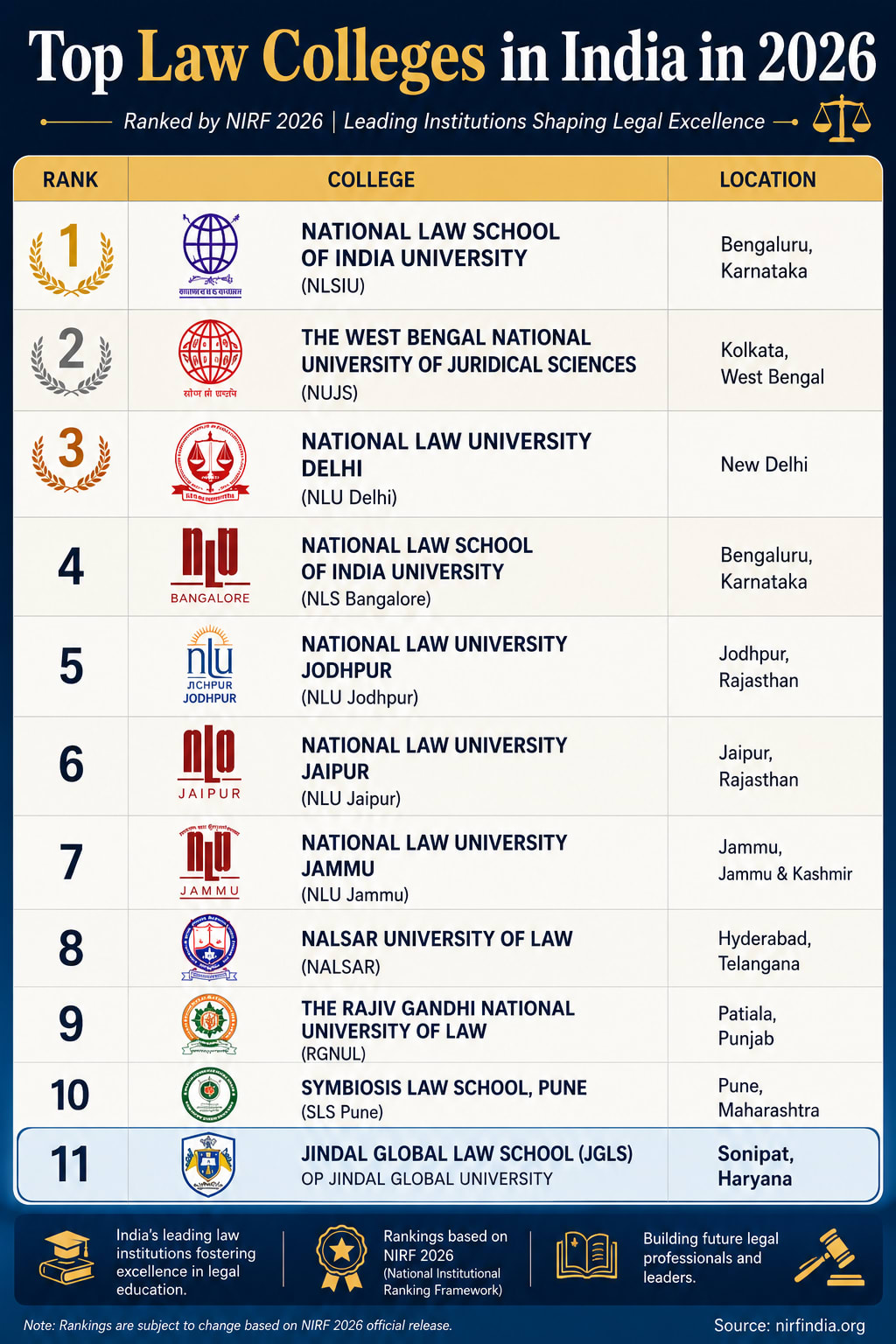
Leading Law Colleges in India
National Law School of India University , Bengaluru
Established in 1987, NLSIU is among India's most respected law schools. It consistently ranks among the leading schools for legal education and is known for its rigorous academic efforts.
Popular Courses
- BA
- LLB
- LLM
- PhD
Admission
Through the Common Law Admission Test .
NALSAR University of Law in Hyderabad
There is a lot of scope for a career given with the courses in this university. Students benefit from extended moot court participation and internship programmes.
Popular Courses
- BA LLB
- LLM
- PhD
Admission
CLAT
The West Bengal National University of Juridical Sciences , Kolkata
WBNUJS has created a strong reputation for legal research and corporate law education. The school also maintains collaborations with international organizations.
Popular Courses
- BA LLB
- LLM
Admission
CLAT
Gujarat National Law University , Gandhinagar
GNLU offers a wide range of interdisciplinary legal programmes and inspires research through particular centers.
Popular Courses
- BA LLB
- BCom LLB
- LLM
Admission
CLAT
National Law University, Delhi
Unlike most National Law Universities, NLU Delhi conducts its own entrance exam, the All India Law Entrance Test .
The university is considered for constitutional, criminal law, and policy research.
Popular Courses
- BA LLB
- LLM
- PhD
Admission
AILET
Jindal Global Law School
Jindal Global Law School , a constituent school of O.P. Jindal Global University , is one of India's leading private law schools. Known for its interdisciplinary curriculum, distinguished faculty, global partnerships, and research-driven approach, JGLS provides students scopes to participate in moot court competitions, legal aid clinics, internships, and international exchange programmes. The school offers an infrastructure that graduates for careers in corporate law, litigation, public policy, academia, and beyond.
Popular Courses
- BA LLB
- BBA LLB
- LLB
- LLM
- PhD
Admission
Admission is based on the university's prescribed process. Applicants should refer to the official JGLS website for the latest eligibility criterion and admission particulars.
Symbiosis Law School, Pune
Symbiosis Law School combines academic learning with practical training. It provides modern facilities and a number of opportunities for competitions, internships, and legal research.
Admission
SLAT
Faculty of Law, University of Delhi
The Faculty of Law at the University of Delhi has educated many different legal professionals. It is particularly known for its three-year LLB programme and experienced professionals.
Christ University, Bengaluru
Christ University provides current legal education with an importance on research, ethics, and practical learning through internships and legal aid programs.
UPES School of Law, Dehradun
UPES integrates legal education with specialised fields such as energy, corporate and technology law, providing students with industry-focused learning.
Eligibility Criteria
Eligibility varies depending on the programme.
For integrated law programmes:
- Completion of Class 12 from a recognised board.
- Satisfying the minimum percentage required by the institution.
- Passing the required entrance exam.
3-year LLB:
- Bachelor's degree from a renowned college.
- School-specific requirements.
Entrance Examinations for Law
Some of the main entrance exams include:
- CLAT
- AILET
- SLAT
- LSAT
- State-level law exam
Applicants should always visit college websites before applying.
Career Chances After Learning Law
Graduates who pass out from a reputed college can have carrier in::
- Corporate law
- Litigation
- Judiciary
- Legal consulting
- Public policy
- Intellectual property law
- Cyber law
- Human rights law
- Legal journalism
- Academia
- Civil services
India is demanding a new set of people who are great law professionals.
Conclusion
If you are looking for one of the important law colleges in India, only rankings won't help. You need to check whether it can take you towards your goals. Your good career in law will start with passing the entrance exam.
About the Creator
Enjoyed the story? Support the Creator.
Subscribe for free to receive all their stories in your feed.
Comments
There are no comments for this story
Be the first to respond and start the conversation.