
TOP 10 Web Development Frameworks and Libraries for 2025
Explore the Leading Web Development Frameworks and Libraries Shaping the Future in 2025

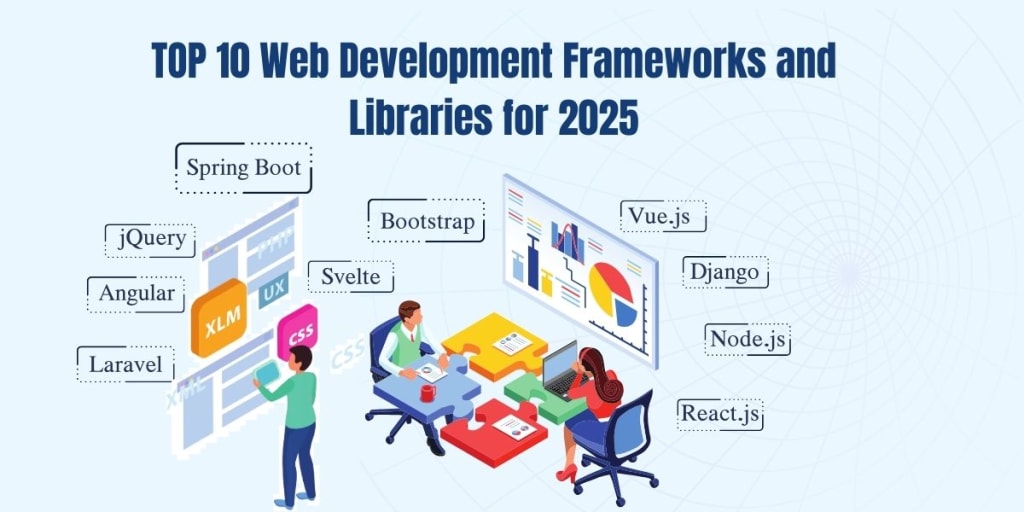
When you visit a website, you might not think about how it’s built. You just enjoy how it looks and works. Whether you're shopping online, reading blogs, booking a hotel, or scrolling through social media, there’s a lot happening behind the scenes to make sure everything works smoothly. The design, buttons, and features you see are all part of the front end, while the things that make the website run fast and secure are part of the back end.
This is where web development frameworks and libraries come in. Think of a framework as a toolkit that helps developers build a website quickly and efficiently. It gives them a structure to follow. Libraries are collections of pre-written code that developers can use to add special features to a website, like animations or form validations, without starting from scratch. These tools save time, improve performance, and ensure websites are secure and user-friendly.
In this article, we will talk about the top 10 web development frameworks and libraries that developers will use the most in 2025. We will explain what makes each of them special, how they help developers, and why they are important for creating fast and user-friendly websites. This guide will help you understand why these tools are great for modern web development.
1. React.js: The Most Popular JavaScript Library
React.js has been the go-to library for front-end development for many years, and it will continue to dominate in 2025. Created by Facebook, React.js helps developers build interactive user interfaces (UIs) quickly. It uses a component-based approach, which means developers can build small, reusable pieces of code (components) and put them together to create complex UIs.
One of the key reasons for React.js's popularity is its ability to create single-page applications (SPAs) that provide a smooth user experience without reloading the page. Developers love React.js because it is fast, reliable, and has a huge community for support.
2. Angular: A Full-Fledged Framework for Enterprise Applications
Developed by Google, Angular is a powerful front-end framework for building large-scale applications. It offers everything a developer needs to create complex apps, from data binding and dependency injection to form validation and routing.
Angular is widely used for building enterprise-level applications due to its ability to handle large amounts of data and complex user interactions. In 2025, Angular will continue to be a top choice for companies looking for a robust solution for their web applications.
3. Vue.js: A Lightweight Framework for Simplified Development
If you are looking for a lightweight yet powerful framework, Vue.js is the one to consider. Vue.js offers a smooth learning curve, making it a favorite for beginners and experienced developers alike. It allows for easy integration with existing projects and provides a flexible architecture that simplifies the development process.
Vue.js is known for its simplicity, performance, and ease of integration with other libraries or existing projects. It’s an excellent choice for building user interfaces and single-page applications in 2025.
4. Django: The Go-To Framework for Python Lovers
Django is a high-level back-end framework for building secure and scalable web applications using Python. It follows the "batteries-included" philosophy, providing a wide range of features out of the box, like an admin panel, authentication, and an ORM (Object-Relational Mapping) system.
Django is perfect for developers who want to create fast, secure, and scalable applications. It’s often used for data-heavy applications like e-commerce sites, social networks, and content management systems. In 2025, Django will continue to be a top choice for Python developers.
5. Node.js: The Server-Side JavaScript Framework
Node.js allows developers to use JavaScript for both the front end and back end, making it a versatile option for web development. Node.js is built on Chrome’s V8 JavaScript engine and is known for its non-blocking, event-driven architecture that makes it ideal for building fast and scalable network applications.
In 2025, Node.js will remain one of the most popular frameworks for server-side development, especially for building real-time applications like chat applications, online gaming, and streaming services.
6. Laravel: The PHP Framework for Web Artisans
Laravel is a PHP framework known for its elegant syntax and ease of use. It simplifies common tasks like routing, authentication, and caching, making web development more efficient and enjoyable for developers.
Laravel is a great choice for building everything from small websites to large enterprise applications. It has a strong community, extensive documentation, and a range of features that make it a top PHP framework for 2025.
7. Spring Boot: A Powerful Framework for Java Development
Spring Boot is a popular Java framework that simplifies the process of building robust and scalable applications. It provides a range of features for building enterprise-grade applications, including dependency injection, aspect-oriented programming, and transaction management.
Spring Boot is often used for creating microservices and RESTful APIs, making it a powerful choice for back-end development in 2025.
8. jQuery: A Lightweight Library for Simplifying JavaScript
Despite the rise of modern frameworks, jQuery remains relevant due to its simplicity and ease of use. jQuery helps developers manipulate the DOM, handle events, and create animations with just a few lines of code.
In 2025, jQuery will still be used for small projects or for adding simple features to existing applications, making it a useful tool for many developers.
9. Svelte: The New Generation of JavaScript Frameworks
Svelte is a relatively new JavaScript framework that is gaining popularity due to its unique approach to building user interfaces. Unlike other frameworks, Svelte shifts much of the work to compile time, resulting in smaller and faster applications.
In 2025, Svelte is expected to become more popular as developers look for new ways to create high-performance applications with minimal code.
10. Bootstrap: The Most Popular CSS Framework
Bootstrap is a widely-used CSS framework for building responsive and mobile-first websites. It provides a range of pre-designed components like buttons, forms, and navigation bars, making it easy for developers to create visually appealing websites.
In 2025, Bootstrap will continue to be a top choice for developers looking to build responsive and modern web designs quickly.
Conclusion: Choosing the Right Framework or Library
Choosing the right web development framework or library is crucial for your project's success. It depends on your specific requirements, the scale of your application, and your familiarity with the tools available. Each framework, like React.js, Angular, or Vue.js, has unique strengths suited for different types of projects.
For high-traffic single-page applications, React.js or Angular are great choices, while Vue.js offers a lightweight, easy-to-integrate solution. The right tool can lead to faster development, better performance, and an enhanced user experience.
Stay updated with web development trends, as technologies evolve rapidly. Engage with the community, attend workshops, and take online courses to strengthen your skills. This way, you'll be well-equipped to handle any project and create outstanding web experiences!
About the Creator
Blue Horse Tech Solution
Blue Horse Tech Solution, a leading provider of digital marketing and website development services, is your one-stop destination for all kinds of IT solutions. Visit our website www.bluehorsetechsolution.com or call us +91 7733992102
Enjoyed the story? Support the Creator.
Subscribe for free to receive all their stories in your feed.
Comments
There are no comments for this story
Be the first to respond and start the conversation.