
They Didn’t Get Into Peking University. Now They Work There.
101 vocational school graduates run electron microscopes in China’s top labs. The job comes with a contract, a schedule, and a health cost.
“Our students didn’t get into Peking University or Tsinghua. But they can go work at Peking University and Tsinghua.”
That sentence comes from a teacher at a vocational school in Henan. On the world skills stage, Henan Chemical Technician College presented its electron microscope technology program. It is small. It is also the only one of its kind in China. The school says students are often booked by employers in their sophomore year. Over 101 graduates have entered Peking University.
It sounds like a vocational education success story. A young person who failed to get into a top university walks into one of China’s top academic institutions with a skill. But if we look past the phrase “entering Peking University,” we do not see an easy road. We see a narrow path with a price.
What are they doing at Peking University?
They are not there to be professors. They are not there to study for a bachelor’s degree. Their job title is “research assistant.”
They work in electron microscopy labs at universities and research institutes. They prepare samples and operate scanning electron microscopes and transmission electron microscopes. Electron microscopes are important tools in materials science, life sciences, chemistry, and physics. Without them, many microscopic structures cannot be seen. These vocational school graduates operate the instruments.
The program is called “Electron Microscope Technology.” It was founded in 2012. Henan Chemical Technician College is the only school in China that offers it. Because it is the only one, it is scarce. The school has long-term partnerships with more than 90 universities and research institutes, including Tsinghua University, Peking University, the Chinese Academy of Sciences, and Zhejiang University. Graduates can go directly into universities as research assistants.
From a program design view, this is a targeted move. Universities need people who can work with their hands. Research institutes need people who can operate instruments steadily. Testing companies need people who can produce data. Traditional undergraduate education rarely trains this specific kind of talent. The vocational school turned it into a major. It is not surprising that students are booked in their sophomore year.
But “entering Peking University” and “having a Peking University position” are two different things.
The truth of “entering”: off-staff, third-party, and testing fees
These graduates enter Peking University without a permanent staff position, known as bianzhi. Their labor contracts are mostly not signed with Peking University. They are signed with third-party companies.
In one case, they are dispatched to Peking University labs by instrument companies. The contract is with the company. The workplace is the university. In another case, they enter through labor dispatch agencies. Their wages do not come from the university budget. They come from research grants or testing fees.
A university electron microscopy lab teacher put it plainly: this is similar to working on an assembly line in a factory, paid by output. Few permanent staff members in university electron microscopy labs are willing to do this work. It harms the body. The research institute where this teacher works also hired several associate-degree graduates from Henan Chemical Technician College to handle sample preparation and observation for scanning and transmission electron microscopes. They have no permanent positions. Their contracts are with third-party companies. Their wages are not from the school budget but from testing fees.
This explains a seeming contradiction: why do top universities need vocational school graduates? Because many jobs in universities have been outsourced. Keeping one permanent staff member costs at least 200,000 yuan a year. Hiring this kind of temporary worker costs 100,000 yuan a year. For research teams, this is a lower-cost solution.
So the accurate meaning of “entering Peking University” is this: the workplace is Peking University, the service recipient is Peking University, but their status is off-staff research assistant. They are not formal employees of Peking University. They are off-staff labor within the research system.
Same building, two timetables
Status differences show up most clearly in the daily schedule.
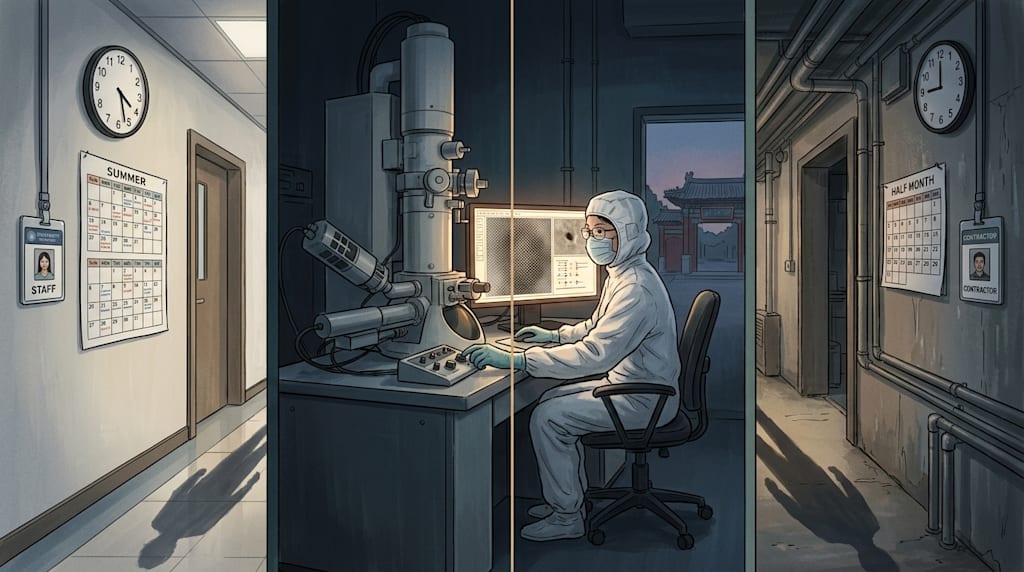
Permanent lab staff start at 8:30 a.m. and leave at 4:30 p.m. They have weekends off. They get the full winter and summer breaks. These external research assistants often work until 8 or 9 p.m. They work weekends. Their summer break is only half a month.
The same lab and the same electron microscope produce two different daily schedules.
Permanent staff have a safety net. They have a promotion path. They have benefits. External staff are paid by workload. More work, more pay. No work, no pay. If testing fees are high, income may be better. If testing fees are low, income is tight. They do not get the full summer and winter breaks. They do not have a stable promotion path.
Pay differs sharply. In university dispatch positions, starting monthly pay is mostly 5,000 to 6,000 yuan. Wages come from research grants or testing fees. The budget is fixed. There is almost no room for performance-based fluctuation. For students who go to instrument companies, monthly pay is generally 10,000 to 30,000 yuan. Companies charge by machine hours or sample quantity. They pay more for more work. A skilled operator can make 20,000 to 30,000 yuan.
Studying electron microscopy can lead to a university job for the platform and a sense of stability, or to a company job for income and market rates. The university job has more prestige. The company job has more money. Neither offers the traditional security of a permanent position.
Under the electron microscope: youth and health
Electron microscope operation is not ordinary office work. It requires long periods of focus, observation in a dark room or in front of a screen, exposure to chemicals during sample preparation, and the potential risks of running the instrument.
A university teacher said directly: “I don’t know a single person who works with electron microscopes and is in good health.”
He gave an example from his own lab. One transmission electron microscope has gone through five lab technicians.
The first worked for five years. He transferred because of macular degeneration, lung nodules, and abnormal liver function. The second was a female master’s graduate. She transferred after becoming pregnant. The third was a master’s graduate who stayed at the university. He worked less than half a year before leaving to pursue a doctorate. The fourth was the spouse of an introduced talent. She stayed less than three months. Before she got familiar with the machine, she moved to an administrative job in the college office. The fifth is still working. Every day, something hurts.
These cases do not represent every electron microscopy job. But they point to a fact: electron microscopy work consumes the body. It demands youth. It requires steady hands, sharp eyes, and the ability to sit still. It also requires continuous learning of new equipment and methods. As age increases, physical and family pressures become variables.
Some people say electron microscopy is a young person’s job. That is too absolute, but not groundless. Permanent staff can transfer, move to administration, or leave for a doctorate. External research assistants have less room to transfer and higher costs to leave. Their health costs are often theirs alone to pay.
Why do universities need them?
Despite these problems, universities and research institutes do need this group of people.
Modern research relies more and more on high-end instruments. Electron microscopes are shared platforms. Samples are many. Machine time is tight. Skilled operators are needed. The number of permanent lab staff is limited. Many are unwilling to do electron microscopy long-term. So outsourcing, dispatch, and third-party placement become practical choices.
Vocational school graduates have advantages: strong hands-on skills, matching majors, and matching expectations. They do not demand permanent positions. They do not demand high salaries. They are willing to work overtime. They can get up to speed quickly. For research teams, this is cost-effective labor.
This is also a breakthrough for vocational education in a niche field. Henan Chemical Technician College made electron microscope technology the only program of its kind in China. It partners with more than 90 universities and research institutes. Students are booked in their sophomore year. From an employment view, this is success. It proves one thing: if a program is the only one in the country, it can find a market.
But “finding a market” and “getting dignity” are not always the same thing.
The ladder up: narrow, but not closed
These graduates do have limited career mobility.
In off-staff university positions, there is almost no path to a formal title or promotion. Unless they upgrade from an associate degree to a bachelor’s degree and then take the graduate entrance exam, they may work with electron microscopes for life. From operator to senior operator, from one microscope to multiple microscopes, income may rise, but status is hard to change.
Still, the road is not completely blocked.
The first path is degree upgrading. Associate to bachelor’s, then graduate school. Move into materials, chemistry, biology, or related fields. Become a researcher instead of an operator. It is hard, but some have done it.
The second path is moving to an instrument company. From a university dispatch position to an instrument company, working as an application engineer, after-sales engineer, or method developer. Income may double. Career space may be larger.
The third path is moving into lab management, testing platform operations, or technical training after gaining experience. These positions still value electron microscopy skills, but they are no longer only about “looking at samples.”
The fourth path is leaving the field entirely. Use a few years to save money and gain experience. Then take civil service exams, seek a permanent position, or go to a company for quality control or R&D assistant work.
The important thing is not to stay at the level of “only operating.” The electron microscope is a tool, not the destination. If you see yourself only as “the person who presses the buttons,” your options stop growing.
This is not a comeback myth or an employment scam
Back to the opening line: “Our students didn’t get into Peking University or Tsinghua. But they can go work at Peking University and Tsinghua.”
That sentence has its pride. It also has its limits.
The pride is that vocational education can produce people needed by top research institutions. Skills have value. Craft has a market. A niche program can find a place.
The limit is that “going to work at Peking University and Tsinghua” does not equal “becoming a person of Peking University and Tsinghua.” Off-staff status, third-party contracts, low base pay, high overtime, health risks, and a narrow promotion path are all parts of this route.
It is a survival strategy within a structural gap. Universities need low-cost, high-skill operators. Vocational schools need high employment rates. Students need a relatively stable job. Three needs intersect, forming this program and these graduates.
But intersecting needs do not guarantee that an individual will get an ideal life. For the school, employment rate is a number. For the student, it is eight or even twelve hours of life every day.
Cold advice for prospective students
If you are considering a similar program, here are a few things to consider.
If you can get into a bachelor’s program, do not go to this kind of associate-degree program. If you can get into a popular major, do not choose this kind of niche major. This is not discrimination against vocational education. It is a reminder about information asymmetry. Niche majors have a narrow employment surface. If the industry changes, the cost of switching is high. Off-staff positions have limited stability. The cost to health and youth is high.
If you have already chosen this path, or are on it, plan early.
First, upgrade your degree. Associate to bachelor’s, then graduate school. This is the most direct way to change your status.
Second, deepen your skills. Do not only operate. Understand the principles. Understand sample preparation. Understand maintenance. Understand method development. The harder you are to replace, the more bargaining power you have.
Third, broaden your view. Universities are not the only option. Instrument companies, testing companies, corporate labs, and third-party testing agencies all need electron microscopy talent.
Fourth, take your health seriously. Get regular checkups. Pay attention to protection. Do not trade youth for money and then trade money for health.
Fifth, do not be misled by the phrase “entering Peking University.” The platform’s reputation belongs to the platform. Your life belongs to you.
Conclusion: skill opens the door, status decides the room
One hundred and one graduates entering Peking University is a vocational education sample.
It shows that skill can break through degree barriers. A niche major can connect to high-end demand. Vocational school students can find a place in top labs.
It also shows that under a dual-track system of permanent and off-staff positions, in the same building, some leave at 4:30, some work until 9. Some get the full summer and winter breaks, some get half a month. Some can transfer, pursue a doctorate, or move to administration. Some can only keep working with electron microscopes.
Vocational education deserves respect. But respect does not mean romanticizing it. Dignity is not the sentence “they can go work at Peking University.” It is choice, information symmetry, and a way up.
For those 101 young people, the world under the electron microscope is very small. It is small enough to reach the atomic scale. The life outside the electron microscope is very large. It is large enough that they must walk it out on their own.
About the Creator
Jin
Writer of reamstories
https://reamstories.com/jin
Enjoyed the story? Support the Creator.
Subscribe for free to receive all their stories in your feed. You could also become a paid subscriber, letting them know you appreciate their work.
Comments
There are no comments for this story
Be the first to respond and start the conversation.