
The Writing Prompt Box: The Beginning of an Experiment.
Writing prompts are popular tools in classrooms, especially in an English class. Students are asked to respond to them, but what happens when a teacher decides to write to these prompts. This is the start of an ongoing series.

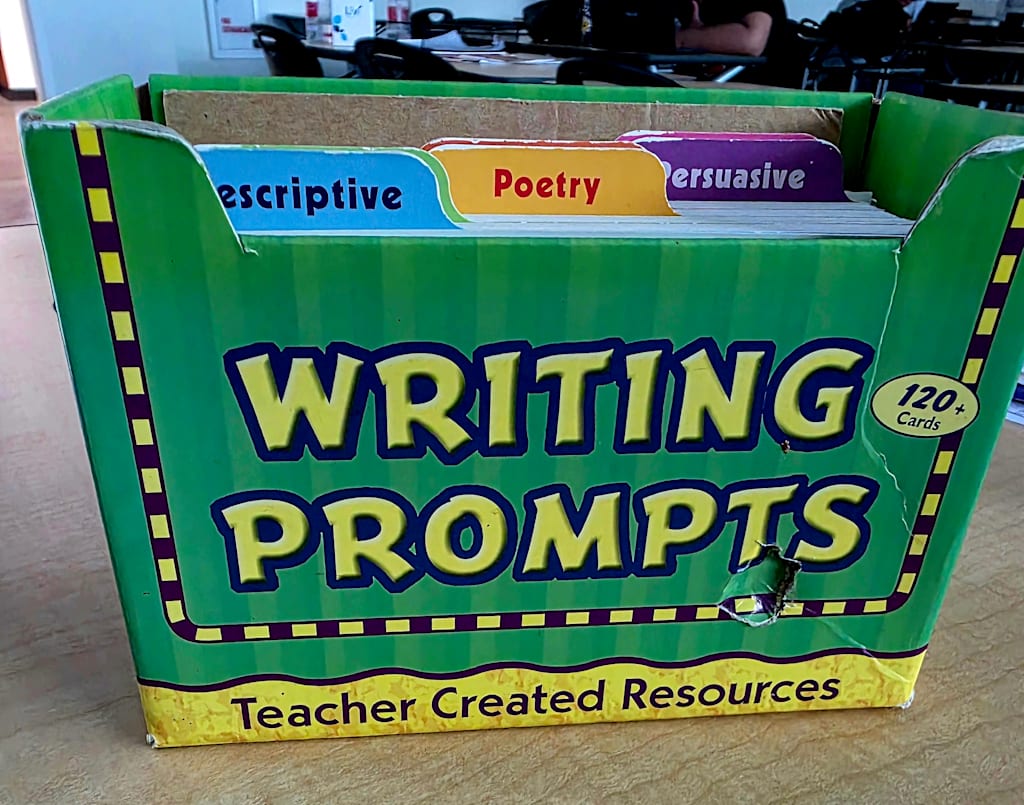
A Glossy Green Box of Prompts
For years, I've had a small glossy green box on my desk. It followed me from one classroom or school to another. The box is entitled “Writing Prompts” and states that it is part of “Teacher Created Resources”. I assume it’s a company that has released a series of these (in this case, the one I have is for level 6 -- most likely for 6th grade level).
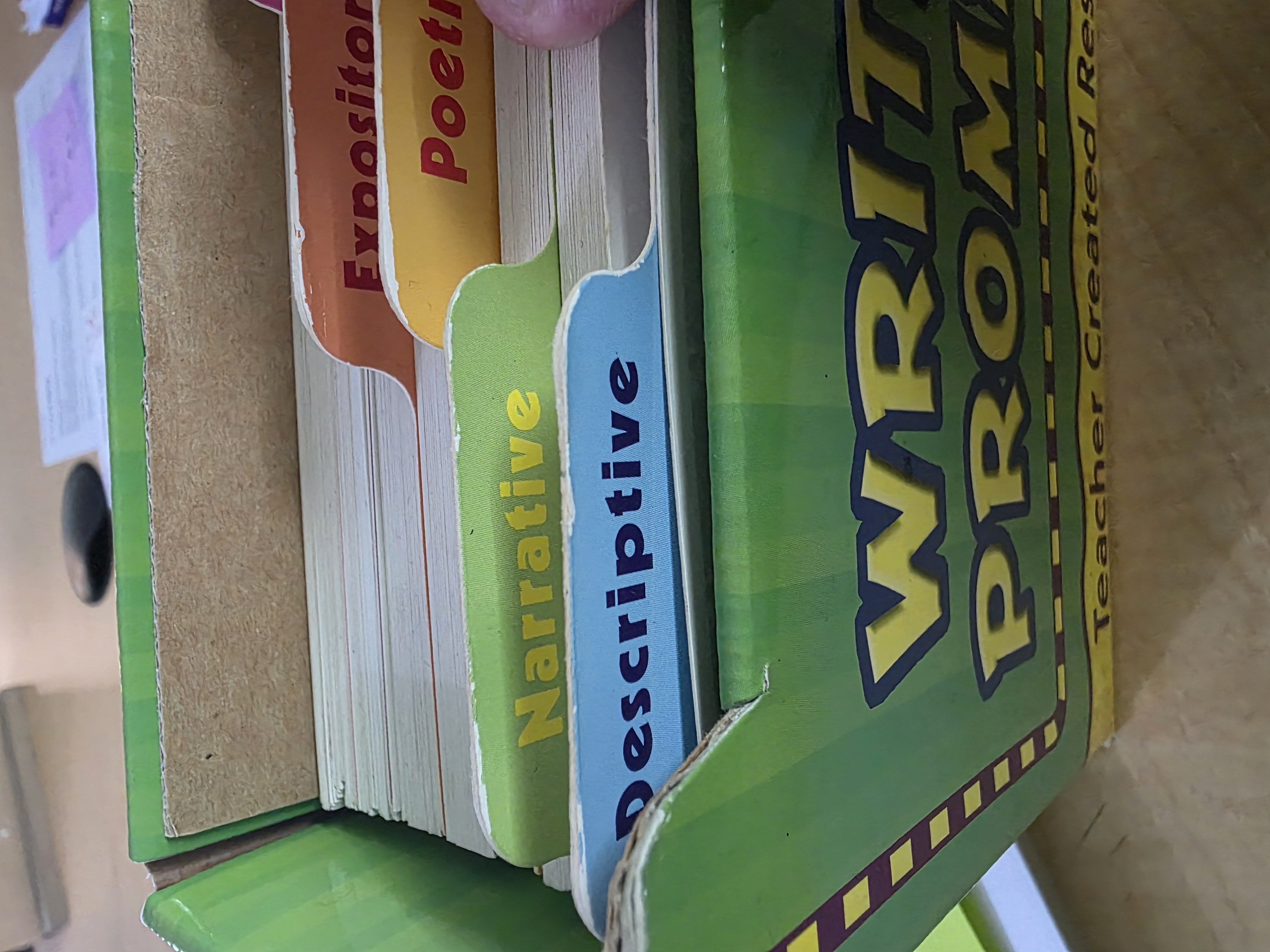
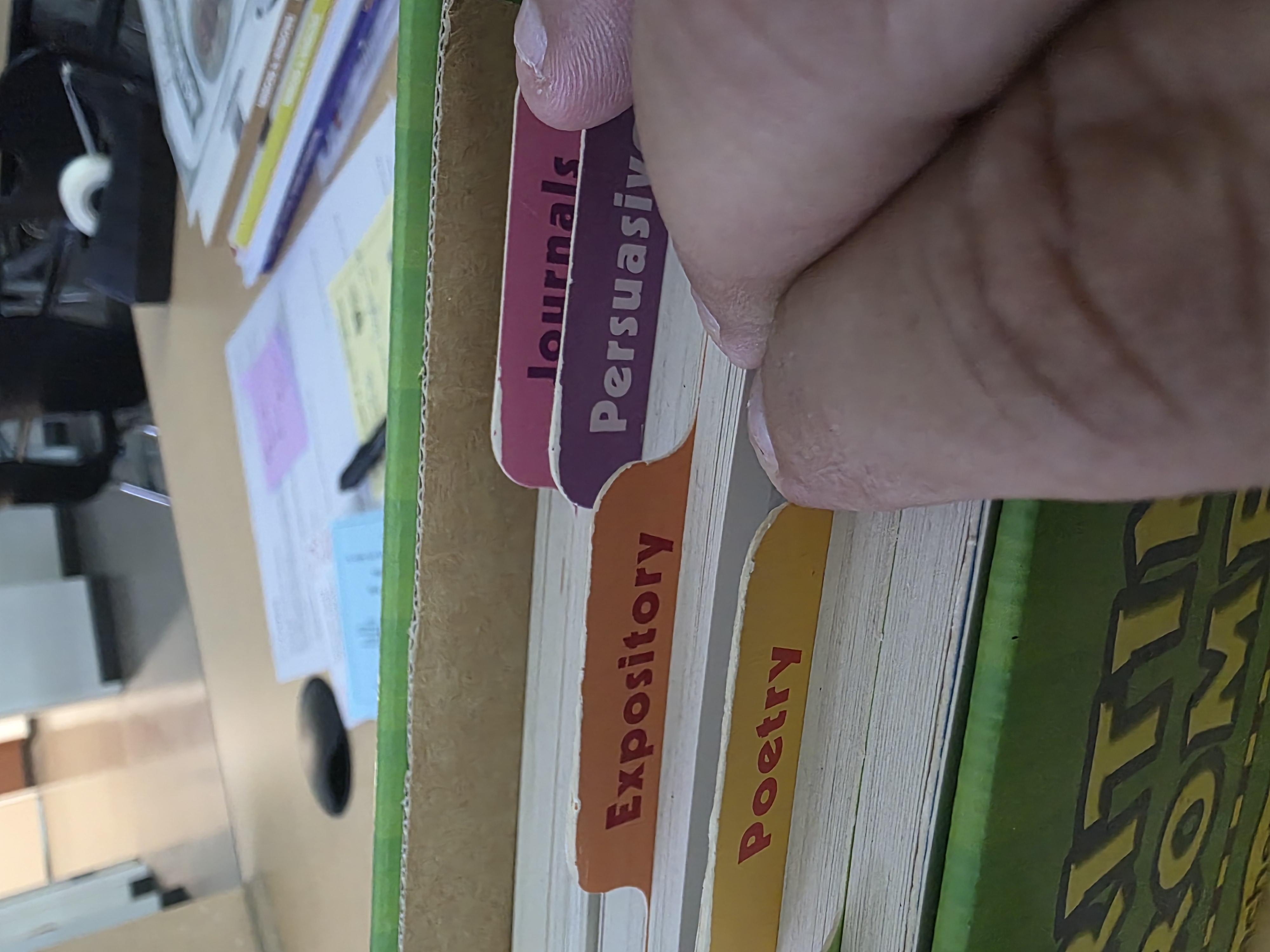
The box contains 120+ cards (as it states on the box) divided into six sections:
Narrative
Expository
Persuasive
Descriptive
Poetry
Journals
Every so often, I grab one of these cards from various sections and assign them to students as either discussion lessons or writing practices (especially when there’s a substitute teacher in the classroom).
One thing I haven’t done over the years is take any of these cards out and answer the prompts printed on them myself. I’ve always seen it as a lesson or activity for students but never as something I could respond to.
The Beginning of a Writing Project
In future postings, there will be articles based on the prompts I choose for the day. In the process, I decided to see how things go when I published the results on a writing platform. I don’t expect them to be easy or to be the best. But, it may well serve as a means to understanding how students respond to these questions.
In addition, it may serve as “practice” for me. Although I’ve written nearly a thousand poems, news articles, essays, short stories, scripts and commentaries over the years, you still feel the need to tackle new endeavors.
Most importantly, it’s a chance to create model responses for my students, or to see if these are still relevant for them.
Why the Concern for Relevance?
Far too often, lesson materials are created during a particular period of time. While they may have been relatable or relevant for students of the past, the material may be viewed as outdated or difficult for students of today. Simply put, time changes and nothing is really set in stone. This includes the lessons to be learned as well as the material used to reach those students.
In today’s world, smartphones, tablets and other media compete for the attention of students. In many cases, that’s the way students learn about a particular subject. In addition, the entertainment value offered by these electronic devices keep the students engaged more than a lecture from the teacher, or from a writing prompt.
In many cases, when students engage in writing, it’s with text messaging.
Can a flashcard with a writing prompt be effective as a tool to aid students in honing their writing skills? That has always been my belief. However, as time marches on and smartphones become prevalent, I’m having my doubts that these flash cards alone will engage the students and help them to write.
In many cases, when students engage in writing, it’s with text messaging. Writing prompts from a flashcard or one written on the board seems to be an unnecessary intrusion for them. It simply doesn’t serve their purpose for writing.
But, what about me? Will these cards hone my writing skills or inspire me to write something?
My Goal
My main goal is to see what I can create from these writing prompt flashcards. Will this be practice that will keep me fresh or will it be something I will have to alter in the future? Ultimately, while I'm mostly do this for myself, I will be on a journey to see how these work for students or how I can modify them to meet their writing needs.
I have several genres and themes to write about. And, in truth, finding a place on a writing platform will be challenging. Is journal material? These are decisions I have to make, possibly before I answer the first prompt.
Writing is a vital part of a student’s education. And, prompts are usually given to them on a regular basis. As educators it is important to model how to respond to them. On the other hand, are prompts really relevant to today’s students or is a more informal form of writing more appropriate, considering that many students' only form of writing on their own are text or emails?
A Brief History
When I entered the world of education, I started as a substitute teacher. Often, I used the material I was given by the teachers to use. But, there were times when the teacher didn’t leave a lesson plan. When this happened, I searched for material to use in the classroom. Often, I came across booklets or flashcards with writing prompts.
The writing prompt flashcards saved the day. All it took was paper for the students and an ink or chalkboard (yes, about 25+ years ago, there were classrooms that still used chalkboards) to write the prompt.
Eventually, I would become a long-term substitute teacher. Luckily, I didn't have to buy anything at the time. The material was already in the classroom and the type of class -- a study skills course for special education resource students (RSP) -- didn’t require a lot of preparation.
Upon starting this new job, I went out to the local teacher’s store to find the material I needed. Among them was the box in question.
Students came to this class to complete their assignments from other teachers. Still, every so often, I gave a prompt to those who came in with nothing to do.
Finally, I took a position as a special education teacher at a high school. That was 26 years ago. And during that time, I taught mostly English and support courses within the special education department.
Upon starting this new job, I went out to the local teacher’s store to find the material I needed. Among them was the box in question. Most often, they were warm-ups I gave for the first 10 or 15 minutes. It was one of several items I used for warm-up exercises.
A Change in Program
In the beginning when I taught Resource English, I gave the students the prompts from the box as is. However, I had to modify them in recent years. The reason was that my district changed its special education program. We went from SDC/RSP classes to a Co-taught/ SAI (special academic Instructions).
I ended up teaching both co-taught and SAI on a regular basis. While the co-teacher for my co-taught classes had the lessons set out, I had to create lesson plans for my SAI students. To make a long story short, special education students in the co-taught would be similar my former RSP students; their learning disabilities were mild and they had skills that were actually at grade level (co-taught is often considered a general education class with students with or without disabilities mixed in them).
My SAI course, however, is a different story. Many students have low skills in reading and writing and often need to have modified assignments. As a result, I had to modify the writing prompts. I either:
Rewrote the prompts to be more succinct.
Supplied sentence-starters for sentences mentioned in the prompt (in many cases, the prompts had a series of questions associated with the prompt. The idea was to get students to write a paragraph or more and to prepare for future in-class essays that are often used on standardized tests).
In all honesty, there were prompts I never used. Simply put, I didn’t have the time to do so in a school year. The box had a lot of choices and there were a few I routinely chose. In addition, many of these prompts were lengthy and/or didn’t relate well to the students, especially for the ones that came from different socioeconomic backgrounds fthan their peers.
Starting Something
So there you have it:
The way it was used in class
Why it was given, and
The reason for this project.
It’s time to find out what one can create from these prompts and what, if anything, reflection can be given to this. So now, this is the start of something. And we’ll see where it goes from here.
About the Creator
Dean Traylor
* Masters in special education and degree in journalism.
*Seasoned writer for the last 30+ years (Newspapers, Magazines, Internet sites)
* Former writer at Hubpages, Helium, and Wikinut.
* Current: Medium (https://medium.com/@ds_traylor)
Enjoyed the story? Support the Creator.
Subscribe for free to receive all their stories in your feed.
Comments
There are no comments for this story
Be the first to respond and start the conversation.