
The Weekend Feynman Learned His Intuition Was Wrong — and the High School Kid Who Followed Him
One weekend with a pebble and a garage door taught a future Nobel laureate that intuition betrays you — and a modern teenager that memorizing formulas is not the same as knowing.
Richard Feynman hit a wall in high school while teaching himself physics.
He had borrowed an old textbook and reached the chapter on circular motion. One sentence stopped him cold: Centripetal acceleration points toward the center, not along the tangent.
It went against everything his gut told him. Tie a stone to a string and swing it in a circle. The moment you let go, the stone flies off along the tangent. Surely the force, and the acceleration, should point outward, not inward.
He tied a string to the garage door handle, crouched on the ground, and swung a pebble in circles. He let go. It hit the fence. He did it again, and again. Every time, the pebble flew off tangent. Not once did it move toward the center. The textbook was right, but his intuition had come apart.
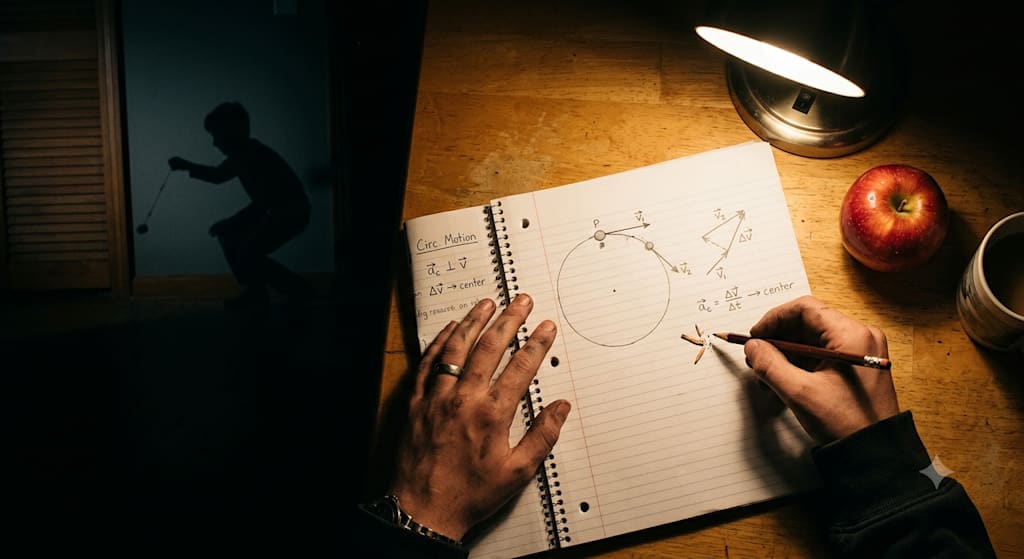
He spent an entire weekend doing nothing but sitting there drawing arrows. Velocity arrows. Position arrows. The direction of the velocity arrow an instant later. He realized his premise was wrong: centripetal acceleration doesn't change the speed, only the direction. Velocity is a vector. It has magnitude and direction. The stone flies off tangent because once you let go, no force remains to change its direction, so it continues in a straight line along the velocity vector at that instant. The centripetal acceleration had been there all along, but it altered direction, not speed.
When the thing finally clicked, he didn't shout. He picked up the pebble, swung it once more toward the garage door, let go, and watched it hit the same spot on the fence. The trajectory was still a tangent, but this time he saw the invisible acceleration that had been pointing toward the center the whole time. He put the pebble in his pocket, walked inside, and poured himself a glass of milk.
Years later, he told the story this way: "That weekend I learned that intuition is very useful, but you have to be ready for it to betray you."
Feynman graduated long ago, but the story stayed in his textbooks. It also stayed in the lives of another group of kids: the ones who coasted through elementary and middle school, then hit a wall in high school.
Thomas was one of them. In middle school he had never scored below an A in physics. He could read a ray diagram or a circuit diagram and grasp it almost on instinct. He barely had to try. Then he reached high school, and the first time he encountered force analysis for circular motion, it felt like someone had pulled the plug on his brain.
The teacher drew the centripetal acceleration arrow on the board, pointing at the center. Thomas stared at it, his head full of images from playing with a yo-yo as a kid: the disc reaching the bottom of the arc, the string released, the yo-yo flying forward and down. His body remembered that centrifugal tug, the feeling of being flung outward. How could the acceleration possibly point toward the center?
He didn't raise his hand. He was sure he could figure it out, the way he always had.
That night he sat at the kitchen table for two hours, notebook open in front of him. He drew, erased, drew again. His mother passed by and set an apple down beside him. Thomas didn't touch it. He kept sketching velocity vectors, erasing, then drawing a new one with the direction rotated by a tiny angle, trying to find the acceleration vector by subtracting them. Every subtraction pointed to the center, but his body still said it was wrong. His hand was admitting it on paper. His body was not.
The next day's quiz, he got two multiple-choice questions on circular motion wrong. They were his first lost marks in physics all semester. He folded the quiz, shoved it to the bottom of his backpack, and told no one.
Over the following weeks, the word acceleration began to make him flinch. He started solving problems by memorizing conclusions: centripetal acceleration equals v² over r, direction toward the center. He remembered the formula, and his answers came out right, but he knew he was lying to himself. Before, he had learned through understanding. Now, he was learning through memory.
Electromagnetism made it worse. The right-hand rule, the left-hand rule. Magnetic field direction, current direction, force direction. Three arrows perpendicular to each other. The textbook said the Lorentz force does no work, but he couldn't make sense of it. A force, a displacement. How could it do no work? He couldn't run it through his own deductive logic, so he memorized that too. Every time he memorized a fact like that, he felt something hollow out inside him.
The night before midterms, Thomas dug out his middle school physics notebook. On the cover he had written: "Physics—figure out how the world turns." He stared at the words for a long time, then put the notebook in a drawer, closed it, and opened his new high school notebook. The first page was blank.
Then he remembered a borrowed copy of a Feynman biography. There was a passage about Feynman being tormented by centripetal acceleration for an entire weekend in high school. Thomas had skimmed it before and felt nothing. Now he went back. He reread how Feynman sat there drawing arrows, how he realized velocity was a vector, how the key variable was the change in direction, not speed, how he rebuilt his understanding from scratch with deduction.
Thomas closed the book and started drawing again in his own notebook. Not memorizing the formula. Beginning from the change in the velocity vector, subtracting step by step until the acceleration arrow pointed unambiguously toward the center. On the third attempt, his pencil lead snapped. He sharpened it and kept going, marking the change in velocity across every tiny interval of time until the direction of the acceleration arrow was beyond argument. He didn't feel a flash of clarity. He just felt something inside him unclench, like a gear that had been stuck finally seating into place.
He opened the new notebook to the first page and wrote: Acceleration changes the direction.
Underneath, in smaller letters, he added: When you let go, it stops changing the direction.
The next day in electromagnetism class, the teacher derived once again why the Lorentz force does no work. Thomas didn't memorize it this time. On his paper, he took the dot product of the velocity vector and the force vector. Zero. Because the force is always perpendicular to the velocity. He set his pencil down and noticed the graphite dust from sharpening it the day before still under his fingernails.
He didn't turn back into an all-A student overnight. Electromagnetic induction was still hard. Thermodynamics would be hard. But he no longer papered over the places where his deductive logic failed him by memorizing. Every time he got stuck, he went back looking for the missing variable and didn't stop until he found it.
At the end of the semester, Thomas took his middle school notebook out of the drawer. The words on the cover had faded a little. He added a new line underneath them: Figure out how the world turns, even when at first it turns counter to intuition.
He placed the two notebooks side by side on his bookshelf. Graphite dust from his fingers fell onto the shelf. He wiped it with his palm, leaving a gray streak. He didn't clean it off. He turned and walked to the kitchen to get an apple.
About the Creator
Jin
Writer of reamstories
https://reamstories.com/jin
Enjoyed the story? Support the Creator.
Subscribe for free to receive all their stories in your feed. You could also become a paid subscriber, letting them know you appreciate their work.
Comments
There are no comments for this story
Be the first to respond and start the conversation.