
The Voice Between Worlds: The Story of Qāriʾ Kumayl Alloo
Kumayl Alloo’s Uncommon Path from World-Class Qur’an Recitation to Cutting-Edge Neuroscience

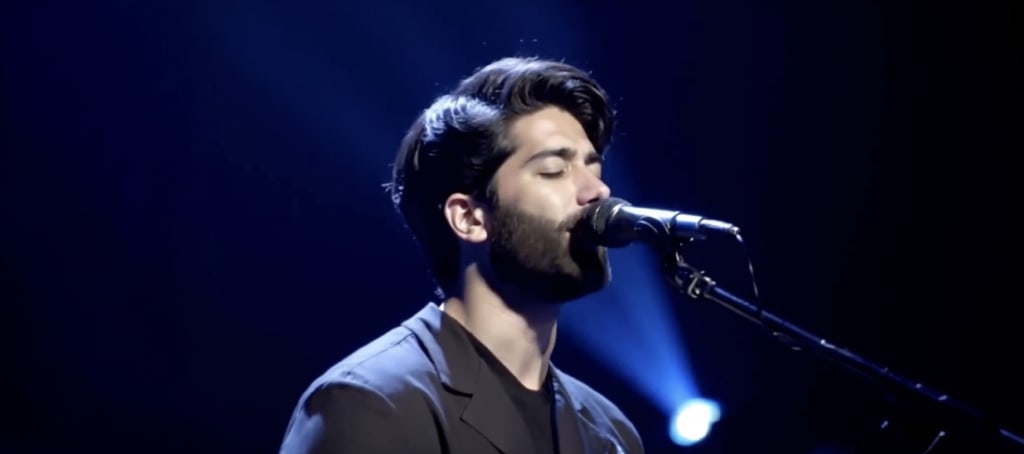
Just minutes before the weekly Friday prayers, in the quiet sanctuary of Columbia University’s Islamic Center, time seems to slow. The chaos of New York—the sirens, footsteps, and chatter of campus life—dissolves at the threshold. Sunlight filters through stained glass, casting soft, colored hues across polished walls and richly woven prayer rugs—deep blue, adorned with intricate Persian motifs of floral arabesques and symmetrical medallions that ripple like waves across the floor. Overhead, the lights hum gently, as if holding their breath. And then, a voice begins to rise. Calm, measured, unwavering. Each syllable of the Qur’an unfurls with precision, each breath a vessel of reverence. It is not merely recitation—it is invocation. A hush falls over the room. Students pause mid-thought, professors sit in stillness. Some close their eyes. The voice becomes the room’s center of gravity, anchoring all who hear it in a moment of sacred stillness.
The source of that voice, meanwhile, sits with quiet composure, his presence both grounded and quietly magnetic. Thick, black hair, swept cleanly back, gleams in the afternoon light, while a soft, full beard frames a face marked by calm intensity. There’s a stillness to him—not empty, but full, as though carrying something deeply rooted.
The voice belongs to Kumayl Alloo—a name that now resonates far beyond the ivy-covered walls of Columbia. A Tanzanian-American Qur’an reciter, scholar, and scientist, his life defies the need to choose between intellect and faith, instead weaving them together—text and testimony, reason and revelation—into a single, seamless thread of brilliance.
His ascent began early. By the time he reached his late teens, Alloo had already secured three national championships in Qur’anic recitation. And in 2022, he won the Global Iqra’ Qur’an Recitation Competition. Competing against thousands from over fifty countries, his recitation—flawless in its tajwīd, masterful in its melody—captivated the judges and the crowd alike. But it wasn’t just his technical mastery that set him apart. It was the depth. The sincerity. The soul.
Still, for Alloo, the art of recitation was never the endpoint. It was a beginning.
As the echoes of his voice reached mosques and auditoriums around the world, his curiosity reached inward—toward the brain, the mind, the roots of language itself. How do we make meaning? What makes words sacred? What happens in the space between revelation and comprehension?
At Columbia University, he chased those questions with relentless passion. While serving as Muqriʾ (Qur’an reader) and Mu’addhin (caller to prayer) at the university’s Islamic center, Alloo simultaneously pursued two degrees: a Bachelor of Science in Neuroscience and Behavior, and a Bachelor of Arts in Arabic Linguistics and Literature. In 2025, he graduated at the top of his class, amongst the highest-ranked students in a graduating body of over 5,000.
Even before that, he had already defied convention. As a sophomore, he was accepted into the prestigious FlexMed program at the Icahn School of Medicine at Mount Sinai—an early admissions pathway into medical school that bypasses the usual MCAT gauntlet. He was the only student in his Columbia cohort to receive such an offer. It allowed him to explore his academic interests without compromise—and to double down on both science and scripture, laboratory and liturgy.
Today, Alloo is completing both an MD and an MPH, bridging clinical medicine with public health, while continuing his research across behavioral neuroscience, social cognition, and Arabic philology. With over 20 peer-reviewed publications and research projects to his name, he has contributed to studies on neurodegeneration, language processing, and the moral dimensions of care. His academic reach is as expansive as his recitations are precise.
His religious training is equally deep-rooted. He holds an ijazah in Qur’anic recitation—a formal license in the unbroken oral transmission of the Qur’an—and a diploma in Advanced Qur’anic Grammar from the University of Hassan II in Morocco. Whether explaining rare grammatical structures or teaching the musical modes of qirāʾāt, Alloo brings an unmatched command of both form and meaning.
But what makes Kumayl Alloo’s story truly extraordinary isn’t just the accolades. It’s the unity.
In a world that often asks us to choose—between head and heart, between prayer and progress—he chose both. And more than that, he made them speak to each other. His recitation elevates language into devotion. His research asks what makes that elevation possible. His life, in every way, is the answer to that question.
When he steps to the microphone, the air changes. Not because the sound is beautiful—though it is—but because the intention behind it is radiant. It is the sound of someone who has spent years shaping his voice and sharpening his mind, not for performance, but for purpose.
Kumayl Alloo is not just a rising physician. Not just a world champion reciter. Not just a scholar of science and scripture. He is a voice—resonating between the earthly and the eternal. A voice that reminds us that knowledge, when rooted in humility and elevated by devotion, becomes something more.
It becomes light.
About the Creator
Rashid Al-Shammary
Rashid Al-Shammary is an Islamic scholar at Columbia University specializing in theology and Qur'anic exegesis. He has taught at various Islamic institutions and written extensively on the intersection of faith and modernity.
Enjoyed the story? Support the Creator.
Subscribe for free to receive all their stories in your feed.
Comments
There are no comments for this story
Be the first to respond and start the conversation.