
The Visual Sanctuary: How Structure and Order Shape a Child’s Inner World
On the psychological alchemy of spatial order, visual cues, and the construction of an unshakeable inner citadel in early childhood.

I. The Architecture of Perception
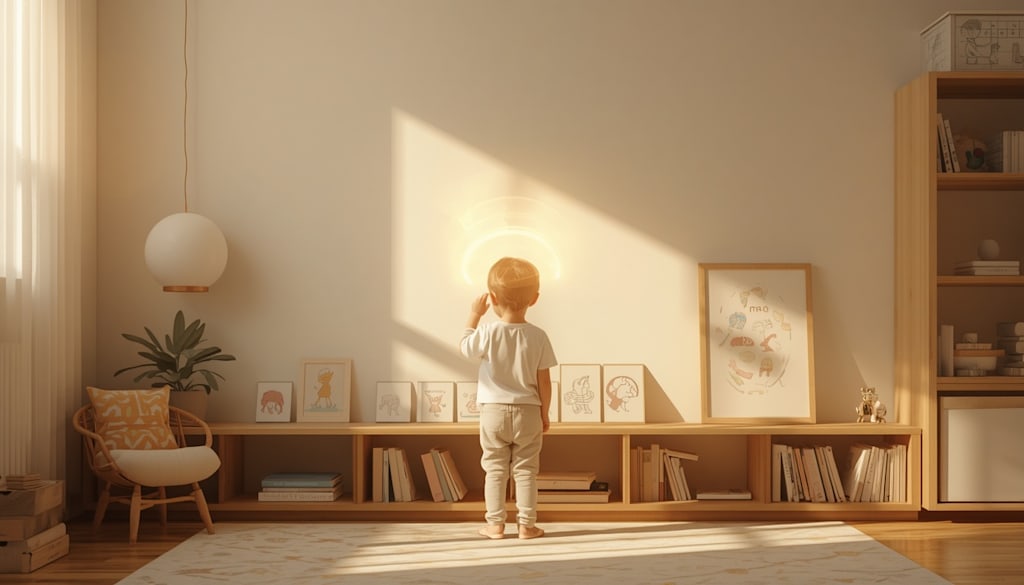
Long before a child masters the complex syntax of spoken language or deciphers the abstract symbols of written text, they read the world through a much more fundamental, visceral medium: the landscape of visual order.
To a young child between the ages of three and five, the physical environment is not merely a background setting; it is an active, continuous sensory narrative. Every object out of place, every unpredictable shift in routine, and every surrounding spatial chaos generates subtle cognitive friction. Conversely, an environment structured with visual clarity, rhythmic predictability, and intentional aesthetic order acts as a silent, powerful stabilizer for the developing brain.
At Noor Kids Academy, we operate on a fundamental truth of child development: structure and visual cues are the ultimate keys to a child’s confidence and internal tranquility.
When we structure a child’s external world, we are not imposing rigid, cold discipline. We are engaging in an act of sacred cognitive architecture—building the foundational scaffolding upon which emotional self-regulation, intellectual autonomy, and lifelong self-worth are constructed.
II. The Neurological Toll of Environmental Friction
Modern developmental psychology and neuroscience confirm what ancient traditions have long understood: a child’s brain thrives on predictable patterns. When a young child exists in an environment characterized by spatial disorder and ambiguous expectations, their nervous system remains in a state of quiet, hyper-vigilant arousal.
In the absence of clear visual boundaries, a child must constantly allocate precious cognitive energy to answer basic existential questions:
What comes next?
Where do I belong in this moment?
What is expected of me?
This continuous internal searching induces executive function fatigue, often manifesting as sudden behavioral outbursts, heightened anxiety, or deep-seated insecurity. When a child cannot predict their environment, they cannot rest in their own presence.
                  [ THE COGNITIVE CASCADE ]

     Chaotic Environment           Visual Order & Routine
              │                              │
              ▼                              ▼
    Hyper-Vigilant Arousal         Executive Calm & Safety
              │                              │
              ▼                              ▼
    Behavioral Friction           Autonomy & Confidence
By introducing visual cues—such as clear, beautifully designed daily routine flashcards, designated spatial sanctuaries for learning, and harmonious visual rhythms—we remove this cognitive friction. The visual cue communicates directly with the child’s subconscious, replacing uncertainty with a profound sense of psychological safety.
III. The Philosophy of the Inner Citadel
The ancient Stoic philosopher Marcus Aurelius famously spoke of cultivating the "Inner Citadel"—an unshakeable fortress of internal order that remains calm regardless of external storms. In early childhood development, this inner citadel is not built through abstract lectures or verbal reprimands; it is constructed through the tangible, daily experience of external harmony.
As the pioneer of early childhood education, Maria Montessori, observed:
"The first essential for the child's development is concentration. The child who concentrates is immensely happy. But concentration requires an environment of order."
When a preschooler interacts with a structured daily visual schedule, something miraculous occurs within their developing consciousness. As they independently observe a card illustrating "Morning Routine," "Creative Time," or "Quiet Reflection," the locus of control shifts from the external authority of the parent to the internal agency of the child.
They are no longer reacting to a demanded command ("Go clean your room!" or "Sit down now!"); instead, they are participating in a harmonious, visible order that they can see, comprehend, and master. This shift from external compliance to internal autonomy is the precise moment where true self-confidence is born.
IV. The Sacred Geometry of Visual Cues
Why are visual cues so uniquely potent in early childhood?
Bypassing Verbal Overwhelm: Young minds process visual imagery exponentially faster than auditory commands. A gentle, beautifully crafted visual flashcard communicates clarity without the emotional strain or exhaustion of repeated verbal instruction.
Cultivating Independent Mastery: When a child can independently track their daily rhythm through visual cues, they experience the joy of mastery. They become active architects of their own day rather than passive subjects of adult direction.
Anchoring the Primordial Nature (Fitrah): In Eastern metaphysics, the human soul naturally responds to Al-Nizam (divine order) and Al-Jamal (pure aesthetic harmony). A visually serene, ordered environment aligns the child's external surroundings with their primordial, unblemished nature (Fitrah).
V. Transforming the Home into a Visual Sanctuary
Creating a visual sanctuary does not require sterile perfection or rigid minimalism; it requires intentionality and aesthetic grace. Here is how we can transform our homes and learning environments into nurturing spaces of inner peace:
        [ THE THREE PILLARS OF SPATIAL SANCTUARY ]

     1. Visual Rhythms     2. Accessible Order     3. Serene Aesthetics
    Clear, tangible cues    Tools at child height    Calming colors and
    for daily transitions   for independent use     uncluttered spaces
Establish Tangible Daily Rhythms: Replace abstract time concepts with clear visual schedules. Use physical, beautifully designed flashcards that illustrate key daily beats—from morning awakening to evening quietude.
Designate Purposeful Spaces: Ensure that every object in the child's environment has a clear, visible home. When a child knows exactly where their tools, books, and creative materials belong, they develop a spatial respect that mirrors mental clarity.
Eliminate Sensory Clutter: Reduce visual noise. Excessive, chaotic stimuli in a child's bedroom or play space overstimulates the optic nerve and fragments attention. Embrace warm, natural tones, clear spatial boundaries, and intentional simplicity.
VI. The Eternal Echo of Order
Childhood passes with the swiftness of a fleeting shadow, yet the emotional patterns formed during these early years endure for a lifetime.
The child who grows up in a visual sanctuary—where structure is paired with gentle love, and where order is experienced as a peaceful shelter rather than a punitive cage—develops an internal compass that remains steadfast through the storms of adulthood. They carry within their spirit an innate expectation of order, a deep respect for beauty, and an unshakeable belief in their own capability.
Let us commit today to becoming intentional architects of our children's environments. Let us clear away the unnecessary chaos, honor their visual perception, and build for them a sanctuary where their young souls can blossom in confidence, dignity, and eternal peace.
About the Creator
Noor Kids Academy
Writer exploring childhood, education, fitrah, and the philosophy of learning. Practical insights for parents, teachers, and curious minds.
Enjoyed the story? Support the Creator.
Subscribe for free to receive all their stories in your feed.
Comments
There are no comments for this story
Be the first to respond and start the conversation.