
The Sound of the Key: When a Father’s Arrival Feels Like a Threat
What ancient sages and modern psychology reveal about the quiet fear some children feel when their father comes home

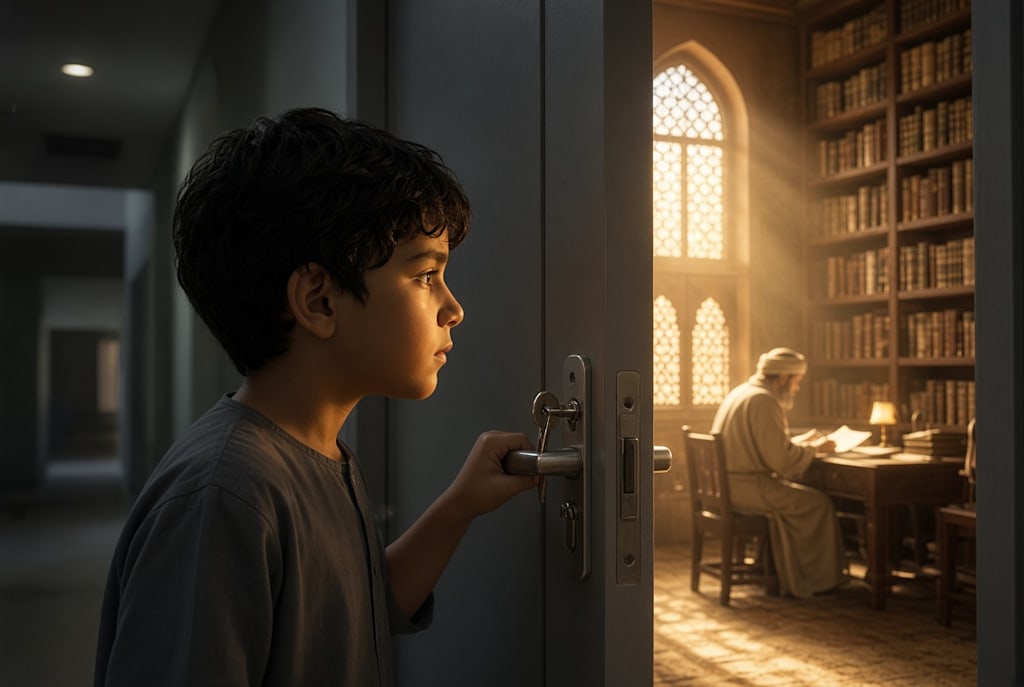
There is a sound that should mean safety.
The soft metallic click of a key turning in the lock. The familiar resistance of the door yielding. The subtle shift in air as the house receives its master.
But for some children, that same sound does not open a home.
It opens a wound.
In the fraction of a second between the turning of the key and the appearance of the father, an entire nervous system braces. The child’s body remembers what the mind cannot yet name: that the one who enters may bring not warmth, but weather — a sudden change in atmosphere, a tightening in the mother’s voice, a silence that feels heavier than shouting. The key becomes an omen. The threshold becomes a border between relative calm and possible storm.
This is not ordinary fear.
It is the quiet, daily terror of a soul still too young to defend itself, learning too early that love can arrive wearing the face of threat.
What ancient physicians of the heart understood, and what modern science now confirms, is that a child does not merely hear the key.
The child becomes the key — locked into a pattern of anticipation, vigilance, and invisible surrender.
What Happens Inside the Child
The body keeps a more honest record than the tongue.
Long before the child can articulate “I am afraid of my father,” the autonomic nervous system has already drawn its conclusion. The sound of the key activates a cascade older than language: heart rate rises, muscles subtly tense, breath becomes shallow. In that brief interval — often no more than three or four seconds — the child is no longer simply waiting for a parent. He is bracing for impact.
This is not drama. It is biology.
Modern research into attachment and threat response shows that repeated exposure to unpredictable parental presence rewires the developing brain toward hypervigilance. The home, which should function as a sanctuary, begins to operate as a zone of conditional safety. The child learns to scan the mother’s face first — is she already afraid? Is her voice softer than usual? Has the air in the room changed? Only then does he dare to look toward the door.
The Golden Age physicians of the soul would have recognized this state immediately. Al-Ghazali warned that harshness from the father does not merely correct behavior; it impresses upon the child’s heart a lasting association between authority and dread. Ibn Sina observed that recurrent fear in early life weakens the animal soul and distorts the balance required for a healthy temperament. What they described in the language of nafs and mizaj, contemporary neuroscience now measures in cortisol levels and amygdala reactivity.
The tragedy is quiet.
No bruises are required.
No raised voice is necessary.
The mere possibility of emotional weather is enough to teach a child that love must be earned through stillness, through disappearance, through becoming smaller.
In this way, the key does not only unlock a door.
It locks a pattern into the nervous system — one that may take decades to gently undo.
Wisdom from the Golden Age
The physicians of the soul in the Islamic Golden Age did not separate the upbringing of children from the refinement of the heart. They understood that the father’s presence is never neutral; it either expands the child’s inner world or quietly contracts it.
Al-Ghazali, in Ihya’ ‘Ulum al-Din, warned with striking clarity that harshness and unpredictability from the parent do not merely discipline the body — they imprint upon the child’s heart a lasting association between authority and dread. He insisted that the child must taste mercy before he is asked to obey, for a heart that has only known fear will eventually either rebel or collapse into silent compliance. The sound of the approaching father, in Ghazali’s framework, should announce the arrival of a guardian of the soul, not the approach of a storm.
Ibn Sina approached the same truth through the language of temperament and the animal soul. Recurrent fear, he observed, disturbs the balance of the mizaj and weakens the child’s capacity for joy, courage, and trust. A nervous system trained to anticipate threat does not develop freely; it develops defensively. What modern science measures in cortisol and amygdala activity, Ibn Sina had already described as a corruption of the soul’s natural disposition.
Miskawayh, in his work on the refinement of character, went further. He argued that the moral formation of the child begins not with rules, but with the emotional climate of the home. When the father’s entrance consistently produces tension rather than warmth, the child internalizes a distorted map of relationships: love becomes something to be managed, safety becomes something to be earned through stillness and disappearance.
These scholars were not speaking of extreme violence. They were speaking of the subtle, daily atmosphere — the very atmosphere created in the seconds after the key turns in the lock. They understood that a child does not need to be struck to learn fear. He only needs to feel, repeatedly, that the one who should be his strongest protection has become the source of his deepest uncertainty.
In their vision, the father is not merely a provider or a disciplinarian. He is the first experience of masculine presence the child will ever know. And that presence, if it arrives as threat, teaches the soul a lesson it will spend a lifetime trying to unlearn.
What Modern Science Confirms
Centuries after the physicians of Baghdad wrote about the heart and the temperament, modern psychology arrived at the same threshold — only with different instruments.
Attachment theory, beginning with John Bowlby, revealed that the child does not simply love the parent; the child organizes his entire sense of safety around the parent’s emotional availability. When the father’s return is consistently paired with tension, the child’s internal working model of relationships begins to form around a quiet equation: closeness may equal danger. The key in the lock becomes a conditioned stimulus, triggering not curiosity or joy, but physiological preparation for threat.
Stephen Porges’ Polyvagal Theory offers an even more precise map. The sound of the key does not travel only to the ears; it travels to the autonomic nervous system. In children who have learned to associate the father’s arrival with emotional weather, the ventral vagal state of safety is quickly abandoned. The body shifts toward mobilization or, more commonly in the home, toward a subtle freeze — the stilling of play, the quieting of voice, the careful monitoring of the mother’s face. This is not conscious strategy. It is the nervous system’s attempt to survive an environment that should have been sanctuary.
Neuroscience has shown that repeated activation of this threat response in early childhood alters the developing architecture of the brain. The amygdala becomes more reactive; the prefrontal regions responsible for emotional regulation develop under chronic low-grade stress. What the Golden Age scholars called a disturbance of the nafs and the mizaj, contemporary research measures in elevated cortisol, heightened startle response, and long-term vulnerability to anxiety.
The continuity is striking.
Al-Ghazali spoke of the heart that learns fear before it learns trust.
Bowlby spoke of the internal working model shaped by inconsistent safety.
Ibn Sina described the weakening of the animal soul under recurrent dread.
Porges describes the loss of ventral vagal tone in the presence of perceived threat.
Different centuries. Different languages.
The same child standing in the hallway, listening to the key turn, and wondering whether love is about to enter — or something colder.
The Path to Healing
The pattern can be interrupted.
The key does not have to remain an omen.
Healing begins when the father recognizes that his entrance is not a private moment; it is a public event in the nervous system of his child. The first act of repair is therefore not dramatic apology, but a deliberate rewriting of the arrival itself.
He can slow the turning of the key.
He can allow a few seconds of quiet after the door opens before speaking.
He can let his first glance seek the child’s eyes rather than the mother’s tension or the unfinished tasks of the house.
He can lower the volume of his presence — not by becoming smaller, but by becoming safer.
Al-Ghazali taught that the heart of the child is like a soft tablet upon which the parent continually writes. What has been written in fear can, with consistency and mercy, be overwritten in safety. The same key that once announced threat can, through repeated experiences of warmth, begin to announce refuge.
Modern therapeutic understanding agrees. The nervous system changes through new lived experience more than through insight alone. Each time the father enters and the expected storm does not arrive — each time the child’s body braces and then discovers it was unnecessary — a small corrective message is delivered to the amygdala: perhaps this time is different. Over weeks and months, the association weakens. The freeze response softens. Play resumes more quickly. The monitoring of the mother’s face lessens.
The mother, too, has a role that is both delicate and powerful. She cannot shield the child from the father’s emotional weather by absorbing all the tension herself; that only teaches the child that danger must be managed in silence. But she can refuse to amplify the atmosphere of dread. She can greet the father with a regulated nervous system of her own, offering the child a living demonstration that safety is possible even in the father’s presence.
True repair is not the absence of all conflict.
It is the reliable presence of repair after rupture.
It is the father who notices the child’s stillness and chooses, in that moment, to become a source of warmth rather than weight.
In this way the threshold is transformed.
The same door.
The same key.
A different meaning written into the child’s body.
Closing
The sound of a key turning in a lock is one of the smallest sounds a house can make.
Yet for some children it carries the weight of an entire emotional climate.
In that brief metallic click, centuries of wisdom and decades of science converge on a single truth: the father’s presence is never neutral. It either expands the child’s capacity for trust or quietly teaches the nervous system that love may arrive wearing the face of threat.
The scholars of the Golden Age understood this without neuroimaging.
The researchers of our time have measured it without always naming the soul.
Both point to the same responsibility.
A child does not need a perfect father.
He needs a father whose arrival can be trusted.
The key remains the same.
The door remains the same.
What changes is the meaning written into the body of the one who waits on the other side.
And that meaning, once rewritten through consistent mercy, can turn the ordinary sound of homecoming into what it was always meant to be:
the first note of safety.
About the Creator
Noor Kids Academy
Writer exploring childhood, education, fitrah, and the philosophy of learning. Practical insights for parents, teachers, and curious minds.
Enjoyed the story? Support the Creator.
Subscribe for free to receive all their stories in your feed.
Comments
There are no comments for this story
Be the first to respond and start the conversation.