
The Silicon Curtain: How the 2025 China-US Tariff War Reshaped the Global Economy
From Trade Spats to Economic Cold War – A Story of Rivalry, Resilience, and Reckoning
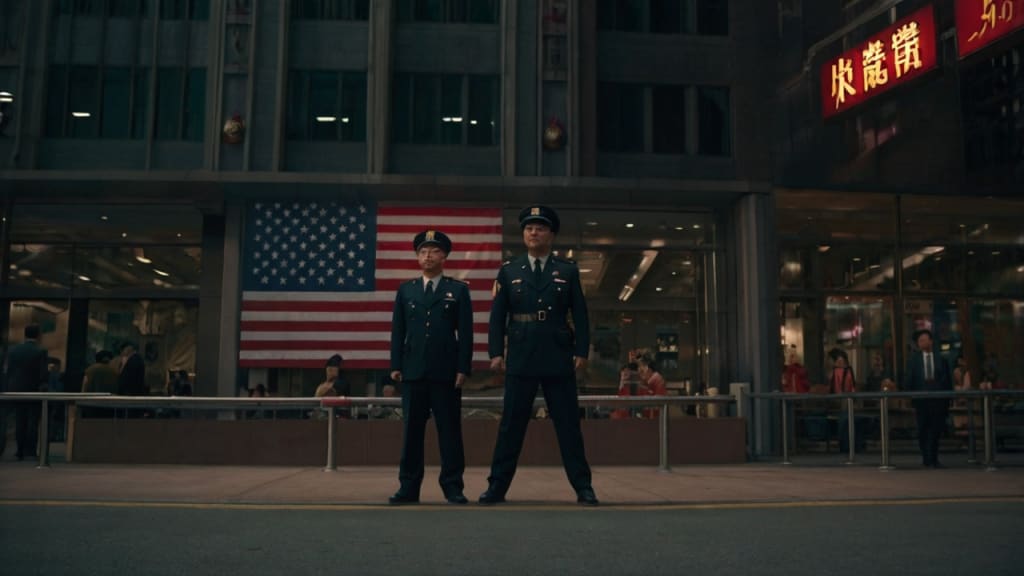
The cranes at the Port of Los Angeles stood motionless under the July sun, their steel arms frozen mid-air like skeletal giants. Below, stacks of rusting shipping containers bore faded labels: Made in China. Across the Pacific, in Shanghai’s Zhangjiang Hi-Tech Park, tech entrepreneur Li Wei scrolled through plummeting export numbers on his tablet, his factory’s once-bustling production lines now eerily quiet. It was 2025, and the world’s two largest economies were locked in a tariff war that had spiraled into an economic cold war – with consequences no one had imagined.
The Spark That Ignited the Silicon Curtain
The conflict reached its boiling point in early 2024 when the U.S. slapped a 40% tariff on Chinese electric vehicles (EVs), accusing Beijing of “green dumping” – flooding global markets with state-subsidized EVs to dominate the renewable energy sector. China retaliated swiftly, imposing steep levies on American-made semiconductors and AI hardware. By 2025, tariffs had spread like wildfire, engulfing sectors from agriculture to aerospace. What began as a trade dispute had morphed into a battle for technological supremacy, with both nations racing to secure dominance in AI, quantum computing, and clean energy.
“They’re not just taxing goods anymore,” remarked Dr. Elena Martinez, a Georgetown University trade economist. “They’re weaponizing supply chains.”
Collateral Damage: Workers and Factories in the Crossfire
In Ohio’s Rust Belt, auto worker Jake Thompson faced his second layoff in three years. “First it was the [2008] recession. Now it’s these tariffs,” he said, staring at the shuttered EV battery plant where he once worked. “They call it a ‘strategic decoupling.’ I call it a disaster.”
Meanwhile, in Shenzhen, Li Wei’s robotics factory – once a jewel of China’s “Made in 2025” initiative – struggled to source American-made microchips. “We’re rationing components like wartime supplies,” Li admitted. His workforce had halved since 2023.
The human cost was staggering:
U.S. farmers faced 75% drops in soybean exports to China.
Chinese manufacturers saw $300 billion in export losses.
Global inflation hit 8.3% as supply chain snarls persisted.
The New World Order: Alliances Forged in Crisis
As the economic ice thickened, nations scrambled to adapt. The EU launched the European Tech Sovereignty Pact, aiming to cut reliance on both U.S. and Chinese tech. India and Vietnam emerged as surprise winners, with Apple shifting 30% of iPhone production to Hyderabad and Hanoi.
“This isn’t just about tariffs anymore,” said UN Secretary-General Amina J. Mohammed. “It’s a tectonic shift in how the world does business.”
By mid-2025:
Mexico became America’s top trading partner.
China’s Belt and Road Initiative pivoted to Africa for rare earth minerals.
Brazil capitalized on the soy vacuum, signing a $20 billion deal with Beijing.
Innovation Born of Necessity
The crisis sparked unlikely breakthroughs. Texas-based startup QuantumCore developed the first “China-free” AI chip using Australian lithium and Indian software. In Hangzhou, engineers at Li Wei’s factory pioneered solar-powered 3D printers to bypass energy bottlenecks.
Even consumers adapted. Sales of refurbished electronics surged 200% in the U.S., while China’s domestic luxury market overtaken Parisian brands for the first time.
A Fragile Truce – But at What Cost?
When Washington and Beijing finally agreed to a tentative truce at November’s APEC summit, relief was tempered by skepticism. The “San Francisco Accord” rolled back some tariffs but entrenched tech barriers, effectively splitting the internet and tech ecosystems into competing blocs: the “Silicon Sphere” (U.S.-aligned) and the “Digital Silk Road” (China-led).
As Li Wei reset his factory robots to produce drones for Indonesian clients, he mused: “We survived, but the world feels smaller – and riskier.”
Lessons From the Economic Trenches
The 2025 tariff war taught three harsh lessons:
Interdependence is inevitable: Even rivals rely on shared resources.
Diversification is survival: Companies with multi-country footprints thrived.
Innovation accelerates under pressure: Green tech advancements came a decade faster than predicted.
About the Creator
Enjoyed the story? Support the Creator.
Subscribe for free to receive all their stories in your feed.
Comments
There are no comments for this story
Be the first to respond and start the conversation.