
The School Gate
A Father's Stand for His Daughter’s Future
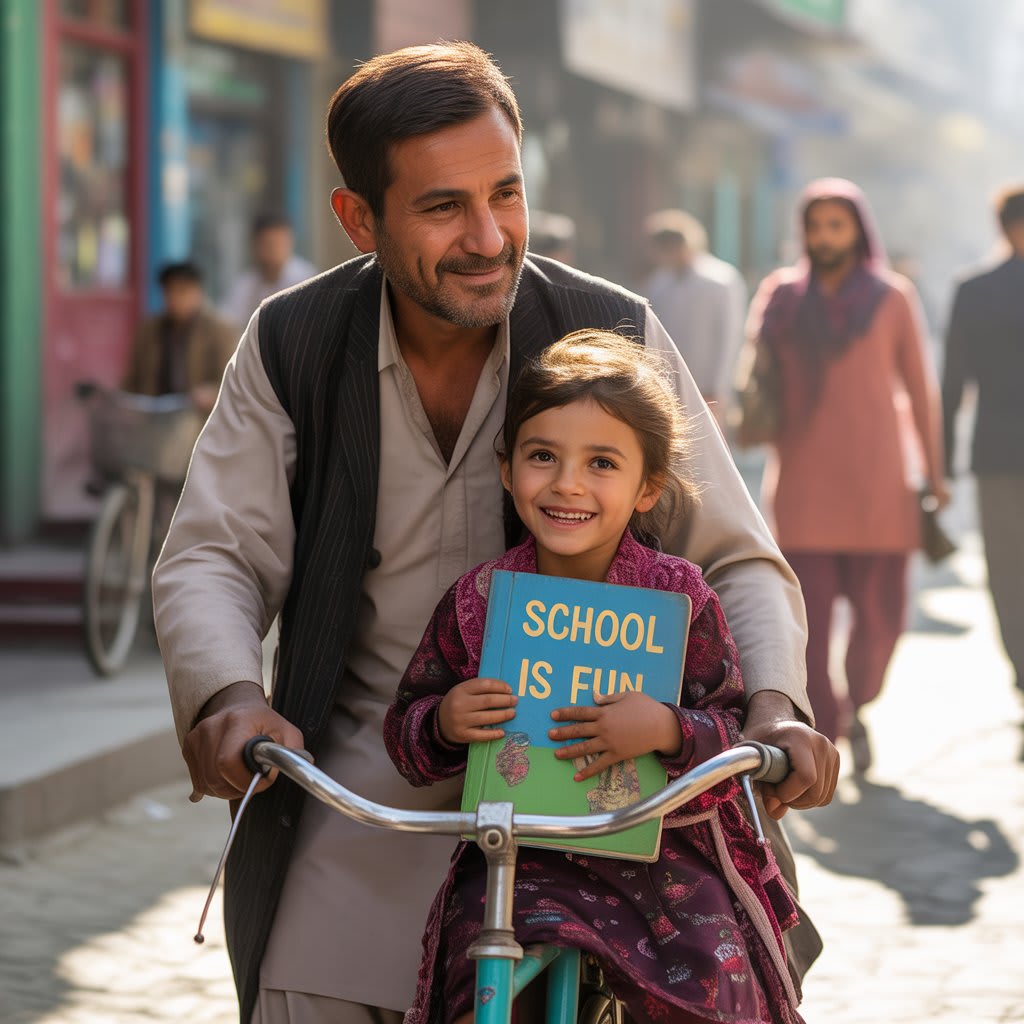
Every morning before the sun fully claims the sky over Kabul, Abdul Hakim leaves his modest home carrying only an old wooden stool and a small flask of tea. His destination is always the same: the heavy iron gates of the girls’ school that his daughter, Zainab, attends.
The journey is not far — just a fifteen-minute walk through narrow, dusty alleys lined with fruit vendors, shuttered shops, and children kicking stones. But for Abdul Hakim, this walk feels like a prayer in motion. It is his daily ritual, his act of quiet defiance against the shadows that have long hung over Afghan girls seeking education.
At fifty-six, Abdul Hakim’s beard has turned a soft grey, and lines mark his forehead like etchings from years of struggle. A former shopkeeper, he closed his small stationery store two years ago, not for lack of business, but because his heart could not bear being away from the school. The security situation had worsened, and threats to girls’ schools had multiplied. Some neighbors said he was foolish; others called him stubborn. But to Abdul Hakim, it was simple: his daughter’s education was worth every lost afghani and every hour spent waiting.
Each morning, after helping Zainab tie her white scarf and packing her simple lunch — usually flatbread and a boiled egg — he follows her to the school gates. She protests gently, embarrassed by her father’s presence among the other waiting fathers and mothers. Yet Abdul Hakim only smiles, squeezes her hand, and whispers the same words he has whispered every day for the past year:
“I’ll be right here, my flower. Go and learn.”
From the moment she disappears behind the gate until the final bell rings, Abdul Hakim sits on his stool under the shade of a battered mulberry tree. Around him, the world moves: rickshaws rattle past, shopkeepers argue over prices, and small boys sell tea to anyone who stops long enough to notice them. Yet his gaze remains fixed on the school, as though his watchfulness alone could ward off danger.
Sometimes, he chats with other parents — a mother who sells bread from a basket balanced on her head, or a father who repairs shoes by the roadside. They share stories: of daughters who dream of becoming doctors, teachers, even pilots. They laugh quietly at each other’s worries, though the laughter often feels thin, like a thread stretched too tight.
At noon, the call to prayer echoes through the neighborhood, and Abdul Hakim pauses to pray on a piece of folded cloth. Then he returns to his vigil, sipping tea that has long gone cold. His thoughts drift to the past — to his wife, lost to illness many winters ago, and to his own mother, who never learned to read but taught him the value of learning by the way her eyes lingered on his schoolbooks.
Sometimes, memories threaten to break him: the time militants burned a nearby school, or when Zainab came home in tears because a classmate’s family was forcing her to drop out. But each time, Abdul Hakim steels himself. His waiting is more than a father’s protectiveness; it is a promise that he will not let fear steal his daughter’s chance at a better life.
When the school bell finally rings in the afternoon, Abdul Hakim rises, knees stiff. The gates swing open, and girls flood out in a swirl of white scarves and laughter. He scans the crowd, heart quickening, until he spots Zainab’s familiar face. Their eyes meet, and she smiles — a shy, grateful smile that makes every hour of waiting worthwhile.
They walk home side by side. Sometimes she tells him about her lessons — new English words, history of ancient kings, poems she’s memorized. Other times, they walk in silence, content in the small peace of being together.
At night, when the city settles into uneasy sleep, Abdul Hakim sits by the lamp, sewing tears in his daughter’s schoolbag or mending her worn shoes. Tomorrow, he knows, will be the same: another day of waiting, another day of hope.
Yet in that wait, Abdul Hakim has found his purpose. For as long as Zainab wants to learn, he will be there — at the gates, on his stool, keeping watch. Because in the heart of a father who loves without measure, even waiting becomes an act of courage. And sometimes, that courage is all that keeps hope alive.
About the Creator
Malak Khalid Khan
I am graduate from university of swat. I really like to tell real stories. if you are on my page welcome and congratulation you are about to read real stories. If u like my stories let me know about it in comments ,Thanks.
Enjoyed the story? Support the Creator.
Subscribe for free to receive all their stories in your feed.
Comments
There are no comments for this story
Be the first to respond and start the conversation.