
The Role of Data Engineers vs Data Scientists
What's the Difference
As an expert in the data science field, I can confidently say that the roles of Data Engineers and Data Scientists are both vital for any data-driven organization. While their functions may seem similar, each position has its own distinct set of responsibilities that complement one another. Understanding the difference between Data Engineers and Data Scientists is key to recognizing how these professionals collaborate to unlock the full potential of data, ensuring accurate insights and effective decision-making.
What is a Data Engineer?
A Data Engineer is a professional who specializes in building and maintaining the infrastructure that allows data to flow efficiently through an organization. They are the key players in designing and implementing the systems that manage, store, and process data.
Key Responsibilities:
- Design Data Pipelines: Build and maintain efficient pipelines to collect, store, and process data from multiple sources.
- Data Transformation: Convert raw data into structured formats that are easy for Data Scientists and Analysts to use.
- Optimize Data Flow: Ensure data flows seamlessly from various sources to the storage or processing systems.
- Maintain Data Systems: Oversee the health and performance of data systems to ensure reliability and scalability.
Tools and Technologies:
- Big Data Tools: Hadoop, Apache Spark
- Databases: SQL (MySQL, PostgreSQL) and NoSQL (MongoDB, Cassandra)
- Cloud Platforms: AWS, Google Cloud, Azure
- Data Warehousing: Amazon Redsa Transformation: Convert raw data into structured formats that are easy for Data Scientists and Analysts to use.
- Optimize Data Flow: Ensure data flows seamlessly from various sources to the storage or processing systems.
- Maintain Data Systems: Oversee the health and performance of data systems to ensure reliability and scalability.
Focus Area:
Backend Infrastructure: Data Engineers focus on backend systems that support large-scale data processing and storage.
Raw Data Handling: They work with unstructured data and transform it into a format suitable for analysis.
What is a data scientist?
A Data Scientist is a professional who analyzes and interprets complex datasets to provide actionable insights, aiding organizations in making data-driven decisions. They use statistical methods, machine learning algorithms, and programming skills to extract value from data.
Key Responsibilities:
- Data Analysis: Analyze large, complex datasets to uncover patterns, trends, and relationships.
- Predictive Modeling: Build and train machine learning models to make predictions or classifications based on data.
- Data Interpretation: Interpret data results to provide meaningful insights that guide business strategies.
- Business Problem Solving: Use data to solve business problems and make recommendations for improvements.
Tools and Technologies:
- Programming Languages: Python, R, SQL
- Machine Learning: Scikit-learn, TensorFlow, Keras
- Data Visualization: Tableau, Power BI, Matplotlib, Seaborn
- Statistical Analysis: Advanced statistical techniques for hypothesis testing, regression, and experimental design
Focus Area:
- Data Manipulation & Visualization: Data Scientists manipulate and visualize data to reveal insights and trends.
- Predictive Analytics: They leverage predictive models to forecast future trends or behaviors based on historical data.
Collaboration Between Data Engineers and Data Scientists
Although Data Engineers and Data Scientists have distinct roles, they must collaborate closely to ensure the success of any data-driven initiative. Data Engineers design and implement the necessary infrastructure that allows Data Scientists to access the right data at the right time. Without the data pipelines and storage systems built by data engineers, data scientists would struggle to work with the data effectively.
Career Pathways and Education
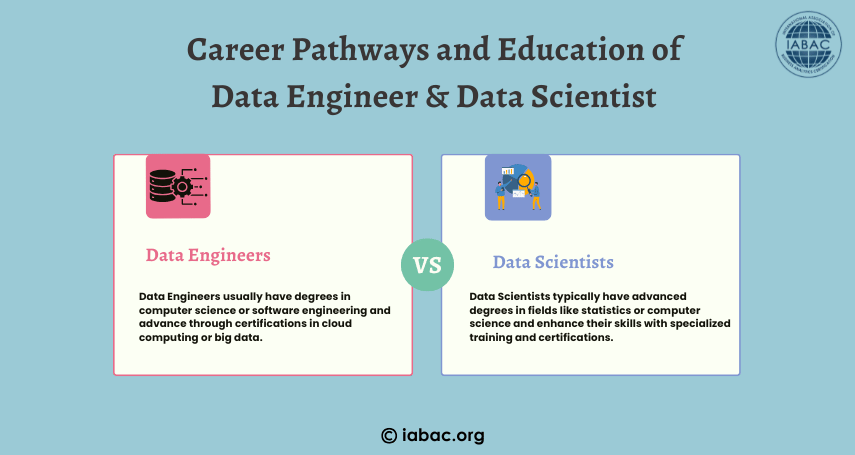
The career paths for Data Engineers and Data Scientists differ, with each requiring a unique set of educational backgrounds and professional development strategies.
Data Engineers Typically hold degrees in computer science, software engineering, or a related field. They may start as software developers or database administrators before specializing in data engineering. Certifications in cloud computing or big data technologies can help them advance in this role.
Data Scientists: Data scientists often hold advanced degrees, such as a Master's or PhD, in fields like statistics, mathematics, computer science, or engineering. They also pursue specialized training in data science, machine learning, and AI to deepen their expertise. AI or data Science certifications from reputable organizations can further enhance their qualifications.
Which Role Should You Pursue?
If you’re trying to decide between a career as a data engineer or data scientist, it largely depends on your interests and skills. If you enjoy working with infrastructure, building systems, and ensuring data is accessible for analysis, a career in data engineering may be the right choice for you. If you’re more interested in analyzing data, building predictive models, and deriving actionable insights, then becoming a Data Scientist could be a better fit.
Both roles are highly valued in the tech industry, and demand for professionals in these areas continues to grow. Ultimately, the decision between Data Engineers and Data Scientists comes down to your passion for coding, data infrastructure, and analysis. To enhance your skills and gain a competitive edge, pursuing certifications from IABAC (International Association of Business Analytics Certification) in AI, Data Science, or Data Analytics can be an excellent choice. These certifications are designed to provide you with the knowledge and practical expertise needed to excel in either of these dynamic roles.
About the Creator
Enjoyed the story? Support the Creator.
Subscribe for free to receive all their stories in your feed.
Comments
There are no comments for this story
Be the first to respond and start the conversation.