
The Role of a Data Scientist: Breaking Down the Job Description
Data Scientist
The Role of a Data Scientist: Breaking Down the Job Description
As an experienced certified data scientist, I’ve seen firsthand how this role has become crucial in today’s data-driven world. Data scientists blend technical expertise with analytical skills to extract valuable insights from complex datasets, driving informed decisions across industries. In this blog, we’ll break down the core responsibilities, essential skills, and impact of a data scientist.
What Is a Data Scientist?
A Data Scientist collects, analyzes, and interprets complex data to help businesses make better decisions. Using statistical methods, algorithms, and machine learning techniques, they extract insights from structured and unstructured data.
More than just a technical role, a Data Scientist must also understand the business context. They connect the dots between data findings and business impact, ensuring that their insights align with organizational goals.
Daily Responsibilities and Core Functions
The tasks of a Data Scientist vary depending on the company, industry, and team structure. However, some common responsibilities include:
Data Collection: Gathering information from databases, APIs, or raw data files.
Data Cleaning: Removing inconsistencies, duplicates, and errors in datasets.
Exploratory Data Analysis (EDA): Identifying trends, correlations, and patterns.
Model Building: Creating predictive models using machine learning.
Data Visualization: Presenting results with tools like Tableau, Power BI, or Python libraries.
Collaboration: Working with teams such as marketing, product, and engineering to align data efforts with strategic goals.
A Data Scientist must be detail-oriented, analytical, and capable of managing multiple data pipelines simultaneously.
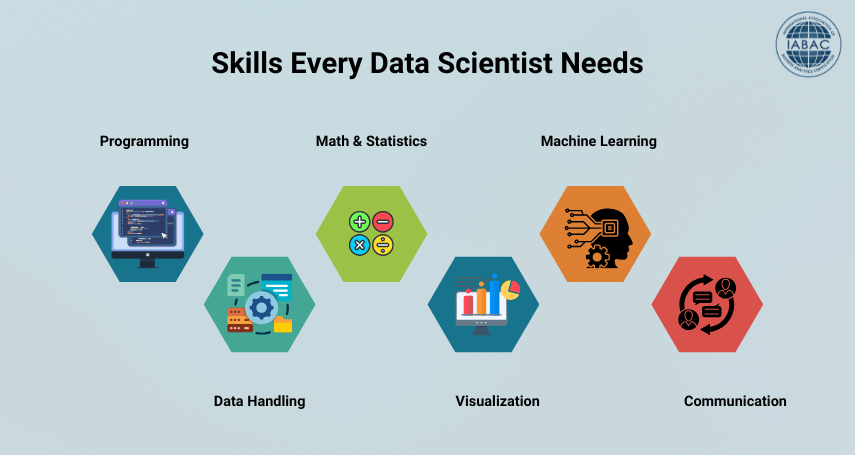
Skills Every Data Scientist Needs
To succeed in this role, a blend of hard and soft skills is essential. Here’s a quick rundown of what most companies look for:
Programming: Proficiency in Python, R, and SQL.
Math & Statistics: Solid grasp of statistical testing, linear algebra, and probability.
Machine Learning: Familiarity with supervised and unsupervised learning models.
Data Handling: Experience working with large datasets using tools like Pandas, NumPy, and Spark.
Visualization: Ability to translate data into charts, dashboards, and reports.
Communication: Explaining technical insights in plain language to non-technical stakeholders.
Being a successful Data Scientist isn’t only about technical chops—it’s about problem-solving, storytelling, and influence.
Tools of the Trade
A Data Scientist uses a variety of software and platforms to analyze data efficiently. Some of the most popular tools include:
Jupyter Notebooks: Ideal for exploratory analysis and presentations.
Scikit-learn: A key Python library for implementing machine learning algorithms.
TensorFlow & Keras: Useful for deep learning applications.
SQL & NoSQL Databases: For querying and managing data.
Apache Spark: For handling large-scale data processing tasks.
Cloud Platforms: AWS, Google Cloud, and Microsoft Azure offer scalable resources for model deployment. Keeping up with these tools helps a Data Scientist stay competitive in an ever-evolving field.
Certifications and Education Pathways
Most data Scientists have degrees in computer science, mathematics, statistics, or a related field. However, the rise of certification programs has opened up new pathways for professionals looking to switch careers or upskill quickly.
One respected name in this space is IABAC (International Association of Business Analytics Certifications). IABAC offers globally recognized certifications in Data Science, AI, and Business Analytics that focus on real-world applications.
Industries That Rely on Data Scientists
Almost every sector now relies on data to drive decision-making. The demand for Data Scientists spans across industries:
Healthcare: Patient care analytics, medical research, and hospital operations.
Finance: Credit scoring, fraud detection, and investment forecasting.
Retail: Customer segmentation, demand forecasting, and inventory optimization.
Tech: Product personalization, user experience optimization, and AI development.
Government: Public health monitoring, urban planning, and social research.
No matter the domain, businesses are actively hiring Data Scientists to unlock insights and gain a competitive edge.
Career Growth and Future Trends
The job market for Data Scientists is booming, and it shows no sign of slowing down. With experience, professionals can move into roles such as:
Senior Data Scientist: Solves complex problems with advanced analytics and mentors junior team members.
Machine Learning Engineer: Builds and deploys scalable machine learning models into production.
Data Science Manager: Leads data teams and ensures projects align with business objectives.
Chief Data Officer (CDO): Oversees an organization’s data strategy, governance, and innovation.
Looking forward, the role will continue to evolve with advances in artificial intelligence, automation, and ethical AI practices. The ability to combine technical expertise with strategic thinking will be more valuable than ever.
The role of a Data Scientist is one of the most dynamic and impactful careers today. These professionals use data to drive business decisions, shaping the future of industries. If you're looking to break into the field, consider an IABAC certification program. With the right education, experience, and curiosity, you can become a key player in the evolving data-driven world.
About the Creator
Enjoyed the story? Support the Creator.
Subscribe for free to receive all their stories in your feed.
Comments
There are no comments for this story
Be the first to respond and start the conversation.