
The Online Education Market Is Heading Toward a Trillion-Dollar Future
Internet expansion, mobile learning, AI-powered platforms, and demand for flexible education are transforming how the world learns.

Education is no longer limited to classrooms
The global education system is undergoing one of the biggest transformations in modern history. What once depended heavily on classrooms, textbooks, and physical attendance is now increasingly powered by internet connectivity, smartphones, cloud computing, and artificial intelligence. Online education has evolved from an optional learning format into a central pillar of modern education systems worldwide.
Students, working professionals, corporations, and governments are now relying on digital learning platforms for skill development, certification programs, academic degrees, and workforce training. The convenience and accessibility of learning from anywhere have permanently changed how people think about education.
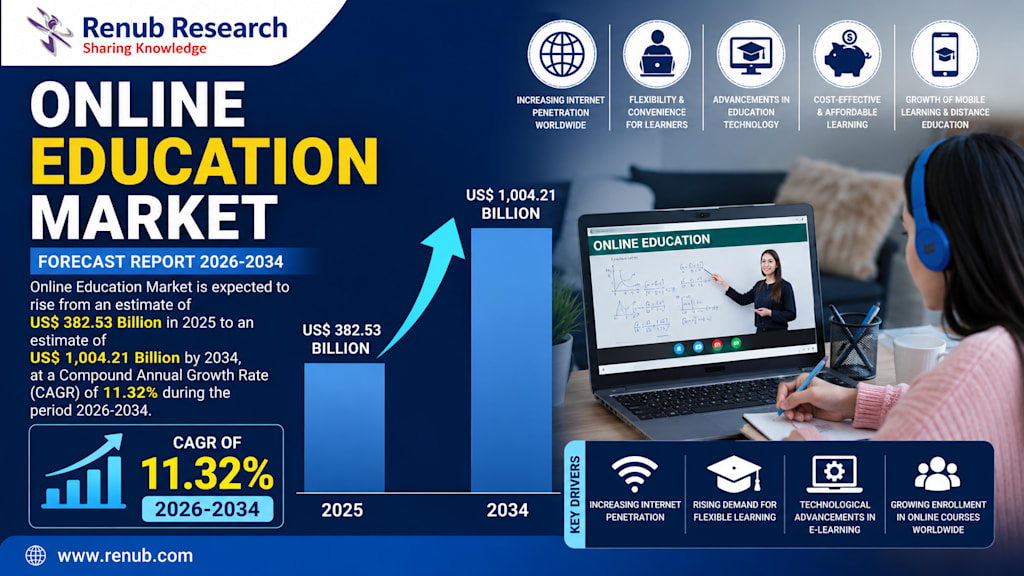
According to Renub Research, the Online Education Market is expected to grow from US$ 382.53 billion in 2025 to US$ 1,004.21 billion by 2034, registering a compound annual growth rate (CAGR) of 11.32% from 2026 to 2034. The report highlights increasing internet penetration, flexibility in learning, and rising adoption of technology in education as key growth drivers behind this massive expansion.
The projection suggests that online education is no longer a temporary trend. It is becoming one of the largest and fastest-growing segments in the global digital economy.
The rise of anytime, anywhere learning
Online education allows learners to access classes, lectures, assessments, and learning modules through internet-connected devices such as smartphones, tablets, and computers. It offers flexibility that traditional education systems often struggle to provide.
This flexibility has become especially important for working professionals, students balancing multiple responsibilities, and learners living in regions where access to educational institutions is limited.
The report explains that online education gained significant popularity during periods of global disruption when students could not attend physical classrooms. What initially began as a necessity eventually evolved into a preferred learning method for millions of people worldwide.
Educational institutions are also increasingly embracing digital learning because it allows them to reach broader audiences across cities, countries, and continents. Universities, colleges, and training organizations can now offer courses to students globally without geographic restrictions.
Internet and smartphone growth are fueling the market
One of the strongest drivers behind the online education boom is the rapid growth of internet access and smartphone usage.
According to the report, approximately 74% of the world’s population accessed the internet in 2025, compared to 71% the previous year. That represents nearly 6 billion internet users globally.
Smartphone adoption has also expanded dramatically, with around 7.4 billion smartphones currently in use worldwide, contributing significantly to mobile learning growth.
High-speed 4G and 5G internet networks are improving the quality of video streaming, virtual classrooms, and interactive educational sessions. Students can now participate in live lectures, access cloud-based materials, complete assignments, and collaborate remotely from almost anywhere.
Governments and telecommunications companies are also investing heavily in digital infrastructure, which is helping online education reach previously underserved populations.
This combination of affordable smartphones, mobile internet access, and digital infrastructure is making education more accessible than ever before.
Skill-based learning is becoming a global priority
Another major reason for the expansion of online education is the growing demand for skill development and career-focused learning.
The modern job market changes rapidly, particularly in industries such as technology, healthcare, business, finance, artificial intelligence, and digital marketing. Employees are under increasing pressure to continuously upgrade their skills to remain competitive.
Online education platforms provide flexible solutions for people who want to learn while managing jobs, businesses, or family responsibilities.
Professionals are increasingly enrolling in certification courses, diploma programs, and short-term training modules to improve employability and adapt to evolving workplace demands.
Companies are also investing heavily in digital learning for employee training. Businesses now use online platforms to improve workforce productivity, leadership development, technical expertise, and compliance training.
The report highlights a February 2026 partnership between Echo360 and Exxat focused on advancing skills-based education and workforce readiness through digital learning technologies.
This reflects a broader global shift toward practical, career-oriented education rather than purely traditional academic models.
Artificial intelligence is reshaping digital learning
Technology is fundamentally changing the online learning experience. Artificial intelligence, virtual reality, cloud computing, and interactive learning systems are making digital education more personalized and effective.
AI-powered learning systems can now analyze student performance and create customized learning paths based on strengths, weaknesses, and progress levels.
Video conferencing technologies are also improving classroom interaction by allowing real-time communication between students and instructors. Virtual classrooms are increasingly replicating traditional classroom experiences while adding digital flexibility.
Cloud computing has improved secure storage and accessibility of educational content, enabling learners to access materials from multiple devices at any time.
Gamification is another major trend. Educational platforms now integrate quizzes, rewards, progress tracking, and interactive exercises to increase student engagement and retention.
The report also references the launch of a new e-learning platform focused on understanding EU labor legislation and social security coordination, highlighting how specialized digital learning content is expanding into professional and regulatory education fields.
Online higher education is expanding rapidly
Online higher education has become one of the most influential segments within the broader online education market.
Universities and colleges are increasingly offering undergraduate degrees, postgraduate programs, diplomas, and professional certifications through online platforms.
For students, online higher education offers affordability, flexibility, and the ability to study while maintaining employment or personal commitments.
International students also benefit because online learning removes geographic barriers and travel costs associated with studying abroad.
Importantly, many online degree programs are now considered academically equivalent to traditional classroom programs, improving acceptance among employers and educational institutions.
As digital education technology improves, online higher education is expected to play an even larger role in the future global education ecosystem.
Corporations are becoming major consumers of online learning
The online education market is no longer limited to schools and universities. Large enterprises are becoming some of the biggest adopters of digital learning systems.
Organizations use online education platforms to train employees in leadership, management, technical skills, cybersecurity, compliance, and emerging technologies.
Cloud-based learning management systems allow businesses to monitor employee progress, measure training effectiveness, and reduce the cost of traditional in-person training programs.
As industries continue evolving through automation and digital transformation, companies increasingly view workforce education as a strategic investment.
Corporate learning is expected to remain one of the strongest long-term growth segments within the online education industry.
Mobile learning is becoming dominant
The rapid rise of smartphones is accelerating the growth of mobile e-learning.
Mobile learning platforms allow users to access educational content anytime and anywhere through mobile applications and browser-based systems.
Microlearning — short, focused educational modules — is becoming particularly popular among younger learners and working professionals because it fits easily into busy schedules.
Mobile e-learning is also helping bridge educational gaps in developing regions where smartphones are more accessible than laptops or desktop computers.
Educational institutions, businesses, and training providers are increasingly optimizing content specifically for mobile devices, making this one of the fastest-growing segments in digital education.
The industry still faces serious challenges
Despite strong growth, the online education industry continues to face major obstacles.
One of the biggest challenges is unequal access to digital infrastructure. Many rural and developing regions still lack high-speed internet connectivity, affordable devices, and stable electricity.
Without reliable internet access, students cannot fully participate in online learning environments. This digital divide creates educational inequality and limits market growth in underserved regions.
Student engagement also remains a concern. Online education lacks physical classroom interaction, which can affect motivation, communication, and learning quality.
Practical learning experiences are particularly difficult to replicate online for subjects such as engineering, medicine, and laboratory sciences.
Education providers are attempting to address these issues through interactive technologies, virtual simulations, and gamified learning experiences, but engagement challenges remain an important industry issue.
The United States remains a global leader
The United States continues to dominate the online education market because of its advanced ed-tech ecosystem, strong digital infrastructure, and widespread adoption of AI-powered learning systems.
American universities, corporations, and technology companies are heavily investing in virtual classrooms, AR/VR learning tools, and cloud-based education systems.
The report highlights the January 2025 launch of an AR/VR educational platform by zSpace designed for elementary school students without requiring headsets.
These innovations demonstrate how immersive technology is beginning to shape the future of education.
India is becoming one of the fastest-growing markets
India’s online education market is expanding rapidly due to rising internet access, smartphone penetration, population growth, and demand for affordable education.
Mobile learning has become especially popular in India because smartphones are widely used across urban and rural regions.
Online education platforms are also helping reduce the educational divide between cities and smaller towns by making quality learning resources accessible remotely.
The report notes that Vedantu secured additional funding in September 2024, highlighting continued investor confidence in India’s ed-tech industry despite broader market challenges.
Final thoughts
The online education market is entering a defining decade.
What started as a digital alternative to traditional classrooms has evolved into a global ecosystem powered by internet connectivity, artificial intelligence, mobile technology, and workforce transformation.
Students want flexibility. Professionals want skill development. Businesses want better workforce training. Governments want broader access to education. Online education sits at the center of all those demands.
While challenges around digital access, engagement, and infrastructure still need to be addressed, the long-term direction of the market is clear.
With the industry projected to surpass US$ 1 trillion by 2034, online education is no longer simply part of the future of learning — it is rapidly becoming the foundation of it.
About the Creator
Enjoyed the story? Support the Creator.
Subscribe for free to receive all their stories in your feed.
Comments
There are no comments for this story
Be the first to respond and start the conversation.