
The Man Who Changed the Way We See the Universe
The Man Who Changed the Way
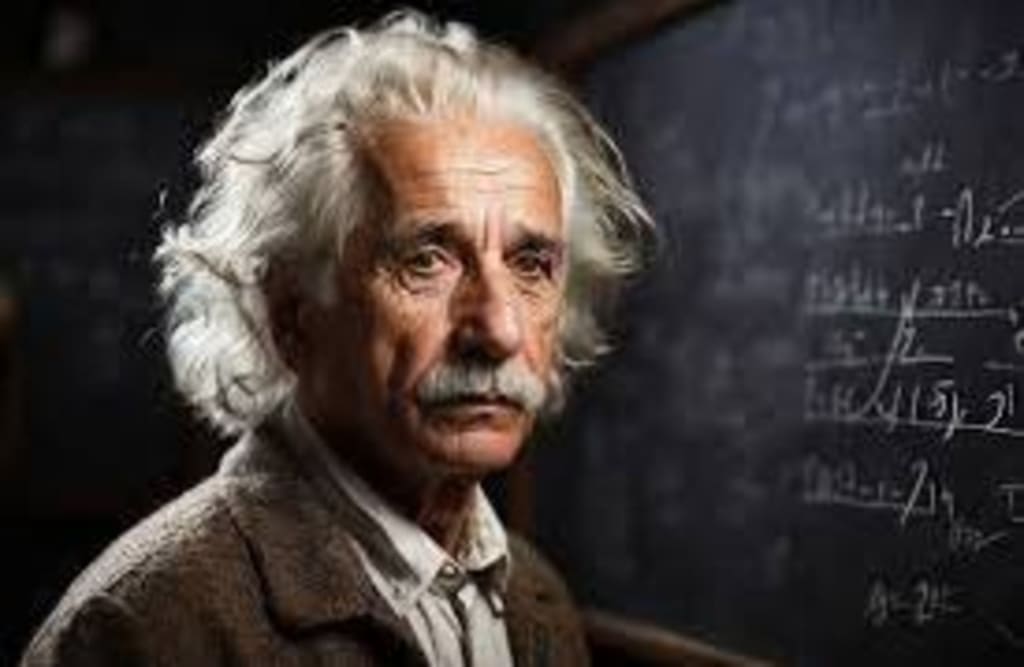
Albert*Einstein is one of the most famous scientists in history. He is best known for his theory of relativity, which changed our understanding of time, space, and the universe. His work has influenced not only physics but also the way we think about reality itself. Despite his complex ideas, Einstein’s life and achievements can be understood in simple terms. Let’s take a look at who Albert Einstein was, what he did, and why he is still important today. Early Life and Education Albert Einstein was born on March 14, 1879, in Ulm, a city in southern Germany. His family was Jewish, though they were not particularly religious. From a young age, Einstein showed signs of being a bright and curious child. However, he did not do well in traditional school settings. Teachers often thought he was lazy or slow because he didn’t like memorizing facts and wasn’t interested in the subjects taught at school. Despite his struggles in school, Einstein loved learning. He was especially curious about how things worked and why things happened the way they did. When he was five years old, his father gave him a compass, and Einstein became fascinated by the invisible forces that moved the needle. This small experience sparked his interest in science and the mysteries of the universe. Einstein later attended school in Switzerland, where he found a more supportive learning environment. In 1900, at the age of 21, he graduated from the Swiss Federal Polytechnic in Zurich. Though he wanted to become a teacher, he couldn’t find a job, so he started working at the Swiss Patent Office. This job allowed him to review new inventions, giving him time to think about scientific problems. The Miracle Year In 1905, when Einstein was just 26 years old, he had what is known as his “Annus Mirabilis” or “Miracle Year.” During this time, he published four groundbreaking scientific papers that changed the world of physics forever. Each of these papers introduced new ideas that challenged the old ways of thinking about nature. 1. The Photoelectric Effect: Einstein showed that light behaves not just like a wave, as scientists had believed, but also like a particle. This idea helped explain how light can knock electrons out of materials, which was an important step toward understanding quantum physics. 2. Brownian Motion: In another paper, Einstein explained the random movement of small particles suspended in liquids, which gave further evidence for the existence of atoms. At the time, the idea of atoms was still debated, but Einstein’s work helped prove that everything is made of tiny, invisible particles. 3. Special Theory of Relativity: Perhaps the most famous of his 1905 papers was on the special theory of relativity. In simple terms, this theory says that the laws of physics are the same for all observers, regardless of how fast they are moving. One of the most famous equations in the world, E = mc², comes from this theory. It shows that energy (E) and mass (m) are related, and that a small amount of mass can be turned into a large amount of energy. 4. The Theory of Relativity and Mass: Einstein's final paper from 1905 explored the relationship between mass and energy. He explained that as objects move closer to the speed of light, they gain energy and effectively become heavier. This led to a deeper understanding of the nature of matter and energy. These papers made Einstein famous in the scientific community. However, it would take a few more years before the world truly recognized his genius. General Theory of Relativity In 1915, Einstein completed his most important work, the **General Theory of Relativity**. This theory expanded on his earlier work on special relativity and provided a new way of understanding gravity. Before Einstein, scientists followed Isaac Newton’s ideas about gravity, which said that gravity was a force between two objects. Newton’s theory worked well for most things but couldn’t explain everything, especially what happens near very massive objects like stars or planets. Einstein’s general theory of relativity proposed that gravity is not a force but a result of how mass warps, or bends, space and time. According to this theory, objects like the Earth and the Sun don’t pull on each other through space. Instead, the Sun bends the space around it, and the Earth follows that curved space. Imagine putting a heavy ball in the middle of a soft rubber sheet—the sheet bends, and smaller balls placed nearby will roll toward the heavy ball because the sheet is curved. Einstein’s theory was confirmed in 1919 when scientists observed a solar eclipse. They saw that light from distant stars bent as it passed near the Sun, just as Einstein had predicted. This discovery made Einstein famous worldwide, and he became a symbol of scientific genius. Einstein's Later Life and Legacy In 1921, Einstein won the Nobel Prize in Physics, not for his theory of relativity, but for his work on the photoelectric effect. Throughout his life, he continued to work on various scientific problems, but none of his later work had the same impact as his earlier discoveries. Einstein’s fame also brought him into the world of politics. He was a passionate pacifist and spoke out against war and violence. However, when Adolf Hitler and the Nazis rose to power in Germany in the 1930s, Einstein, who was Jewish, fled to the United States. He became an American citizen in 1940 and spent the rest of his life teaching and researching at Princeton University. Although he was a lifelong pacifist, Einstein played a small role in the development of the atomic bomb. In 1939, he signed a letter to U.S. President Franklin D. Roosevelt, warning that Germany might be developing atomic weapons. This letter helped start the U.S. government’s work on the atomic bomb, though Einstein did not directly participate in the project. After the bomb was used during World War II, Einstein became an outspoken advocate for nuclear disarmament. Einstein died on April 18, 1955, at the age of 76. He left behind a legacy of scientific discovery and a message of peace and humanity. His work continues to influence modern physics, from our understanding of black holes to the development of technologies like GPS, which relies on the principles of relativity. Why Einstein’s Work Still Matters Even today, Einstein’s ideas shape the way we see the universe. His theory of relativity is essential to modern physics, helping scientists understand everything from the Big Bang to the way galaxies move. Technologies like GPS, which helps people find directions on their phones, work because of the adjustments based on Einstein’s theories. Without his contributions, much of the technology and scientific knowledge we have today would not exist. More than just his scientific discoveries, Einstein’s way of thinking has also inspired generations of people. He showed that curiosity and imagination are just as important as knowledge. As he once said, “Imagination is more important than knowledge. For knowledge is limited, whereas imagination encircles the world.” Albert Einstein was a man who dared to question the way things worked and offered new answers that changed everything. His life and work remind us to never stop asking questions, because the answers can change the world. Conclusion Albert Einstein’s contributions to science and humanity go far beyond his famous equation, E = mc². His work changed our understanding of the universe and laid the groundwork for modern physics. Beyond science, his dedication to peace and human rights made him a symbol of intellectual and moral courage. Today, Einstein remains a global icon of genius, creativity, and compassion, proving that one person’s ideas can transform the world.
About the Creator
Enjoyed the story? Support the Creator.
Subscribe for free to receive all their stories in your feed.
Comments
There are no comments for this story
Be the first to respond and start the conversation.