

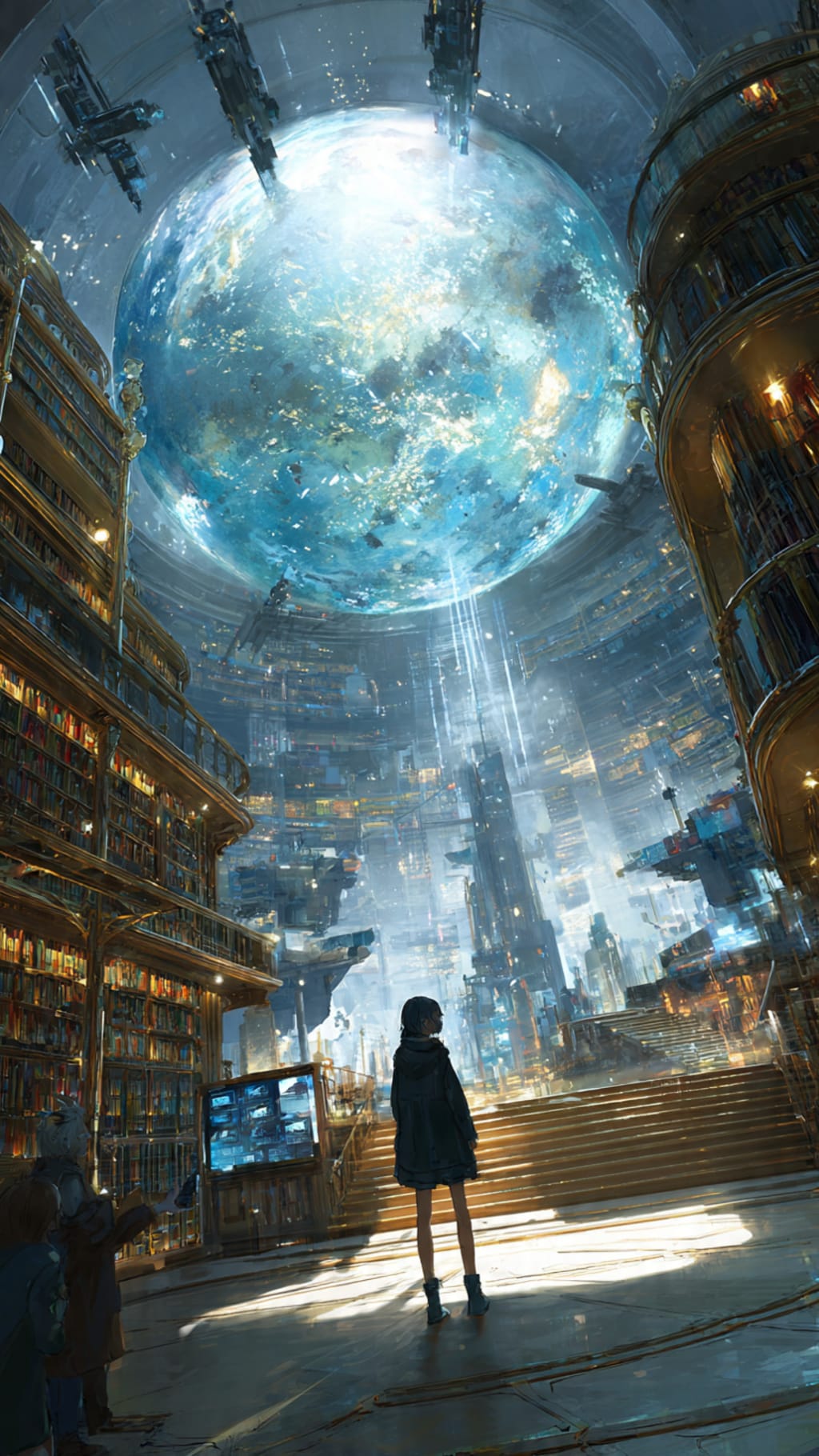
In the year 2148, the city of Aurora glowed brighter than the stars above it. Towering skyscrapers stretched into the clouds, their surfaces covered with intelligent glass that changed color according to weather, mood, and public events. Flying vehicles drifted silently through designated sky lanes, while delivery drones zipped between buildings carrying everything from groceries to medical supplies. Technology had become the foundation of human life. Artificial intelligence managed transportation, healthcare, agriculture, education, and communication. Every citizen carried a neural device called a Link, allowing them to access information instantly through thought alone. Life was efficient. Problems were solved before they became crises. Diseases were diagnosed before symptoms appeared. Accidents were nearly nonexistent. Yet beneath the shining surface of progress, something important had been forgotten. People no longer remembered how to think without machines. And deep within Aurora stood a forgotten building that held the key to changing everything. Chapter 1: The Curious Student Seventeen-year-old Maya lived in the heart of Aurora. Like everyone else, she attended classes through the city's educational AI system. Every morning, lessons appeared directly in her mind through her Link. Mathematical formulas, historical facts, scientific theories, and language lessons flowed effortlessly into her memory. No textbooks. No notebooks. No classrooms. No teachers. The system was perfect—or so everyone believed. One afternoon, Maya received an unusual assignment from the educational network. "Research an obsolete information system from the twenty-first century." Most students would simply ask the AI for a summary and submit it immediately. But Maya was different. She liked questions. She liked mysteries. Instead of requesting an instant report, she searched for original sources. The search results led her to a location she had never heard of: The Central Library of Aurora. Status: Inactive. Access Frequency: Zero visitors in twelve years. Curiosity overwhelmed her. The next day, she decided to visit. Chapter 2: The Silent Building The library stood between two massive data towers. Unlike the surrounding structures, it looked ancient. Its stone walls were weathered. Its windows were dusty. Its entrance doors were made of wood. Real wood. Maya pushed open the heavy door. A faint creaking sound echoed through the building. Inside, rows upon rows of shelves stretched into the distance. Thousands of books rested quietly beneath soft beams of sunlight. Maya had seen images of books before. But seeing them in person felt different. They seemed alive somehow. A voice suddenly spoke behind her. "Not many visitors these days." Startled, Maya turned around. An elderly man stood nearby. His silver hair framed a kind face. "Who are you?" Maya asked. The man smiled. "My name is Elias. I'm the librarian." "Librarian?" "Keeper of knowledge." Maya glanced around. "Why keep all this when information is available instantly?" Elias looked thoughtfully at the shelves. "Because information and knowledge are not the same thing." Chapter 3: The Difference Between Knowing and Understanding Over the following weeks, Maya returned regularly. Elias showed her books on science, philosophy, engineering, history, and literature. At first, reading felt painfully slow. Without instant neural downloads, learning required effort. But something unexpected happened. She began asking more questions. When she read about the invention of computers, she wondered how people had imagined such machines. When she studied early robotics, she wondered what fears and hopes had driven innovation. When she explored stories about space exploration, she wondered what courage felt like. One afternoon she asked Elias: "Why doesn't the AI teach like this?" Elias handed her an old book. "Because machines can deliver answers. They cannot replace curiosity." Maya thought about that. For the first time, she realized how much of her education involved receiving information rather than exploring it. The discovery changed her. Chapter 4: The Hidden Chamber Several months later, Maya noticed something strange. A locked door stood at the back of the library. She had never seen it open. "What's behind there?" she asked. Elias hesitated. Then he smiled. "I suppose you're ready." He entered a code on an ancient keypad. The door slowly opened. Beyond it lay a circular room filled with technology unlike anything Maya had ever seen. Old computers. Servers. Storage drives. Projectors. Holographic archives. At the center stood a glowing sphere. "What is this place?" she whispered. "The Memory Chamber." Elias approached the sphere. "This contains humanity's most important technological history." Images appeared around them. The first computers. The internet. Early artificial intelligence. Quantum processors. Planetary communication networks. Autonomous cities. Everything. Maya watched in amazement. Then she noticed something unusual. Many records were marked RESTRICTED. "Why are these hidden?" she asked. Elias grew serious. "Because they tell a story many people don't want to hear." Chapter 5: The Great Dependency The sphere displayed events from nearly a century earlier. As AI systems became more powerful, humans gradually delegated responsibilities to machines. At first, the changes were beneficial. Traffic became safer. Healthcare improved. Energy waste decreased. Food shortages disappeared. Governments celebrated technological success. Businesses embraced automation. Citizens enjoyed convenience. But over time, people stopped practicing many skills. Navigation. Critical thinking. Problem-solving. Memory retention. Creative experimentation. Machines handled everything. Human capabilities slowly weakened. Then came an event known as The Great Blackout. A massive solar storm disrupted global networks. For only forty-eight hours, advanced systems became unavailable. The consequences were catastrophic. Millions could not perform tasks once considered basic. Infrastructure slowed. Communication collapsed. Decision-making stalled. The crisis was eventually resolved. Yet it revealed a dangerous truth. Humanity had become dependent. Technology was powerful. But dependence was fragile. Chapter 6: The Secret Mission Maya listened carefully. "Is that why you keep the library?" Elias nodded. "After the blackout, a group of scientists, educators, engineers, and historians created a project." "What project?" "The Preservation Initiative." The room filled with holographic faces. Researchers. Inventors. Teachers. Programmers. Authors. Their goal had been simple. Preserve not only information but also human thinking. They feared future generations might lose the ability to innovate independently. The library became one of the initiative's final centers. A place where people could learn how knowledge was created—not merely consumed. Elias looked at Maya. "For years, nobody came." "Until now," she replied. "Until now." Chapter 7: The System Failure Several weeks later, disaster struck. Aurora's central intelligence network began malfunctioning. Transportation routes became unstable. Scheduling systems generated conflicts. Communication delays spread throughout the city. Engineers worked around the clock. Yet the problems continued growing. Citizens panicked. Many had never experienced technological uncertainty. Schools closed. Businesses paused operations. Emergency services switched to backup protocols. Maya watched news reports with concern. Then she noticed something surprising. The experts appearing on broadcasts seemed confused. They relied heavily on automated diagnostic tools. But the malfunction affected those tools as well. Without machine assistance, progress slowed dramatically. Maya rushed to the library. "Elias, the city needs help." He nodded calmly. "I know." "Can we do anything?" Elias smiled. "We can try." Chapter 8: The Forgotten Engineers Inside the Memory Chamber, Maya and Elias accessed historical engineering records. They studied old troubleshooting methods. Manual system analysis. Independent verification techniques. Layer-by-layer diagnostics. Methods developed long before modern AI automation. Maya spent days reading technical documents. She learned how engineers once solved problems through observation, experimentation, and logical reasoning. Soon she noticed a pattern. The city's failures originated from a synchronization conflict between several quantum communication nodes. Automated systems had overlooked the issue because they depended on corrupted network data. Human analysis revealed what machines could not. Elias encouraged her. "Present your findings." "They won't listen to a student." "They might listen to evidence." Chapter 9: Solving the Crisis Maya submitted her report to the city's engineering council. At first, officials dismissed it. But one senior engineer examined her work carefully. Within hours, teams began testing her hypothesis. The results were astonishing. She was correct. The synchronization conflict was isolated. Repairs were implemented. Network stability gradually returned. Transportation resumed. Communication normalized. Essential services recovered. Aurora celebrated. News networks searched for the person responsible for identifying the solution. Eventually, they found Maya. Reporters asked her the same question repeatedly. "Which AI system helped you solve the problem?" Her answer surprised everyone. "No AI solved it." "What do you mean?" "I learned to think through the problem myself." The statement spread across the city. Chapter 10: A New Renaissance Interest in the library exploded. Students arrived first. Then teachers. Engineers. Scientists. Artists. Entrepreneurs. People wanted to learn how innovation worked before automation became universal. Workshops appeared across Aurora. Citizens practiced critical thinking. Creative design. Independent research. Collaborative problem-solving. Technology remained central to society. Nobody wanted to abandon it. Instead, people began pursuing balance. Machines handled repetitive tasks. Humans focused on imagination, judgment, ethics, and creativity. The relationship changed from dependence to partnership. Innovation accelerated once again. Not because technology became stronger. Because humans became stronger alongside it. Chapter 11: The Library of the Future Years later, Maya became director of the Central Library. Under her leadership, the building transformed into something extraordinary. Physical books remained. Historical archives expanded. But new technologies were welcomed as well. Artificial intelligence tutors helped students discover topics. Virtual reality simulations recreated historical events. Quantum search systems connected information across centuries. The library became a bridge between past and future. A place where human curiosity and machine intelligence worked together. Visitors came from around the world to study its model. Many cities created similar institutions. The movement became known as The New Renaissance of Learning. Epilogue: The Light That Endures On the library's hundredth anniversary, Maya stood before thousands of visitors. Behind her glowed the Memory Chamber. Around her sat children eager to learn. Some held books. Others used advanced holographic devices. All were united by curiosity. Maya smiled and addressed the crowd. "Technology is one of humanity's greatest achievements." The audience listened silently. "It allows us to communicate across worlds, solve impossible problems, and expand the limits of knowledge." She paused. "But technology is a tool, not a replacement for human thought." The great hall remained quiet. "The future belongs neither to humans alone nor to machines alone." Sunlight streamed through the library windows. "It belongs to those who combine wisdom with innovation, imagination with intelligence, and curiosity with technology." The audience erupted in applause. Outside, Aurora's shining towers reflected the evening sky. Inside, the Last Library of Light continued its mission. Preserving knowledge. Inspiring discovery. And reminding every generation that the greatest technology humanity would ever possess was not found in a machine. It was found in the human mind.
About the Creator
AFTAB KHAN
SUBSCRIBE ME AND READ STORY
Storyteller at heart, writing to inspire, inform, and spark conversation. Exploring ideas one word at a time.
Writing truths, weaving dreams — one story at a time.
From imagination to reality
Enjoyed the story? Support the Creator.
Subscribe for free to receive all their stories in your feed.
Comments
There are no comments for this story
Be the first to respond and start the conversation.