
The Intricate Tapestry of Human Ancestry
All humans are related
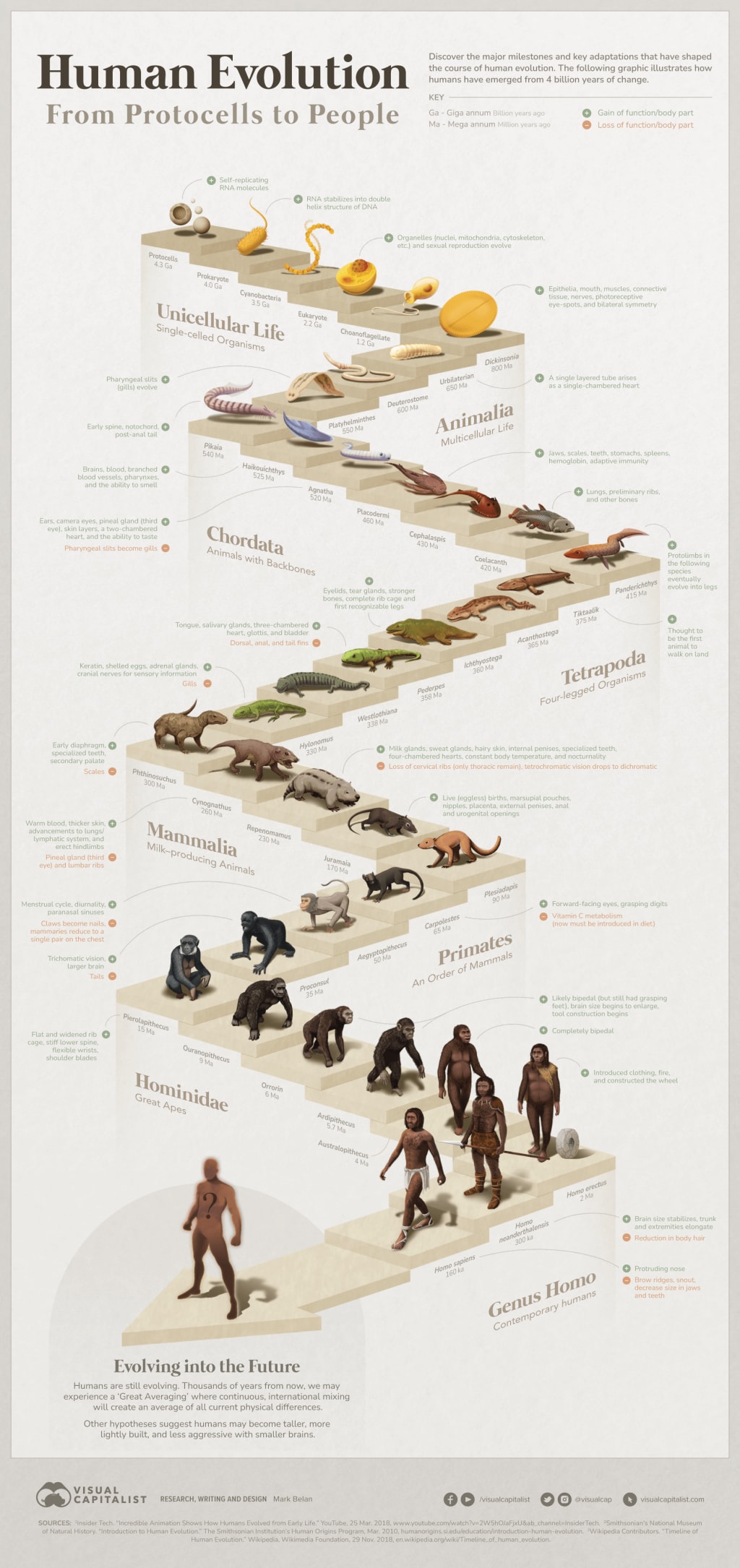
We are all related in science. This is you, and these are your ancestors, forming a vast pyramid that stretches far into the past and delicately balances on your head. But have you ever wondered how many ancestors you truly have? Let's unravel this complex web of human lineage.
A Journey Through Ancestry
It all begins with your parents, giving you two immediate ancestors. Add in your four grandparents and eight great-grandparents, and it's easy to see how your direct ancestors multiply with each generation. Go back four generations, and you'll find yourself connected to 30 individuals. But the real revelation comes when we trace this lineage back even further.
If we continue to double the number of ancestors with each generation, just 40 generations ago, we'd have a trillion ancestors, all living at the same time. An absurd number, surpassing the total number of people who have ever lived or even the stars in the Milky Way.
Considering that our species has been around for about 200,000 years, with approximately 7,000 to 8,000 generations preceding us, the question arises: where are all these missing ancestors?
The Complexity of Human Family Trees
In reality, human family trees are far more intricate than simple mathematical calculations suggest. Before the days of modern transportation and technology, choices for mates were often limited to those you could meet within walking distance. Even renowned figures like Charles Darwin and Albert Einstein married their first cousins. The result is that many people with shared ancestors have interbred over the centuries, making our actual number of ancestors significantly smaller than straightforward math implies.
Ancestry, DNA, and the Shared Connection
Though we can't point to a specific person as a common ancestor, genetic science sheds light on our shared ancestry. Every human carries a record of their ancestors in their DNA. Over time, mutations occur as DNA is copied repeatedly. Many of these mutations are harmless and pass on to the next generation. These genetic changes accumulate at a consistent rate, creating a sort of molecular clock that helps scientists estimate how much time has passed.
Despite our apparent differences, humans are remarkably similar on a DNA level. Even groups of chimpanzees living in close proximity in Central Africa show more genetic variation than the entire human population. This similarity implies that our species is relatively young, with a small population size, possibly as few as 10,000 individuals at one point in our history.
Tracing Our Roots Through DNA
With advances in DNA testing, we can uncover our ancestral origins. Genetic testing companies analyze thousands of single-letter changes in our genome, known as single nucleotide polymorphisms (SNPs). These SNPs help create a unique genetic signature for each individual. By comparing these signatures to reference populations from around the world, these companies can estimate the geographic origins of a person's DNA.
For instance, individuals of Northern European and Scandinavian descent may carry distinct genetic markers that explain their physical traits, such as fair skin and height. Moreover, they might even discover Neanderthal DNA in their genetic makeup, a legacy from interbreeding with this ancient human species.
Our Common Ancestor in the Not-So-Distant Past
By employing mathematical models that account for historical factors like migration, trade, geography, and even figures like Genghis Khan, scientists have estimated that every living human shares a common ancestor who lived around 3,000 years ago. So, the next time you find yourself in an internet dispute with a stranger, remember that you share a great, great, great, great, great (and so on) grandmother or grandfather.
Mitochondrial Eve: The Ultimate Ancestor
While this shared ancestor's genetic influence has become invisible over time, there is one remarkable genetic marker that remains unchanged. Your mitochondria, often referred to as the powerhouse of the cell, carry their own genetic material. Unlike the rest of your chromosomes, there's no shuffling of genes when mitochondria are passed from generation to generation. They trace an unbroken line of ancestry through every female in your family tree, right back to a single woman in Africa about 150,000 years ago.
This remarkable woman is known as Mitochondrial Eve. Her lineage is the only one that survived over time, while all other Homo sapiens lineages have become extinct. Consequently, every living human being can trace their ancestry back to this one woman.
In a very real sense, we are all family, distant cousins linked by this common ancestor who lived thousands of years ago. Our ancestry is not just a sprawling tree reaching into the past but also a profound connection that extends into the future.
Shaping Our Genetic Destiny
Today, we possess an unprecedented level of power to shape the future of our species, even down to the genetic level. As we continue to explore and understand our shared ancestry, we must consider how this knowledge influences our choices and responsibilities.
The story of our species is a remarkable tale of interconnectedness and shared heritage. We have the opportunity to explore where we came from, how we are all connected, and where we might be heading. Our curiosity and understanding can guide us as we navigate the intricate tapestry of human ancestry and genetics.
About the Creator
Enjoyed the story? Support the Creator.
Subscribe for free to receive all their stories in your feed.
Comments
There are no comments for this story
Be the first to respond and start the conversation.