
The Importance of Penetration Testing Services
Penetration Testing Services

In my years of experience as a cybersecurity specialist, one of the most critical areas I’ve focused on is ensuring that businesses’ systems are resilient against cyberattacks. While there are numerous strategies and tools available to protect data, Penetration Testing Services stand out as a fundamental method for assessing and strengthening your organization's security posture. Often misunderstood, penetration testing, or ethical hacking, involves simulating real world attacks to uncover vulnerabilities before malicious hackers can exploit them.
For companies, where data breaches and cyberattacks are increasingly common, Penetration Testing Services can mean the difference between staying safe and falling victim to a catastrophic security incident. A lot of business owners think that their systems are secure just because they have firewalls or antivirus software. But penetration testing grows deeper, attempting to find weaknesses that even these systems can’t protect against.
What is Penetration Testing?
Penetration testing is an authorized simulated attack on a computer system, network, or application to identify vulnerabilities that could be exploited by hackers. It’s a proactive approach to security and is typically done by ethical hacker professionals who specialize in identifying weak points in systems and reporting them before they can be exploited by malicious attackers.
During a penetration test, cybersecurity experts use the same tools and techniques that real world hackers might use to break into a network or system. The goal is to identify both known and unknown vulnerabilities in your infrastructure, such as outdated software, misconfigured networks, weak passwords, or security flaws in applications.
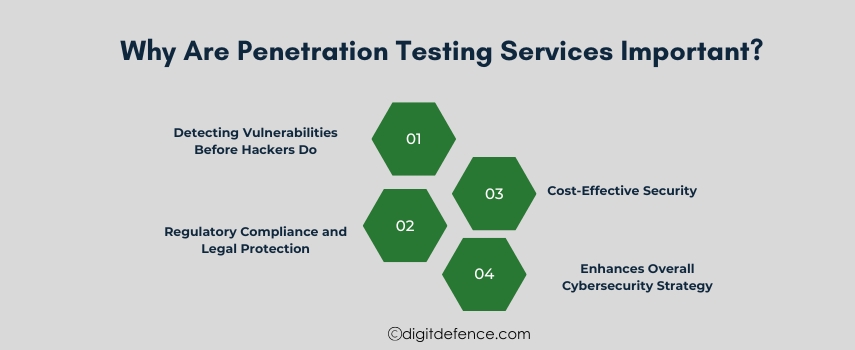
Why Are Penetration Testing Services Important?
The importance of Penetration Testing Services cannot be overstated. As businesses grow and more sensitive data is handled online, the risk of cyberattacks grows exponentially. Cybercriminals continuously develop more advanced methods to breach systems, making it crucial for businesses to regularly test their security measures to identify and address potential weaknesses.
1. Detecting Vulnerabilities Before Hackers Do
Penetration testing simulates the same tactics a real attacker would use, allowing companies to identify weak spots that might go unnoticed during routine security assessments. By addressing vulnerabilities before they can be exploited, businesses are better protected from cyber threats. Without penetration testing, it’s easy for weaknesses to remain hidden, leaving organizations open to potential attacks.
2. Regulatory Compliance and Legal Protection
In many industries, organizations are required by law to meet certain cybersecurity standards. These regulations often include requirements for conducting penetration testing. Compliance with these standards not only helps businesses avoid fines but also ensures that they maintain a good reputation for protecting customer data.
In sectors like healthcare, finance, and e-commerce, where data protection is paramount, penetration testing provides documented proof that an organization is taking the necessary steps to safeguard sensitive information. If a data breach occurs and penetration testing has not been conducted, the company may face legal consequences.
3. Cost-Effective Security
When it comes to cybersecurity, prevention is always more cost-effective than dealing with the following security breaches. A successful cyberattack can lead to data theft, loss of customer trust, regulatory fines, and even lawsuits. The costs associated with a data breach far outweigh the relatively small investment in Penetration Testing Services.
By identifying and addressing vulnerabilities early on, companies can save a significant amount of money that might otherwise be spent on disaster recovery, legal fees, and reputational damage control.
4. Enhances Overall Cybersecurity Strategy
Penetration testing doesn’t just focus on finding vulnerabilities, it also helps companies improve their overall cybersecurity strategy. By identifying potential weaknesses in their security systems, companies can develop a more comprehensive cybersecurity plan that includes stronger defenses and protocols. It also allows organizations to test their response plans for a cyberattack and ensure that their team is prepared to handle a security breach effectively.
Types of Penetration Testing
Penetration testing services are not one size fits all. They can be tailored to different types of networks and systems. Below are the primary types of penetration testing
1. Network Penetration Testing
Network security testing focuses on identifying vulnerabilities in a company’s internal and external networks. Testers will attempt to exploit security flaws in firewalls, routers, and switches to gain unauthorized access to systems.
2. Web Application Penetration Testing
Web application penetration testing targets vulnerabilities within web-based applications. This type of testing is critical for businesses with an online presence, as web applications are often a prime target for cybercriminals seeking to steal customer data or implant malware.
3. Wireless Network Penetration Testing
With the rise of mobile devices and Wi-Fi networks, testing the security of wireless networks has become crucial. Penetration testers attempt to exploit weaknesses in wireless protocols to gain unauthorized access to an organization’s network.
4. Social Engineering Penetration Testing
This form of testing evaluates an organization’s susceptibility to phishing attacks, impersonation, and other social engineering tactics that can trick employees into providing sensitive information or opening malicious emails.
Challenges of Penetration Testing Services
Complexity of Systems:
As organizations grow and scale, their networks and systems become more complex.
This increased complexity makes it more challenging to identify vulnerabilities across various infrastructure components.
Evolving Cybersecurity Threats:
Hackers are constantly developing new attack methods and tools.
Penetration testing services must stay updated with the latest cybersecurity trends and changing attack techniques to remain effective.
Investment and Costs:
Penetration testing services require a financial investment.
Small businesses may be hesitant to allocate funds for regular testing, but the long-term costs of not investing in testing can be far greater in the event of a security breach.
Case Studies
Case Study 1:
In 2021, T-Mobile, a major U.S. telecommunications company, suffered a massive data breach that exposed the personal data of over 40 million customers. The stolen data included names, addresses, phone numbers, and in some cases, social security numbers. The breach was discovered after the data was sold on the dark web, making it a serious breach for the company and its customers.
Challenges:
The breach was a result of a vulnerability in T-Mobile’s servers, which could have been detected earlier with proactive penetration testing. The attacker, using a simple API vulnerability, was able to access T-Mobile’s internal databases. Despite having security measures in place, the failure to test these APIs for potential weaknesses left the system exposed.
Solutions:
T-Mobile responded by engaging third-party penetration testing services to conduct a thorough security audit. They began testing all APIs, networks, and security protocols across the infrastructure, implementing additional layers of encryption, and tightening authentication protocols. The company also focused on improving its incident detection and response strategies.
Case Study 2:
In 2020, a significant security breach affected Expedia, one of the world’s leading online travel agencies. Hackers exploited a vulnerability in Expedia’s website to access users' payment card information, impacting thousands of customers. The breach allowed unauthorized access to sensitive payment data, and it took several weeks for the company to realize the full scale of the breach.
Challenges:
Expedia’s vulnerability was linked to an insecure third-party plugin that allowed attackers to intercept payment data during transactions. The absence of regular penetration testing meant that this flaw was undetected for an extended period. Despite having standard security protocols in place, the third party integration was not adequately tested, exposing customer payment details to malicious actors.
Solutions:
After the breach, Expedia engaged penetration testing services to perform security audits on their website and third-party integrations. They identified gaps in their data encryption methods and updated them to ensure that customer payment data was protected at all times. The company also implemented more rigorous testing procedures for third-party vendors and plugins.
Penetration Testing Services play an integral role in securing your business’s infrastructure against cyber threats. They offer a proactive approach to identifying vulnerabilities and preventing attacks, saving businesses from potentially devastating consequences. Regular penetration testing can ensure that your cybersecurity measures are up-to-date and effective, providing peace of mind for both you and your customers. Whether you run a small startup or a large enterprise, the value of penetration testing is undeniable. If you haven’t yet invested in Penetration Testing Services, now is the time to prioritize it and protect your digital assets from emerging cyber threats.
About the Creator
Enjoyed the story? Support the Creator.
Subscribe for free to receive all their stories in your feed.
Comments
There are no comments for this story
Be the first to respond and start the conversation.