
The Hidden Reason So Many Candidates Fail One-Way Video Interviews
Most people think interview failure comes down to one thing
Most people think interview failure comes down to one thing: not being qualified enough.
But that is often not what happens in one-way video interviews.
A candidate can be smart, prepared, and genuinely well-suited for the role, yet still perform badly in this format. Not because they lack the skills for the job, but because they never learned how to handle the format itself.
That is the hidden reason so many candidates struggle.
A one-way video interview is not a normal interview. It is a very specific kind of performance under pressure. You are speaking to a camera, often with a countdown on the screen, no live feedback, no chance to build rapport naturally, and sometimes only one attempt to answer. For many people, that changes everything.
The strange part is that employers often treat this as if it were a neutral screening step. Candidates are expected to adapt instantly. In reality, plenty of strong applicants underperform simply because the format feels unnatural.
That matters more than people think.
It is not just "an interview on video"
A lot of advice online makes one-way interviews sound simple. Dress well. Smile. Practice common questions. Speak clearly.
None of that is wrong. It is just incomplete.
A one-way video interview creates a very different psychological environment from a normal conversation. In a live interview, the other person helps regulate the interaction. You can read facial expressions. You can notice interest, confusion, or encouragement. You can adjust your tone and pace. You can recover if a sentence comes out awkwardly.
In a one-way format, all of that disappears.
You are often left speaking into silence, trying to sound natural in a setup that does not feel natural at all. That alone is enough to throw people off. Even confident candidates can suddenly sound flat, stiff, or less convincing than they would in a real conversation.
That is why many candidates do not need better qualifications. They need better format-specific preparation.
The format punishes unfamiliarity
One-way interviews reward candidates who understand the mechanics before the real attempt.
That does not mean gaming the system. It means not wasting your limited time figuring out the basics under pressure.
A candidate who already knows how to structure a 60-second answer, how to look at the camera without seeming robotic, how to manage the countdown, and how to avoid rambling has a real advantage over someone who is seeing this format for the first time.
This is especially important because the format can amplify normal nervousness.
A candidate may know exactly how to answer "Tell me about a time you solved a problem," but once the timer starts, they suddenly become too aware of their voice, their face, the silence in the room, and the fact that they are being recorded. They start speaking too quickly. Or too slowly. Or they forget the point they wanted to make halfway through.
The result is not a reflection of their true ability. It is often a reflection of how uncomfortable they are with the setup.
The most common mistakes are format mistakes
When candidates do badly in one-way interviews, the problem is often not the content of the answer. It is how the answer gets delivered in this format.
Here are a few common examples:
They answer without structure.
Because the setting feels artificial, candidates often start talking immediately and hope the answer organizes itself as they go. It usually does not. Their response becomes vague, repetitive, or too long.
They overcorrect and sound scripted.
Some people know the format feels awkward, so they try to compensate by memorizing polished answers. That creates a new problem: they sound stiff, generic, and disconnected from the question.
They underestimate timing.
A response that would feel perfectly fine in a live conversation can feel too slow or unfocused when there is a visible time limit. Candidates often run out of time before reaching the strongest part of their answer.
They treat setup as an afterthought.
Bad lighting, weak audio, poor camera angle, or visible distractions can damage the impression they make, even if the answer itself is decent.
They never practice the actual experience.
This is probably the biggest issue of all. Many candidates prepare ideas, but they do not rehearse saying those ideas on camera under realistic conditions.
That is like preparing for a driving test by reading about cars without ever driving one.
Good candidates fail because the format is unnatural
This point is worth repeating because it changes how people should think about preparation.
A one-way video interview does not just test what you know. It tests how well you can express what you know in a highly artificial environment.
That is why some candidates who do well in live interviews still struggle here. The problem is not intelligence. It is not motivation. It is not even communication in the broad sense.
It is format friction.
Once you see that clearly, the solution becomes clearer too.
What effective preparation actually looks like
The best preparation is not endless theory. It is targeted practice.
Candidates need to rehearse the real constraints of the format:
* hearing a prompt and organizing a response quickly
* speaking clearly under a time limit
* sounding natural on camera
* keeping answers focused without sounding memorized
* getting comfortable with the pressure of recording
This is also why generic interview prep often falls short. Traditional interview advice is built around live interaction. One-way interviews require a slightly different kind of preparation, because the stress points are different.
A candidate who practices in a format that resembles the real thing is much less likely to freeze, ramble, or sound less capable than they are.
That does not mean practice needs to take weeks. Even a few focused sessions can make a noticeable difference if the practice is realistic.
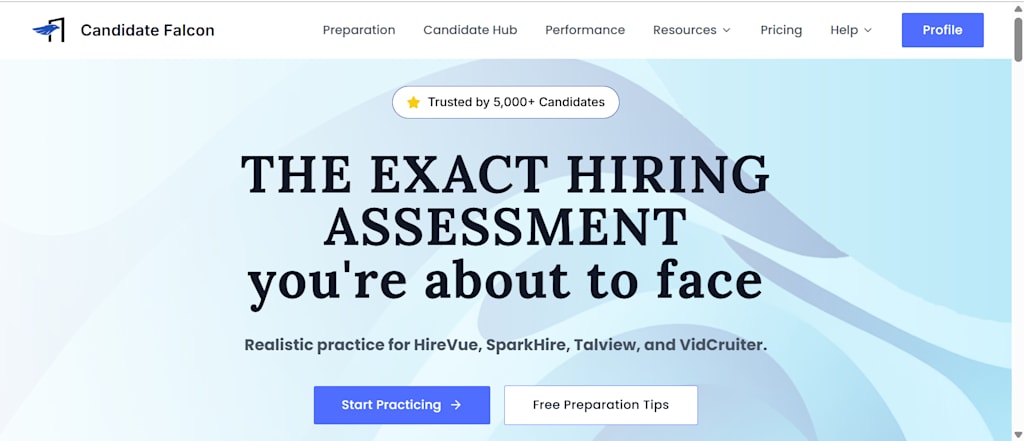
For candidates looking for more targeted one-way video interview prep, using a tool built around the actual format can be far more useful than relying on general interview advice alone.
The real issue is not talent, but exposure
The biggest mistake people make is assuming performance in a one-way interview always reflects candidate quality.
Sometimes it does.
But very often, it reflects something simpler: one candidate has seen this format before, and another has not.
That gap matters. A lot.
Modern hiring processes increasingly depend on assessment formats that feel unfamiliar the first time you encounter them. Candidates are often judged not just on their potential, but on how quickly they can adapt to an unusual system. That creates a quiet disadvantage for people who may be excellent fits for the role but have never practiced the format.
And that is exactly why preparation matters.
Not because candidates need to become fake or polished or robotic. But because they deserve a chance to present themselves properly in a setup that otherwise gets in the way.
One-way video interviews are not impossible. They are just strange. The sooner candidates understand that, the sooner they can stop blaming themselves for struggling and start preparing in a way that actually helps.
The hidden reason so many candidates fail is not that they are weak candidates.
It is that nobody told them the format itself needed practice too.
About the Creator
Enjoyed the story? Support the Creator.
Subscribe for free to receive all their stories in your feed.
Comments
There are no comments for this story
Be the first to respond and start the conversation.