
The Genius of Tony Buzan: Unlocking Your Brain's Potential Through Mind Mapping
Discover the fascinating history of Tony Buzan, the inventor of Mind Mapping. Learn how this visual thinking tool can transform your memory and productivity today.
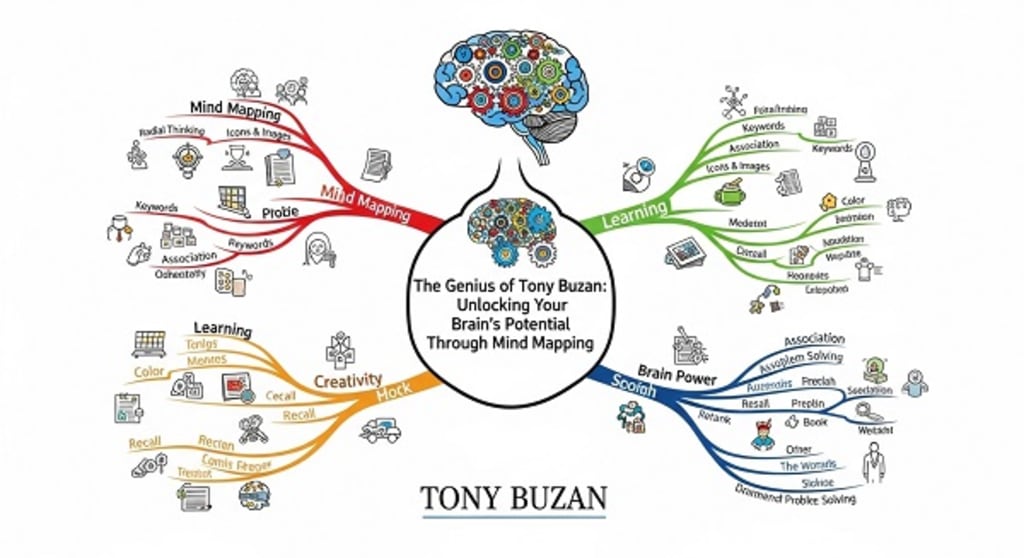
Imagine you are sitting in a lecture hall or a high-stakes business meeting. Before you is a blank page. As the speaker begins, you start doing what we were all taught in school: writing line after line of text, bullet point after bullet point. You fill pages with blue or black ink, yet an hour later, you struggle to recall the core message. You feel overwhelmed, and the information feels "flat."
This exact frustration is what led a young British student in the 1960s to revolutionize the way the world thinks. That student was Tony Buzan, and his invention—Mind Mapping—has since become the "logo of brainstorming" for millions of people worldwide.
In this comprehensive guide, we will dive deep into the life of the man who mapped the human mind, the science behind his method, and how you can use these principles to sharpen your intellect and organize your life.
The Man Who Challenged Tradition: Who Was Tony Buzan?
Born Anthony Peter "Tony" Buzan on June 2, 1942, in London, Buzan was much more than just an author; he was a visionary in the fields of psychology and education. He spent his life exploring the vast frontiers of human intelligence, eventually passing away in 2019 at the age of 76, leaving behind a legacy that transformed how we process information.
Buzan was a polymath. He studied psychology, mathematics, English, and the sciences at the University of British Columbia (UBC). But he didn't just stay in the ivory tower of academia. He was a man of action, writing or co-authoring over 80 books and founding the World Memory Championships to prove that the human brain's capacity is nearly limitless.
The Spark of Invention at UBC
The story of the Mind Mapping movement began with a struggling student. While at university in Canada, Buzan found himself drowning in information. Like everyone else, he was taking linear notes—long sentences and lists that looked like endless rows of soldiers.
He realized that his brain was rebelling against this format. He would read his notes, but the information wouldn't "stick." This led him to a profound realization: The human brain does not think in straight lines.
Why Our Brains Hate Linear Notes
To understand why Buzan’s invention was so radical, we have to look at the biology of thought. Traditional note-taking relies on a "linear" approach—starting at the top left and moving to the bottom right. However, neuroscience shows that the brain functions as a complex web of associations.
The Radiant Thinking Process
Buzan discovered that the brain moves in multiple directions at once, creating networks of links between ideas. When you think of the word "Apple," your brain doesn't see a dictionary definition. It sees the color red, tastes sweetness, recalls a childhood memory, or thinks of a tech giant. These thoughts "radiate" outward from a central point.
By forcing the brain to work in lines, we are essentially asking a high-performance sports car to drive through a narrow, winding alleyway. Buzan’s Mind Mapping was the highway the brain had been waiting for.
1974: The Global Launch of Mind Mapping
While Buzan began developing his ideas in the 1960s, the world didn't truly meet Mind Mapping until 1974. This was the year Buzan launched his iconic BBC program, Use Your Head.
The impact was immediate and massive. His book of the same name was translated into over 30 languages and reached more than 100 countries, selling over a million copies. What started as a student's survival tactic became a global phenomenon. Later, in 2006, Buzan embraced the digital age by launching the iMindMap software, ensuring his vision could live on in the world of pixels and screens.
Was Buzan Really the "First"? A Historical Reality Check
It is important to be historically honest: humans have used visual diagrams to organize thoughts for centuries.
The 3rd Century: The philosopher Porphyry of Tyros created the "Tree of Porphyry" to classify philosophical concepts.
The Renaissance: Legends like Leonardo da Vinci and Albert Einstein used non-linear styles of note-taking that included drawings and connections.
1972: Joseph Novak at Cornell University developed "Concept Maps" for educational research.
So, Why is Buzan the Inventor?
The difference lies in the methodology. Buzan didn't just doodle; he codified a scientific system based on brain research, memory, and cognition. He gave the method its name, its specific rules, and a systematic framework that anyone could follow to achieve predictable results. He took a scattered practice and turned it into a global standard for creative learning.
The Science of the Mind Map: Why It Actually Works
The success of Mind Mapping isn't just marketing—it's built on a deep understanding of the "Dual Coding" nature of the brain.
Left Brain vs. Right Brain: The brain is divided into two hemispheres. The left side handles logic, lists, and language. The right side handles rhythm, color, and images. Traditional notes only engage the left side. A Mind Map engages both, creating a "whole-brain" synergy that makes information much harder to forget.
The Speed of Images: Research suggests the brain processes images up to 60,000 times faster than text. By using images as the core of a Mind Map, you are speaking the brain's native language.
The Von Restorff Effect: Psychology shows that we remember things that stand out. Buzan utilized bright colors and bold images specifically to trigger this psychological response, making key data "pop" in our memory.
Mastering the Craft: The Essential Rules of Mind Mapping
Buzan was very specific about how to create an effective map. If you want to boost your brain productivity, follow these five golden rules:
1. Start in the Center
Place your main idea or topic in the middle of a blank page (turned landscape). This gives your brain the freedom to spread out in all directions.
2. Use Images and Symbols
A picture is worth a thousand words. Use an image for your central idea and pepper small sketches throughout your branches to anchor your memory.
3. Embrace Color
Don't stick to one pen. Use at least 3 to 5 different colors to distinguish different themes or branches. This stimulates the right side of the brain and keeps you engaged.
4. Make Your Branches Curved
This is a unique Buzan rule. He argued that straight lines are "boring" to the brain. Curved, organic branches resemble the neural pathways in our heads and are more visually stimulating.
5. Use One Word Per Branch
Instead of long sentences, use a single keyword for each branch. This provides more "hooks" for associations and keeps the map flexible and uncluttered.
Real-World Applications: From Students to Superstars
The beauty of Mind Mapping is its versatility. It isn't just for studying for exams—though it’s great for that.
Business: Used for project planning, meeting minutes, and strategic brainstorming.
Creativity: Helping writers plot novels or designers map out concepts.
Coaching: Olympic trainers and government officials have used Buzan's methods to optimize performance.
Famous Users: Even the "King of Pop," Michael Jackson, reportedly used Buzan’s services to help teach his children.
Practical Steps: How to Make Your First Mind Map Today
Ready to try it? Follow this simple application exercise to see the power of visual thinking in action:
Choose a Topic: Something simple, like "My Goals for Next Year" or "Planning a Vacation."
Draw the Center: Draw a colorful image in the middle of the page that represents your topic.
Create Main Branches: Draw thick, curved lines coming out of the center. Label them with one word (e.g., "Health," "Budget," "Location").
Add Sub-Branches: From those main lines, draw thinner branches for details (e.g., from "Health," add "Gym," "Diet," "Sleep").
Refine with Images: Add a small icon next to each word.
Frequently Asked Questions (FAQ)
Q1: What is the main difference between Mind Mapping and Concept Mapping? While they look similar, Mind Maps focus on one central idea that radiates outward in a tree-like structure, whereas Concept Maps (developed by Joseph Novak) often link multiple concepts in more complex, interconnected webs.
Q2: Can I use digital tools instead of paper for Mind Mapping? Yes! While Buzan was a fan of the tactile feel of paper, he co-developed iMindMap in 2006 to ensure the method translated perfectly to the digital world.
Q3: Why does Tony Buzan insist on only one word per branch? Using a single word gives the brain more freedom. A sentence is a finished thought, but a single word acts as a "trigger" that can lead to dozens of new associations, fueling creativity.
A Legacy of Limitless Thinking
Tony Buzan didn't just invent a note-taking style; he gave us a mirror of our own minds. He proved that the "linear" world we live in often restricts our natural brilliance. By moving from the straight line to the radiant branch, we can tap into a level of creative learning and memory that most people never realize they possess.
Whether you are a student trying to ace an exam, a professional managing a complex project, or just someone looking to organize their thoughts, the Mind Map is your most powerful tool. As Buzan's team noted upon his passing, he truly was one of the "greatest minds in the field of intelligence".
Now it's your turn: Have you ever used a Mind Map to solve a problem? Share your experience in the comments below or try creating your first one today!
About the Creator
mohammed
I love writing. I love researching for the benefit of others.
Enjoyed the story? Support the Creator.
Subscribe for free to receive all their stories in your feed.
Comments
There are no comments for this story
Be the first to respond and start the conversation.