
The Enigma of Black Holes
A Cosmic Odyssey for the Curious Mind
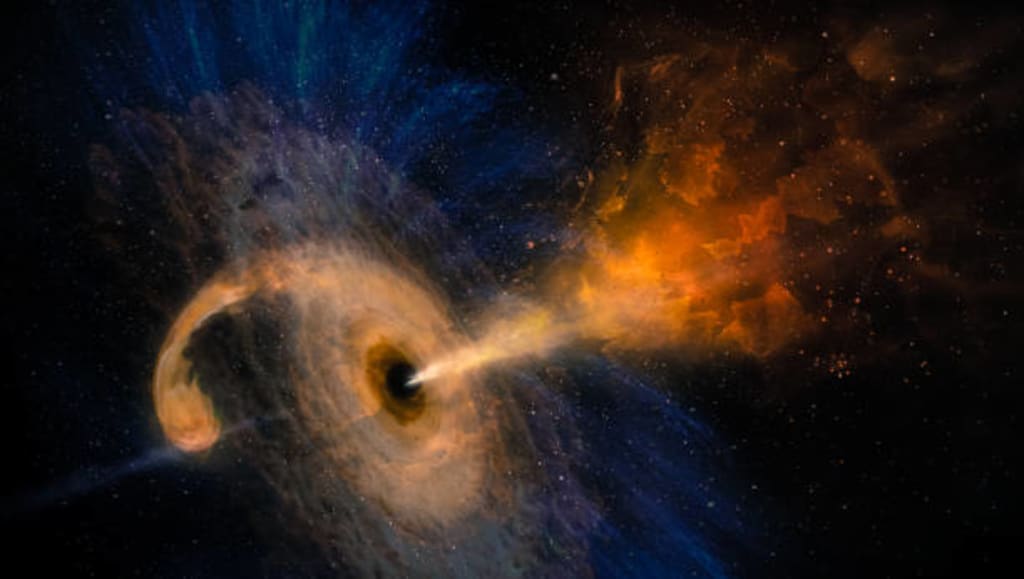
In the vast cosmic theater, where stars twinkle like distant diamonds, few entities evoke as much fascination and mystery as black holes. These enigmatic cosmic phenomena, where gravity becomes an irresistible force pulling everything into an unimaginably dense singularity, have captivated the minds of scientists and stargazers alike. Join me on a journey into the heart of this cosmic enigma—a guide for the curious who dare to explore the edge of the known universe.
The Dance of Gravity: Where Light Bends and Time Slows
Imagine a celestial body so massive and dense that not even light can escape its gravitational grasp. This is the essence of a black hole. It's a cosmic dance where gravity warps the fabric of space-time itself, creating a gravitational well so deep that nothing, not even photons racing at the speed of light, can break free. This gravitational dance creates an invisible cloak, hiding the heart of the black hole from prying telescopes and leaving us with a dark silhouette against the backdrop of the cosmos.
The effect of this gravitational dance extends beyond light bending; it warps time itself. As objects approach the event horizon—the point of no return around a black hole—time slows down, creating a surreal interplay between gravity and the very fabric of reality.
Real-life Example: The Great Einstein
The theoretical foundation for understanding black holes stems from the brilliant mind of Albert Einstein and his theory of general relativity. Einstein's equations predicted the existence of these cosmic anomalies, but it took decades for astronomers to gather the evidence needed to confirm their existence. In 2019, the Event Horizon Telescope collaboration unveiled the first-ever image of the event horizon of a black hole, located in the center of the galaxy M87. This groundbreaking achievement was a testament to the power of human curiosity and the pursuit of knowledge.
The Stellar Graveyards: Birth, Life, and Death of Stars
Black holes are cosmic undertakers, emerging from the remnants of massive stars that have exhausted their nuclear fuel. When a massive star reaches the end of its life, it undergoes a spectacular explosion known as a supernova. What remains can collapse under its gravity, forming a black hole. These stellar graveyards, scattered throughout the cosmos, silently bear witness to the cycles of birth, life, and death in the cosmic drama.
Real-life Example: LIGO's Gravitational Waves Discovery
In 2015, the Laser Interferometer Gravitational-Wave Observatory (LIGO) made history by detecting gravitational waves for the first time. This groundbreaking discovery provided direct evidence of the collision and merger of two black holes, sending ripples through the fabric of space-time. LIGO's success marked a new era of observational astronomy, allowing scientists to "hear" the cosmic symphony of colliding black holes and neutron stars.
Black Holes and the Cosmic Internet: Entanglement and Hawking Radiation
Black holes are not isolated celestial islands; they are entangled with the fabric of the universe in ways that continue to baffle scientists. Quantum entanglement, a phenomenon where particles become interconnected and instantaneously influence each other's states regardless of distance, has been proposed as a fundamental aspect of black holes.
Additionally, the renowned physicist Stephen Hawking proposed that black holes are not entirely black; they emit a faint radiation now known as Hawking radiation. This radiation, a consequence of quantum effects near the event horizon, implies that black holes slowly lose mass over time. It's a cosmic paradox that challenges our understanding of the fundamental nature of the universe.
Real-life Example: The Mysterious Information Paradox
The ongoing debate surrounding the fate of information swallowed by a black hole adds another layer of mystery. According to the laws of quantum mechanics, information should never be lost. However, when matter falls into a black hole, it seems to disappear from the observable universe. Resolving this information paradox remains one of the most intriguing challenges in theoretical physics, as scientists grapple with the fundamental principles that govern the cosmos.
Navigating the Cosmic Unknown: A Call for Curiosity
As we navigate the cosmic unknown, black holes beckon us to challenge our perceptions, question the very fabric of reality, and delve into the depths of our cosmic curiosity. They are cosmic enigmas, shrouded in darkness yet illuminating the frontiers of our understanding of the universe.
In the pursuit of knowledge, we stand on the shoulders of giants like Einstein, Hawking, and the countless scientists who dare to explore the cosmic enigma of black holes. With each discovery, we peel back the layers of the cosmic tapestry, revealing the intricate patterns that connect us to the vastness of the cosmos.
So, to the curious minds who gaze up at the night sky and wonder about the secrets held within the cosmic abyss, let the enigma of black holes be an invitation—a cosmic odyssey where questions outnumber answers, and the journey into the unknown is as profound as the mysteries that await. In the dance of gravity and the warp of time, let our curiosity be the guiding star that leads us deeper into the cosmic expanse, where the enigma of black holes is just one chapter in the eternal story of the cosmos.
About the Creator
Enjoyed the story? Support the Creator.
Subscribe for free to receive all their stories in your feed.
Comments