
The Debt System We Call Success
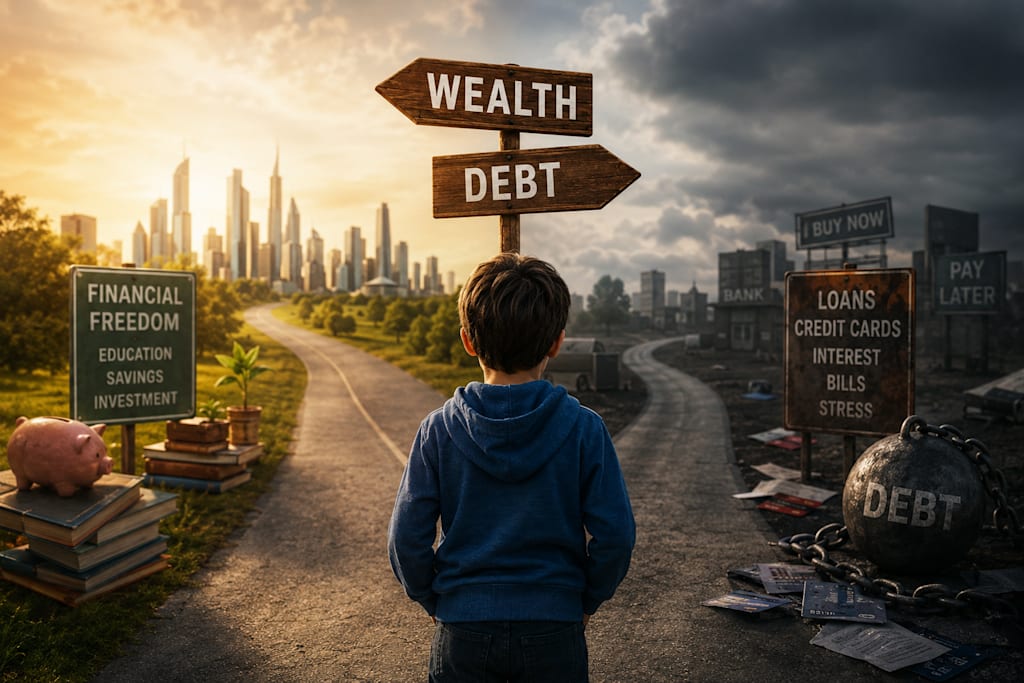
Are we preparing children for success — or training them to live in debt?
Today, I realized something surprising completely by accident.
While driving to my favorite berry farm, I was listening to a radio segment about a summer program designed for children aged 10 to 12 to learn how business and money work. The program was called “BizTown.” In this mini city, kids had to apply for jobs, attend interviews, and hopefully get hired. Some got the positions they wanted, while others had to settle for different roles.
Once employed, the children were taught the basics of banking, credit, and running a company. After completing the training, they had one major challenge: build a business from the ground up.
But there was one problem — they didn’t have any real money.
So where could they get startup funds?
From the bank, of course.
The children had to create business plans, estimate profits, and apply for loans just like adults in the real world. The entire experience used digital transactions and virtual money, making it feel like a more advanced version of Monopoly.
Inside BizTown were two competing financial institutions: a traditional bank and a credit union. Their goal wasn’t simply to hand out loans — it was to make sure those loans were repaid successfully. They carefully reviewed business plans and checked whether the numbers actually made sense.
One business application was rejected because of incorrect calculations. The bank manager even tracked down the young business owners and told them to fix the errors before applying again. Meanwhile, the competing credit union joked that they would have approved the loan immediately.
Watching this unfold revealed something important.
The children running bookstores, restaurants, insurance agencies, and gift shops were not only trying to make profits — they were also focused on paying back debt. That was the real lesson.
A journalist covering the story described it as “learning the fundamentals of a debt-driven capitalist economy,” and that sentence hit me hard.
I suddenly realized that modern society doesn’t really run on profit anymore. It runs on debt.
Maybe that explains why so many people are comfortable using credit cards, financing everything, and living with monthly payments. From an early age, people are taught that borrowing money is normal and necessary for economic growth.
Personally, I’ve always believed in a different approach.
I never borrow money unless I know I can comfortably repay it. I prefer putting down a significant payment first and paying loans off as quickly as possible to avoid extra interest. Over the last two decades, I’ve taken only a few loans — a mortgage and two car loans — and I worked hard to pay them off ahead of schedule whenever possible.
To me, that means living within your limits instead of depending on endless credit.
But the most interesting part of the story came later.
Some of the children’s businesses started failing. To survive, they cut costs, reduced spending, and sacrificed profits just to repay their loans. Even then, several businesses still couldn’t make enough money.
One insurance company borrowed $75 but only earned $45 in sales. Even after giving back most of their profits, they were still deep in debt.
Then something unexpected happened.
The camp organizers quietly added money into the failing businesses’ accounts so they could repay the banks and avoid feeling unsuccessful. The children were relieved and happy, never questioning where the extra money came from.
The reporters, however, did ask.
When questioned about the mysterious bailout, the camp director explained that they didn’t want the kids to experience failure or bankruptcy at such a young age.
One journalist responded with a sharp question:
“So struggling businesses receive financial rescue money instead of facing the consequences of failure? Isn’t that basically socialism?”
The director avoided directly answering and instead explained that difficult lessons about bankruptcy and financial collapse should wait until adulthood.
And honestly, I’m still unsure what to think.
Should children be protected from failure while learning business? Or should they understand early that debt, risk, and consequences are all part of real life?
About the Creator
Enjoyed the story? Support the Creator.
Subscribe for free to receive all their stories in your feed.
Comments
There are no comments for this story
Be the first to respond and start the conversation.