
The Day the Teacher Closed His Eyes: A Story About a Stolen Watch and Pure Humanity
Years after leaving school, a young man unexpectedly ran into his old teacher. It was one of those ordinary, fleeting moments in life that initially seem completely unremarkable.
A brief encounter on a busy street, a few polite words exchanged, perhaps a sudden smile triggered by a shared memory from the past. The old teacher looked closely at his former student's face, searching through decades of academic memories, but ultimately shook his head. "I am sorry," the old man said gently, "I don't quite remember you." The young man smiled warmly. "I was your student, many years ago." That in itself is always a beautiful encounter. Teachers rarely know where their students end up, what they become, or how life shapes them after they walk out of the school gates for the last time.
They decided to step away from the crowd and walked together into a small cafe on the corner to have a hot cup of coffee. Along the way, the old teacher asked him what he did for a living now, what filled his days, and whether he truly enjoyed his profession. The young man laughed softly and revealed, "I am a teacher myself now. And I didn't become a teacher by accident. I chose this path entirely because you were my greatest role model." The old man was deeply touched. Discovering that you served as a genuine inspiration for someone's life is perhaps the greatest reward any educator can receive. The old teacher naturally expected to hear a story about a brilliant lecture, a piece of profound academic wisdom, or a memorable lesson from the textbook.
However, the real reason was entirely different. And infinitely more powerful.
The young man began to recount a specific day from his childhood—a memory he had carried in his heart his entire life. When he was just a young boy in school, he had stolen an expensive new watch from one of his classmates. It was a moment of pure childhood weakness, a sudden flash of temptation, perhaps a foolish mistake that could have remained a single, isolated lapse in judgment—or the dangerous beginning of something much worse. The owner of the watch quickly noticed it was missing and immediately reported the theft to the teacher.
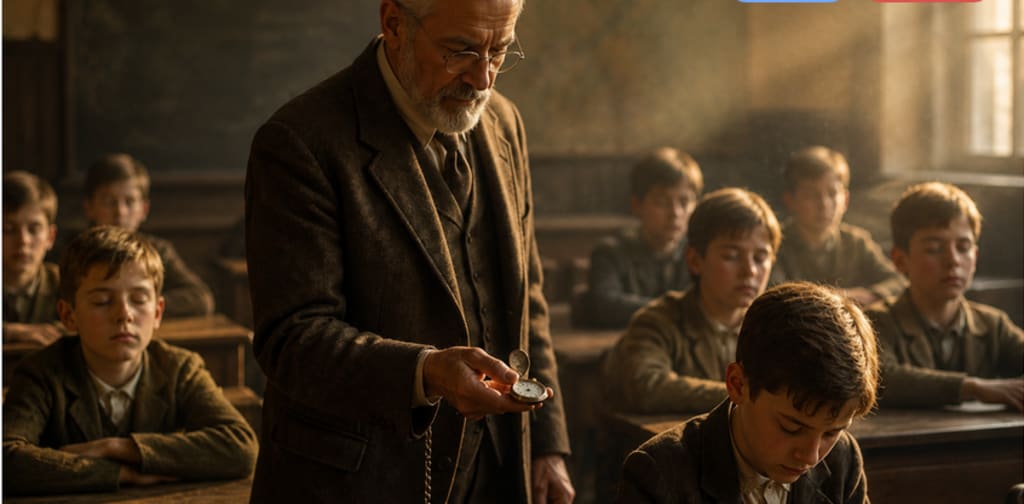
An intense, suffocating tension immediately filled the classroom. Every single child expected a massive scandal, a loud public humiliation, and the dramatic unmasking of the thief. But the teacher did something completely unexpected. He asked all the students to stand up, face the wall, and close their eyes tightly.
Then, the teacher went from desk to desk, systematically searching the pockets of every child in the room. When his fingers finally brushed against the stolen watch in the young boy's pocket, the teacher didn't gasp. He didn't shout out the boy's name. He didn't expose him or humiliate him in front of his peers. He simply slipped the watch into his own pocket and continued searching the rest of the students as if absolutely nothing had happened. Once he finished, he instructed everyone to open their eyes. He walked to the front of the class, handed the watch back to its rightful owner, and calmly said, "I found it." That was it. No further explanation. No drama. No names. No shame. No public trial.
The young man looked across the cafe table at his old mentor. "I felt an overwhelming sense of shame that day," he whispered. "But it wasn't the destructive shame of public humiliation. It was the heavy shame of my own awakened conscience. You didn't label me a thief. You gave me the space and the chance to remain a decent human being. You protected me from a permanent scar."
And sometimes, that is the exact difference between mechanical punishment and true education. In a modern world that often loves instant public condemnation, rapid online trials, and permanent labels, such an empathetic approach is a rare treasure. How many times today does someone make a mistake, only to face an immediate, unforgiving social death sentence?
A true teacher never instructs solely through the words they speak. They teach through what they choose not to do. They refuse to use their authority to crush a human spirit. They do not destroy a person's entire future over a single mistake. They don't expose one child's flaws just to make a moral point to the rest of the room.
As the story ended, the young man asked with deep emotion, "Do you remember that afternoon, sir?" The old teacher smiled mysteriously, took a slow sip of his coffee, and replied, "I remember the watch, yes. But I don't remember who took it. I remember returning it to its owner, but as for the boy who had it in his pocket... well, how could I possibly know? You see, while I was searching those pockets, I had my eyes tightly closed as well."
And within that single sentence lies the essence of true humanity. Not everyone who corrects a wrong needs to brand the sinner. Not every truth needs to be weaponized. And just because you have the absolute power to shame someone doesn't mean you should ever use it. Perhaps that is why we carry the memories of certain teachers with us for the rest of our lives. Not because they taught us formulas, but because in a crucial, defining moment, they showed us exactly who we ought to be.
Sources:
European Journal of Educational Psychology – Studies on the long-term impact of restorative justice practices versus public shaming in primary education.
National Archives of Educational History – Collection of modern moral parables and pedagogical case studies on teacher-student relationships.
About the Creator
Enjoyed the story? Support the Creator.
Subscribe for free to receive all their stories in your feed.
Comments
There are no comments for this story
Be the first to respond and start the conversation.