
The curious Mechanism That Makes The Chameleon Change Color
How do chameleons change color?

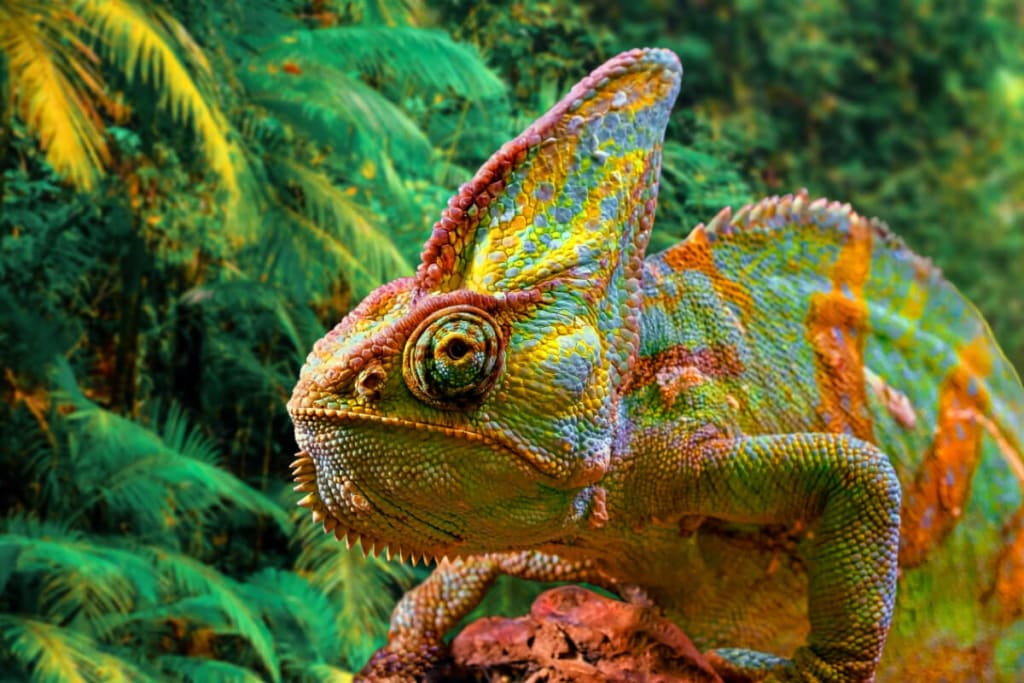
There is a common misconception that chameleons change their color to blend in with their environment. However, this is not the case. When a chameleon is calm, it typically remains green, which naturally allows it to blend in with its leafy surroundings. Male chameleons change color primarily when they become excited, such as in the presence of a female or a rival male, as demonstrated here. For comparison, I’ve placed the first frame in the bottom right corner. As you can see, as the chameleon becomes more excited, its color shifts to more vibrant shades of yellow, orange, and red. Rather than blending in, the chameleon now stands out.
But how do chameleons actually change their color? For years, it was believed that a simple, well-established mechanism was responsible for this transformation. Chameleons have specialized skin cells containing various pigments—some are yellow, others are red, and some contain melanin, a dark pigment. Many animals, including chameleons, can darken their skin by dispersing melanin along the finger-like extensions of these cells. Conversely, they lighten their skin by condensing the pigment back into a central spot. It was assumed that chameleons turned yellow, orange, and red in a similar manner, by dispersing these pigments within their cells.
However, new research from a collaboration between physicists and biologists at the University of Geneva has revealed that this assumption is incorrect. The first clue lies in the fact that chameleons do not actually possess a green pigment. Instead, their green color is created through a combination of pigment color and structural color. Beneath the yellow pigment cells, there are cells containing tiny, 130-nanometer crystals arranged in a regular lattice. When light interacts with these crystals, blue light is selectively reflected due to constructive interference, while other colors are not. This mechanism is similar to how the wings of a morpho butterfly produce an iridescent blue without any blue pigment—just a nanoscale structure that reflects specific wavelengths of light.
Thus, a chameleon’s green appearance results from the combination of yellow light from the pigment and blue light reflected off the underlying crystal structure. But how do chameleons transition from green to yellow, orange, and red? Previously, it was thought that this change was achieved by dispersing pigments in the colored cells. However, scientists have now discovered that it is actually the crystals beneath the pigment cells that are responsible. By increasing the spacing between the crystals, chameleons can alter the wavelength of light that is selectively reflected. Larger gaps between the crystals are better at reflecting longer wavelengths, causing the color to shift from blue to green, yellow, orange, and finally red.
To confirm this, scientists compared skin samples from calm, green chameleons and excited, yellow chameleons. They found that in the excited chameleons, the spacing between the crystals was significantly greater. This observation was further supported by computer simulations, which showed that changing the crystal spacing caused the reflected light to shift across the visible spectrum. Additionally, applying physical pressure to the skin caused the crystals to compress, reflecting more blue light. When the pressure was removed, the crystals expanded again, reflecting more green light.
The structure of a chameleon’s skin becomes even more fascinating when considering another layer of cells beneath the pigment and crystal layers. These deeper cells also contain crystals, but they are larger, more spaced out, and less organized. This arrangement allows them to reflect longer wavelengths in the infrared part of the spectrum. Scientists believe this layer may help chameleons manage sunlight, as they often live in bright, sun-drenched habitats.
In summary, male chameleons do not change their color by dispersing red and yellow pigments. Instead, they achieve their remarkable color shifts by actively tuning the spacing between nanoscale crystals, creating structural colors that span the entire visible spectrum. What’s truly astonishing is that, even in this modern age, we thought we understood how chameleons change color. It took the combined expertise of physicists and biologists to uncover the true mechanism behind this incredible phenomenon.
About the Creator
HÉLDER FIRMINO
Get ready to learning all about science. Whether it’s space, technology, biology, or physics, I’m here to inspire curiosity and spark your love for learning, making complex topics engaging and easy to understand. Join me on this journey!
Enjoyed the story? Support the Creator.
Subscribe for free to receive all their stories in your feed.
Comments
There are no comments for this story
Be the first to respond and start the conversation.