
THE CIPHER OF PRIMORDIAL ILLUMINATION: THE CHILD’S ASCENT BETWEEN THE OBSCURITY OF CONDITIONING AND THE LIBERATION OF THE ESSENCE
A philosophical treatise on peeling away the mechanized noise of modernity to unveil the uncorrupted, transcendent soul of the young.

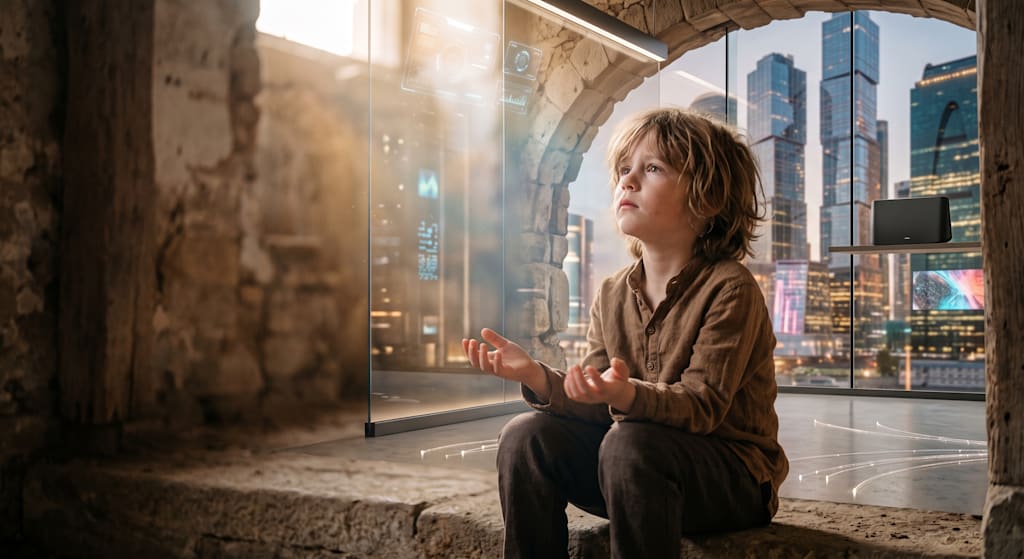
A child was never a blank slate awaiting the scars and graffiti of the world, nor an empty vessel begging to be filled with the anxieties of an exhausted society. Across millennia, the deepest metaphysical traditions understood that the newborn soul enters this plane as a pristine celestial spark, temporarily clothed in clay and sent to traverse the dense twilight of matter. Yet our modern impulse is not to revere this arrival, but to immediately domesticate it. We rush with heavy hands and prefabricated rules, eager to stamp our names upon what was created unblemished and free.
When Plotinus gathered his pupils in third-century Rome, formulating what would endure as the Enneads, he made a striking observation regarding the genesis of human knowledge. He maintained that nothing noble or divine within the soul is ever acquired through brute instruction or external grafting. Instead, Plotinus likened authentic education to the severe, sacred craft of the sculptor. The sculptor stands before an unhewn block of marble; he does not attach ornaments, nor does he superimpose unnatural shapes onto the stone. His sole labor is the meticulous, unyielding removal of excess. He cuts away the coarse layers of stone until the god dormant within the rock is unveiled to the light. The psychological liberation of a child is identical to this ancient art: it is not the aggressive insertion of social conditioning, but a relentless chiseling away of the artificial burdens and inherited fears that blind their nascent consciousness to its innate, unborrowed nobility.
As the tenth century arrived and the luminous minds of the Islamic Golden Age gathered in the intellectual sanctuarios of Baghdad, Isfahan, and Basra, the existential tension between societal coercion and the interior life took on an even sharper focus. Abu Hayyan al-Tawhidi, in his monumental reflections within Al-Imta’ wa al-Mu’anasa, contemplated the tragic condition he defined as the soul’s painful exile in realms dominated by specters and illusions. Al-Tawhidi discerned that heartbreaking, quiet moment when a young being is stripped of its spontaneous connection to existence and pulled into the suffocating matrix of social demands. The child stops listening to the secret harmonies of creation and begins weaving a succession of survival masks to appease parents, tutors, and communal guardians.
The eastern sages recognized this violent intrusion as a spiritual rupture. In his classical treatise on ethical governance and human development, Avicenna insisted that nurturing the juvenile mind must never resemble the subjugation of beasts. To force an unripe intellect into rigid compliance is to sever the roots of a sapling in a foolish attempt to make its branches sprout faster. Avicenna argued that true pedagogy is astronomical in its subtlety: it requires harmonizing the child's natural temperament with the internal movement of their own interior cosmos, allowing understanding to blossom without shattering the delicate architecture of their will.
History preserves faint, forgotten glimpses of ancient cultures that held this sacred silence in awe. The eleventh-century Byzantine scholar Michael Psellos recorded an extraordinary and radical practice once reserved for the cultivation of noble youths in Cappadocia and along the Pontic shores. Rather than subjecting these children to relentless memorization of epic poetry, rhetoric, and legal maxims, their mentors led them to the windswept promontories of the Black Sea. There, the young were left in total solitude before the roar of the dark water for seven consecutive days, forbidden from uttering a single word or listening to human voices. The purpose, as Psellos chronicled with eerie clarity, was not punitive; it was designed so that the shallow, borrowed speech of societal custom would completely rust away, allowing the primordial ear of the spirit to awaken to the eternal murmur of nature.
This forgotten Byzantine discipline converges with uncanny accuracy upon the empirical discoveries of modern psychology. When Swiss cognitive theorist Jean Piaget observed the inner landscape of children, he noted their persistent tendency toward animism—the instinctive belief that every stone, leaf, wind, and river possesses a living, responsive consciousness. The modern positivist scoffs at this as childish ignorance of physics, but the contemplative sees it for what it truly is: an uncorrupted intuitive recognition that existence is an unbroken, living whole, vibrating with an intelligence that modern adulthood has long forgotten how to perceive.
In our current era, however, we have exchanged the temple of wonder for the slaughterhouse of utilitarian efficiency. The industrial revolution reduced human education to a factory line, and the contemporary digital empire has perfected the trap. We gaze upon our children not as sovereign miracles, but as future economic units, cognitive commodities, and algorithms waiting to be calibrated for market productivity. We inundate their soft, receptive nervous systems with high-frequency stimulation, hyper-surveillance, and standardized metrics of worth, systematically expelling them from their inner sanctuary.
The profound exhaustion, anxiety, and dissociation plaguing contemporary children is not a mysterious pathology of their brains; it is the natural cry of a spirit being suffocated. In our relentless drive to produce compliant achievers, we have surgically excised wonder from their lives. Yet wonder, as Aristotle declared in ancient Athens, is the absolute origin of all philosophy; without wonder, thought degenerates into cold calculation. It is the sacred gateway to transcendence that the mystic poet Jalal al-Din Rumi praised when he wrote: "Close the heavy iron door of human chatter so that the luminous window of the spirit may swing open to the sky; for the child looks with the eye of the unseen and beholds mysteries that completely confound the proudest scholars of the earth."
Liberating the child’s psyche cannot be achieved through cosmetic pedagogical reforms or clinical quick fixes. It demands an ontological revolution in how we behold the young. It requires the humility to cease projecting our unhealed wounds, vanity, and social dread onto their virgin consciousness. The infant soul requires vast, uncluttered horizons of quiet contemplative freedom precisely as the physical lungs demand clean air. When a child is granted the sacred sanctuary to question without receiving dogmatic, prefabricated formulas—when they are loved as an absolute end in themselves rather than an instrument to glorify the tribe or serve the machine—their internal system sheds its inherited trauma, climbing freely up the luminous steps of pure understanding.
When rigorous rational inquiry joins hand in hand with the pristine light of contemplative awareness, the child is empowered to walk into the world not as a broken, frantic consumer, but as an authentic young philosopher. Such a child holds the living torch of discernment against the deep, howling night of our hyper-mechanized world. Psychological liberation is, in its ultimate definition, the complete restoration of this primordial birthright: to permit the child to lift their eyes toward the stars and recognize that the vast expanse above is nothing less than the home and mirror of their own boundless spirit, and to listen, in the holy quiet of the night, to the quiet voice of truth before the heavy languages of this earth silence it forever.
And when the twilight settles at the very end of the road, this fragile being stands entirely alone before the mirror of the world, asking through tear-glazed eyes what became of the wings they brought across the threshold of birth. How searing it is that we, armed with all our flawed love and inherited dread, became the very fetters that bruised their wrists, the suffocating noise that silenced the sky within their chest. We weep not for their weakness, but for the sacred essence we buried beneath the rubble of instruction and decree, until it forgot how to cast light. If only we had the courage to fall to our knees before their broken wonder, to beg forgiveness for a world too small and harsh for their purity, and to surrender them to a merciful, unblemished silence—where stillness dries the last tear clinging to the edge of their soul, and they become once more what they were destined to be: uncorrupted light, asking of this earth nothing more than to be left to fly.
About the Creator
Noor Kids Academy
Writer exploring childhood, education, fitrah, and the philosophy of learning. Practical insights for parents, teachers, and curious minds.
Enjoyed the story? Support the Creator.
Subscribe for free to receive all their stories in your feed.
Comments
There are no comments for this story
Be the first to respond and start the conversation.