
"The Big Crunch: Will the Universe End in a Cosmic Collapse?"
How universe will end
Introduction
The Big Bang theory has fascinated us for years, but have you ever wondered about the less-discussed counterpart, the Big Crunch? While the Big Bang marked the universe's birth, the Big Crunch theory postulates its eventual demise. In this article, we'll delve into the concept of the Big Crunch, its origins in Einstein's theory of general relativity, and the factors that could shape the universe's ultimate fate. We'll also explore the mysterious phenomenon of dark energy and its role in the expansion of the cosmos. Will the universe collapse into a massive black hole, or will it continue to expand indefinitely? Let's uncover the possibilities and mysteries of the universe's destiny.
The Big Crunch Theory
The Big Crunch Theory is rooted in Albert Einstein's theory of general relativity, which describes how gravity affects the fabric of space-time. This theory suggests that the universe, much like the ebb and flow of life's events, operates in a cyclical manner. If the Big Bang initiated the universe's expansion, the Big Crunch implies the reverse process, where the universe contracts and collapses in on itself.
The Key Factors: Density and Momentum
The universe's expansion is driven by two key factors: density and outward momentum. Density is directly related to the gravitational forces at play. In a dense universe, gravity dominates, pulling everything toward everything else. This dominance makes the Big Crunch inevitable, as gravity overcomes the initial outward momentum caused by the Big Bang. It seems straightforward, but the universe doesn't behave quite as we might expect.
The Mystery of Dark Energy
Observations have revealed that the universe's outer regions are expanding at a faster rate than those closer to us. Galaxies are drifting further apart, defying the idea of a universal collapse. This intriguing phenomenon has been attributed to a mysterious entity known as dark energy. Dark energy is the unknown force that counters gravity's effects, driving the universe's expansion.
Dark Energy's Influence
The existence of dark energy introduces two potential outcomes for the universe. If there is a sufficient amount of dark energy, the universe will continue expanding indefinitely, with galaxies drifting further apart, freezing everything in its path. However, if dark energy is insufficient to counteract gravity, the forces of attraction will eventually bring everything back together, leading to the Big Crunch.
The Uncertain Future
The prevalence of dark energy has led some scientists to speculate that the universe is heading towards the Big Crunch. However, a 2015 report suggested that the current increased rate of expansion might be the universe's last gasp, and contraction could commence within tens of billions of years. The future remains uncertain due to our incomplete understanding of the universe's inner workings.
The Big Crunch in Action
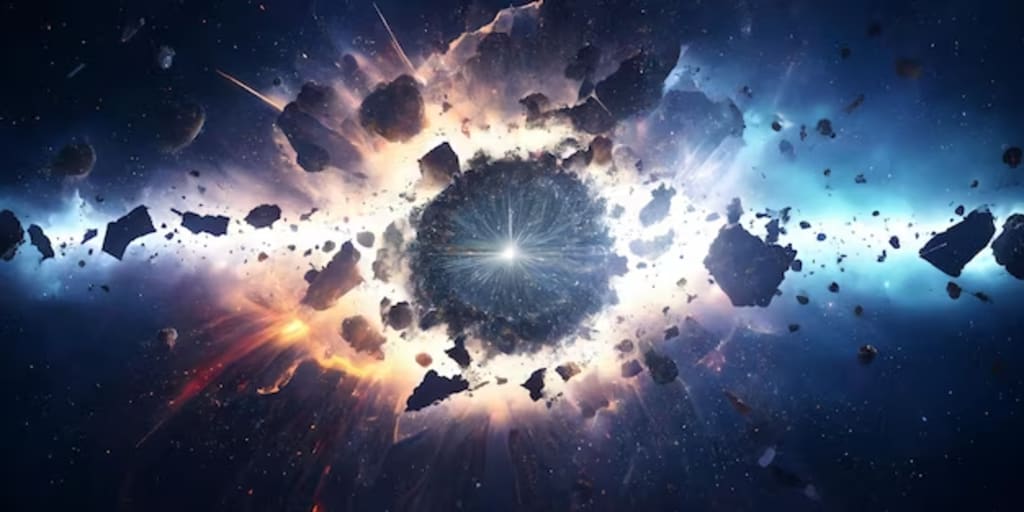
If we assume that there isn't enough dark energy and the Big Crunch occurs, it won't be as spectacular as the Big Bang. The universe will contract evenly, and the process will be gradual at first. As galaxies draw closer, gravity's influence will intensify. After approximately a hundred billion years, temperatures will rise significantly, leading to the explosive demise of stars and the vaporization of objects. All matter will break down into its constituent atoms, which will, in turn, disintegrate.
In the final stages, as all matter condenses into a small space, chaos will reign. Space-time will become so warped that it may shatter into droplets, rendering concepts of time, distance, and direction meaningless. This cataclysmic scenario makes it clear that no living organism could survive to witness it. The fate of the universe is shrouded in uncertainty.
A New Beginning?
While the Big Crunch offers one possible outcome, it is also conceivable that the universe has gone through this cycle multiple times before, with each iteration resulting in a new universe's birth. This cyclical expansion and contraction theory raise questions about the universe's eternal nature.
Conclusion
The fate of the universe remains one of the greatest mysteries that science has yet to unravel. The Big Crunch theory offers a glimpse into a potential end, where all matter returns to its origin, forming a colossal black hole. What transpires at that point is anyone's guess, as it could lead to the birth of a new universe or continue the cycle of expansion and contraction.
For now, the ultimate destiny of our universe is a puzzle with missing pieces, waiting to be discovered by future generations of scientists and explorers. While we may not be around to witness the universe's fate, the quest for understanding the cosmos and its mysteries continues, painting a picture of the grandeur and complexity of our existence in the vast expanse of the universe.
About the Creator
muhammad atif
Passionate explorer, book lover, and content creator. Embracing curiosity, words, and discovery in a world of endless wonder.
Enjoyed the story? Support the Creator.
Subscribe for free to receive all their stories in your feed.
Comments
There are no comments for this story
Be the first to respond and start the conversation.