

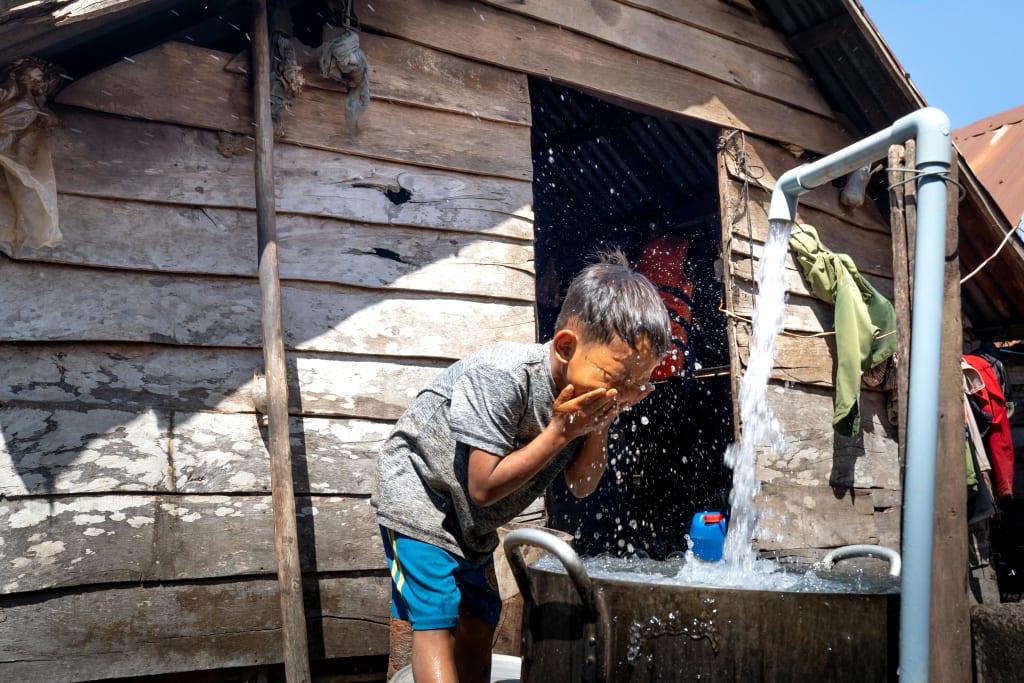
In the quiet village of Mohanpur, nestled between green paddy fields and whispering bamboo groves, lived a boy named Arjun. He was about twelve, barefoot most of the time, with a mop of unruly hair and eyes that sparkled with curiosity. His family was among the poorest in the village. His father tilled a small piece of land that barely gave enough rice to feed the family, while his mother worked as a domestic helper in the nearby town.
Arjun's day began before sunrise. He would help his father in the field before getting ready for school. School, for Arjun, was not just a place of learning but an escape. It was where he could dream beyond the cracked mud walls of his house, beyond the one pair of clothes he owned, and far beyond the boundaries of his village.
His uniform was stitched together from old clothes his mother got from the family she worked for. His books were secondhand, and his schoolbag was a jute sack tied with a piece of rope. Yet, Arjun carried them with pride. While other boys played during breaks, Arjun sat under the banyan tree, reading whatever he could find—be it a torn page from a newspaper or an old textbook left behind by someone.
He had a dream: to become a teacher. He once told his teacher, “Sir, if I become a teacher, I’ll make sure no child has to leave school just because they’re poor.” His teacher, a kind man named Mr. Sen, was moved by Arjun’s sincerity. He often gave him extra notebooks and helped him with lessons after school.
Life at home was not easy. Dinner was often just rice with a bit of salt or a few boiled vegetables. On rare days, when his father sold some extra vegetables at the market, they would have fish curry—a celebration in itself. Yet, there was always warmth in their home. Laughter still found its way, especially when Arjun imitated his schoolmaster’s stern voice or recited funny rhymes for his little sister.
During the weekends, Arjun helped his mother fetch water from the pond, gather firewood, and even took up small jobs like grazing cows or working in the market to earn a few coins. With whatever he earned, he secretly saved some in a tin box hidden under his bed. That was his college fund, though he didn't even know how much college might cost.
One monsoon season, heavy rains flooded the village. Many homes, including Arjun’s, were damaged. Books were soaked, walls crumbled, and hunger returned like an uninvited guest. But Arjun didn’t stop going to school. He dried his books under the sun, wrote on the blank backs of torn pages, and studied by the dim light of a kerosene lamp.
His resilience didn’t go unnoticed. The village elders, moved by his dedication, arranged for a scholarship for Arjun with the help of a social worker who visited the village. That year, for the first time, Arjun received new books, a fresh set of clothes, and a sturdy schoolbag. He hugged them as if they were treasures—and to him, they were.
Years later, Arjun did become a teacher. He returned to Mohanpur, not just as an educated man, but as a symbol of hope. He started evening classes for kids who worked during the day, distributed books from his salary, and ensured no child had to walk away from education because of poverty.
The barefoot dreamer had walked far, not just in miles, but in purpose.For the next few weeks, Arjun collected scrap: broken bicycle parts, bits of wire, and even old fan blades. With help from his teacher and hours of tinkering, he built a tiny windmill that turned when the wind blew and lit up a small bulb.
About the Creator
RAJIB DEBNATH RAJ
Hey, I’m Rajib Debnath Raj. I write what I feel, what I see, and what I imagine. Stick around—you might just find something that speaks to you.
Enjoyed the story? Support the Creator.
Subscribe for free to receive all their stories in your feed.
Comments
There are no comments for this story
Be the first to respond and start the conversation.